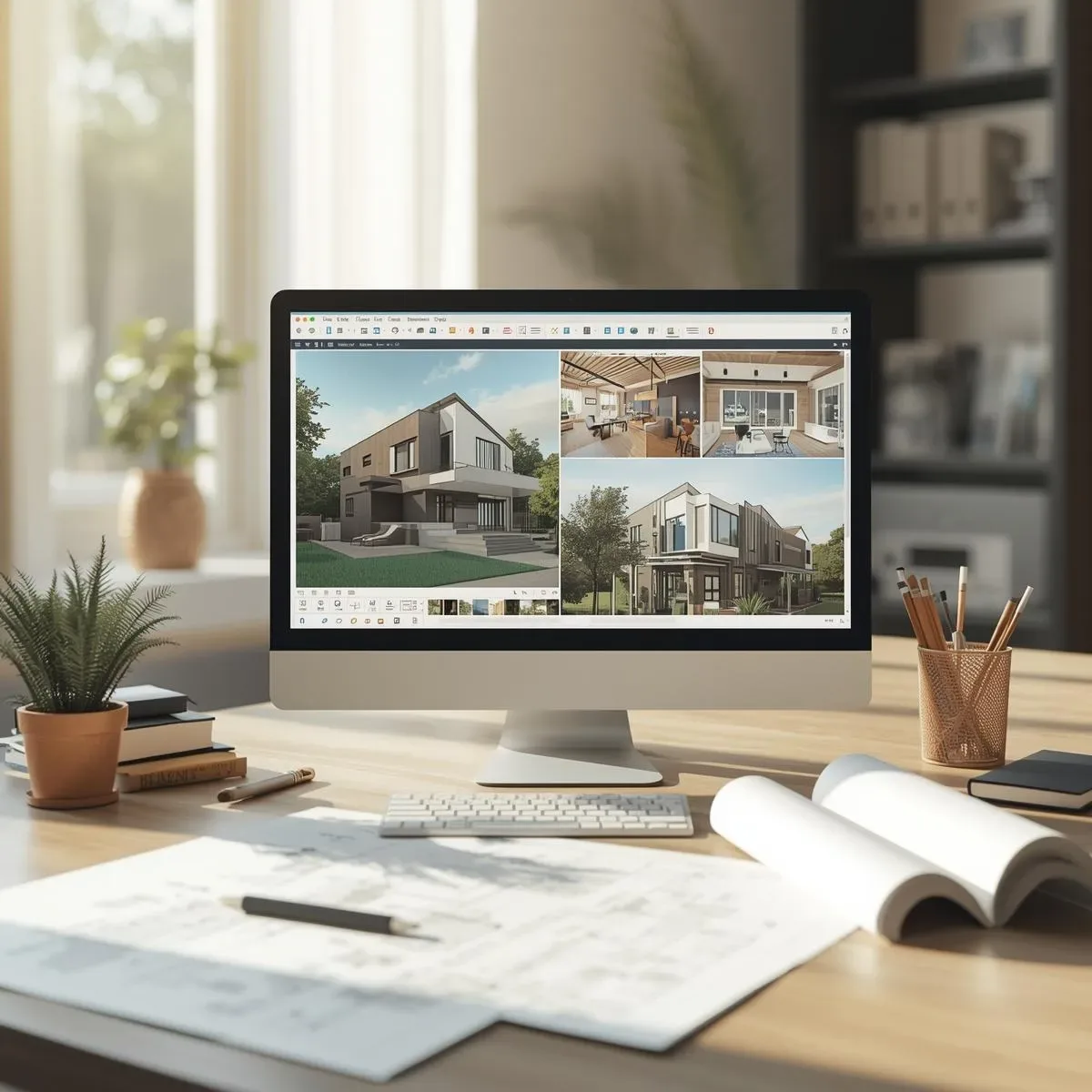
Why Interactive Home Design Matters
Traditional 2D blueprint-based home design creates a gap between imagination and reality. Homeowners struggle to visualize the full picture, communication between designer and owner breaks down, and post-construction changes cost significantly more than design-stage revisions.
’Interactive 3D Models’ solve all of this by creating three-dimensional simulations that users can interact with and modify in real time. Both homeowner and designer see the same picture — enabling confident decisions before a single wall is built.
Core Capabilities of Interactive 3D Models
’360-Degree View Rotation’ with zoom in and out lets you examine every angle of the home — interior and exterior. Homeowners can ’walk into’ the home virtually before the foundation is laid.
’Instant Material and Color Swapping’ lets you test different floor tiles, wall colors, or furniture surface materials and see the result immediately — reducing the risk of costly wrong material choices.
’Drag-and-Drop Furniture Placement’ tests whether a 3-seater sofa fits the living room or whether a wardrobe will block the window, before purchasing or commissioning a single piece.
’Virtual Walkthrough’ simulates movement through the home to test spatial flow, corridor widths, sightlines from various positions, and room connectivity.
Simulating Real-World Function Before Construction
One of the highest-value capabilities of Interactive 3D is ’Functional Simulation’ — testing actual usage scenarios. This includes checking Clearance Space to see whether a kitchen cabinet door clashes with the work desk, verifying Ergonomics to confirm counter heights suit the user, and running Shadow Studies based on real solar angles to identify which rooms will be hot during Bangkok afternoons.
These simulations eliminate common construction errors — bathroom doors that swing into the toilet bowl, or kitchens where natural light never reaches the counter.
Integrating VR/AR with Interactive Design
The pinnacle of Interactive 3D is presenting the model through ’VR’ (Virtual Reality), where homeowners wearing a headset physically stand inside a home that has not yet been built — feeling real ceiling heights, doorway widths, and room dimensions.
’AR’ (Augmented Reality) via smartphone tests how a specific piece of furniture will look in the actual room before any purchase decision is made.
HappySmart offers AI Architect BIM 3D services supporting Interactive Design with Unlimited Revisions, starting at 15,000 Baht. Free consultation via LINE OA.