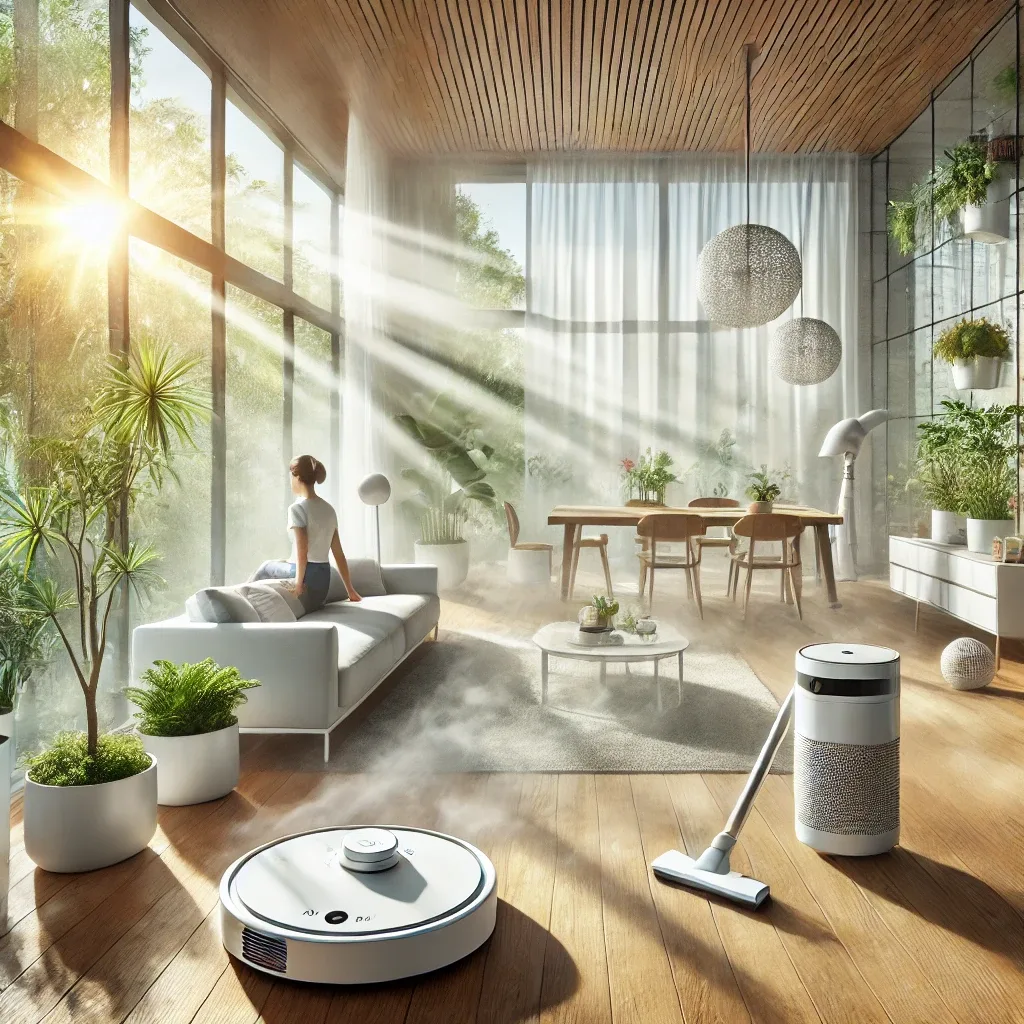
Why Your Home Is Not Yet Dust-Free
Many households install an air purifier and still wonder why PM2.5 levels remain elevated. The main reasons are using a single unit to cover multiple rooms, under-sizing the purifier for the actual floor area, having no real-time sensor to verify effectiveness, and lacking automated window or door control when outdoor pollution spikes. Transforming a home into a genuine clean-air oasis requires a layered system, not just a single device.
Layer 1: Sensors and Alerting
The foundation of everything is knowing the real-time air quality in each room. Install PM2.5, CO2, and toxic gas sensors in the bedroom, living area, and kitchen. Configure real-time LINE Notify alerts when readings exceed thresholds. Display data on a dashboard via tablet or TV so every household member can stay aware of air conditions at a glance.
Layer 2: Smart Air Purifiers
Size purifiers correctly using the formula: CADR (m³/h) ≥ room area (m²) × 2.5. Filters must include both HEPA H13 and activated carbon. Choose models with Wi-Fi or Zigbee connectivity for Home Assistant integration. Automation rules should adjust mode based on live PM2.5, switch to Sleep mode (below 35 dB) at bedtime, and power off when rooms are unoccupied. Recommended brands include Philips Series 3000i/4000i, Dyson TP09, and Blueair Blue 3210.
Layer 3: Smart Ventilation
Fresh outdoor air is valuable — but only when outdoor PM2.5 is lower than indoor levels. Configure automation to open smart ventilation fans or smart windows when outdoor PM2.5 drops below 25 μg/m³, and close them immediately when it exceeds 35 μg/m³. An Energy Recovery Ventilator (ERV) is an excellent option for homes requiring continuous fresh air without thermal energy loss.
Layer 4: Humidity Control
Maintaining 40–60% relative humidity reduces airborne particle propagation and prevents mold growth. Deploy a smart dehumidifier that activates automatically when humidity exceeds 60%, and a humidifier when it drops below 35% during cold seasons or extended air conditioning use. Home Assistant manages this automation alongside LINE Notify alerts, completing the full environmental control loop.
Step-by-Step Installation Guide
The five steps to a dust-free oasis are: (1) Survey your home and select devices matched to each room's floor area. (2) Identify high-risk zones — kitchen and main entrance — for priority sensor placement. (3) Install sensors and define alert thresholds for each room. (4) Connect all devices to Home Assistant and configure automation rules. (5) Follow a filter maintenance schedule — typically every 3–6 months — to sustain peak filtration efficiency over time.