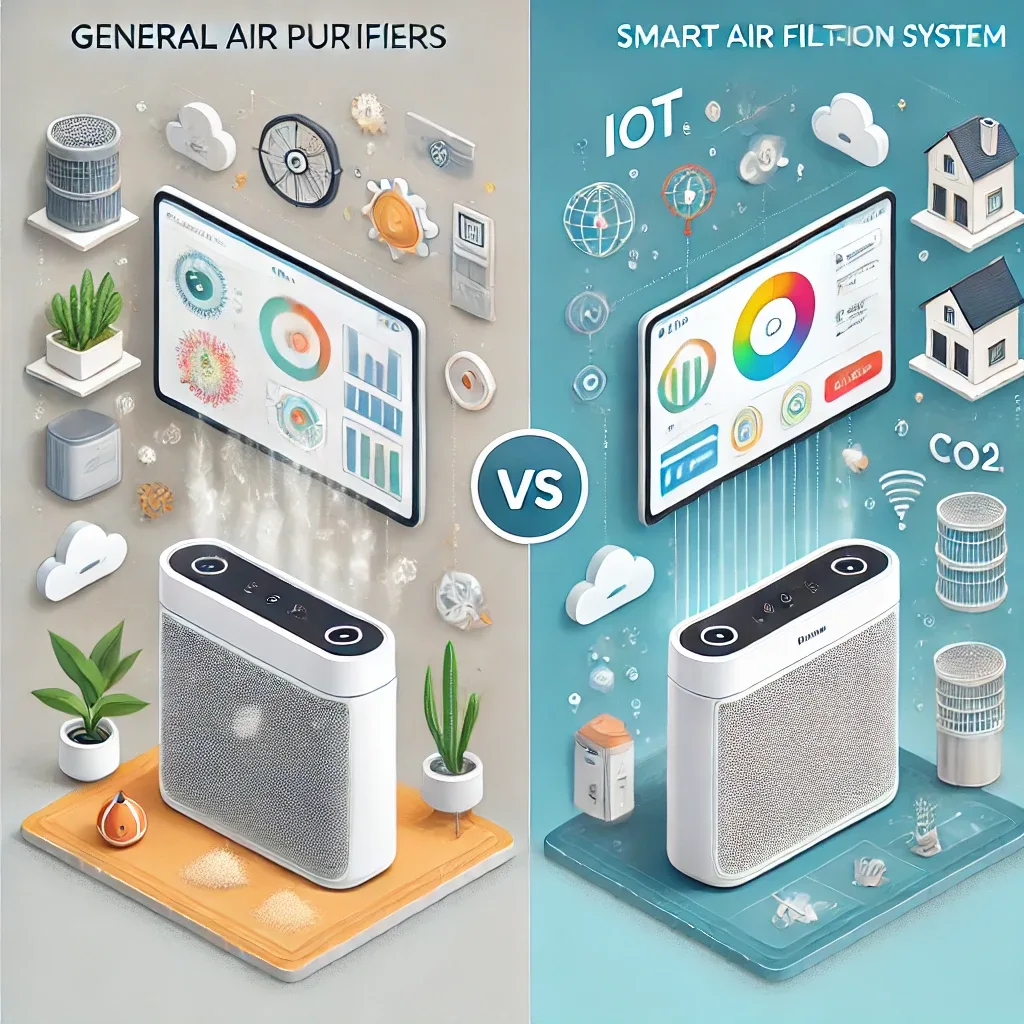
Why Your Air Purifier Choice Matters
When Bangkok's PM2.5 peaks during dry season and northern Thailand's burning season pushes AQI above 150, the choice between a conventional air purifier and a smart filtration system has real health consequences. This article compares four key dimensions to help you make an informed decision rather than defaulting to the cheapest option available.
Dimension 1: Filtration Performance
Conventional purifiers rely on HEPA and activated carbon filters at a fixed fan speed. Their performance depends entirely on filter quality and how consistently the user replaces filters on schedule. Without real-time sensors, the device cannot respond to pollution spikes — it runs at the same speed whether outdoor PM2.5 is 15 or 150 μg/m³. Smart filtration systems use laser diode sensors measuring PM2.5 every minute and adjust fan speed accordingly. Multi-layer filtration can include HEPA H13, activated carbon, UV-C, and negative ion technology to address particles, gases, and pathogens simultaneously. The result is consistent indoor PM2.5 below 15 μg/m³ even during external pollution events.
Dimension 2: Ease of Use and Control
A conventional purifier is operated via physical buttons or a remote control. The user must manually observe that air quality is declining and adjust settings accordingly. Smart systems offer app-based remote control, pre-scheduled activation before you arrive home, and voice command integration with Google Assistant, Alexa, and Apple HomeKit. For advanced users, Home Assistant integration enables multi-device automations: when PM2.5 exceeds 50 μg/m³, the purifier activates at High speed, smart windows close, and LINE Notify alerts every household member simultaneously.
Dimension 3: Long-Term Cost and Value
Purchase price: conventional units start at 1,500–5,000 THB; smart systems range from 8,000 to 25,000 THB. Long-term costs are closer than they appear. Conventional purifiers often use calendar-based filter replacement schedules, replacing filters that still have useful life remaining. Smart purifiers alert based on actual runtime hours and operate at lower speeds when air quality is good, achieving 20–35% energy savings. A well-built smart purifier lasts 7–10 years versus 3–5 years for budget conventional units, making the annual cost of ownership similar.
Dimension 4: Smart Home Integration
This is where the gap is widest. Conventional purifiers are standalone devices — no connection to sensors, ventilation systems, or air conditioners. Smart filtration systems support Zigbee, Wi-Fi, Z-Wave, and Matter protocols, integrating cleanly with Home Assistant for sophisticated multi-device automation. If you plan to build a Smart Home over time, choosing a smart filtration system from the start avoids the cost of replacing equipment later.
Buying Guide Summary
Conventional purifiers suit: limited budgets, small single rooms, minimal automation needs, no Smart Home plans. Smart systems suit: multi-room air quality goals, households with allergy sufferers, children, or elderly members, and anyone planning Smart Home expansion. Regardless of type, apply the CADR formula — CADR (m³/h) ≥ room area (m²) × 2.5 — as a minimum sizing threshold, and always require both HEPA H13 and activated carbon filter stages.