Why Indoor Air Quality Deserves More Attention
Most people spend over 80% of their time indoors, yet rarely monitor air quality inside their own homes. EPA research indicates that indoor air can contain 2–5 times more pollutants than outdoor air, driven by PM2.5 infiltration, CO2 from respiration, VOCs from furniture and paint, and humidity that promotes mold growth. The following five Smart Home methods address each of these sources comprehensively.
Method 1: Smart Air Purifier
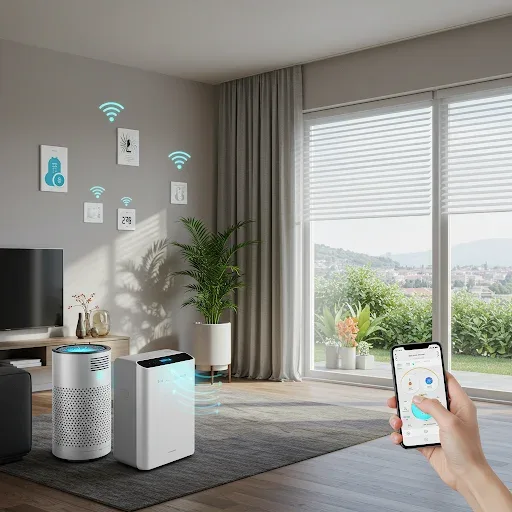
The most critical foundation is an air purifier with HEPA H13 and activated carbon filtration, sized using the formula CADR (m³/h) ≥ room area (m²) × 2.5. Essential features include a built-in PM2.5 sensor for auto-speed adjustment, Sleep mode below 35 dB, filter replacement alerts based on actual runtime hours, and Wi-Fi or Zigbee connectivity for Home Assistant integration. Recommended brands include Philips Series 3000i/4000i, Dyson TP09, Blueair Blue 3210, and Xiaomi Mi Air Purifier 4 Pro.
Method 2: Automated Ventilation System
Fresh outdoor air is valuable — but only at the right moment. CO2 and humidity sensors work with Home Assistant to open smart ventilation fans or windows when outdoor PM2.5 drops below 25 μg/m³, and close them immediately when it exceeds 35 μg/m³. An Energy Recovery Ventilator (ERV) suits homes requiring continuous fresh air without thermal loss. Demand-Controlled Ventilation automatically increases airflow when occupancy rises, keeping CO2 below 800 ppm.
Method 3: Air Quality Sensors
There is no genuine improvement without measurement. Quality sensors must cover PM2.5, PM10, CO2, VOC, CO, temperature, and humidity. Install at breathing height — 1.0 to 1.5 meters — in frequently occupied rooms. Recommended options include the Airthings Wave Plus, Aqara TVOC Air Quality Monitor (Zigbee, approx. 1,800 THB), and Awair Element. Configure four-tier LINE Notify alerts — green, yellow, orange, red — with specific corrective actions at each level.
Method 4: Smart Humidity Control
Maintaining 40–60% relative humidity reduces particle propagation and prevents mold. A smart dehumidifier activates automatically when humidity exceeds 60%; a humidifier activates when it drops below 35% during cold seasons or extended air conditioning use. Humidity that is too low dries nasal membranes and reduces the body's natural airborne filtration, making bi-directional control equally important. Home Assistant manages these automations in parallel with air quality alerts.
Method 5: Smart Air Conditioner with Filtration
Modern smart ACs in some product lines include built-in HEPA or carbon filters alongside app-based temperature and humidity control. Connect to Home Assistant via Smart IR Controller or native integration, then configure automations — for example, adjusting temperature automatically when CO2 spikes after a room fills with people. Running all five methods together through Home Assistant creates a unified indoor environment: clean air, comfortable temperature, balanced humidity, and optimized energy use.