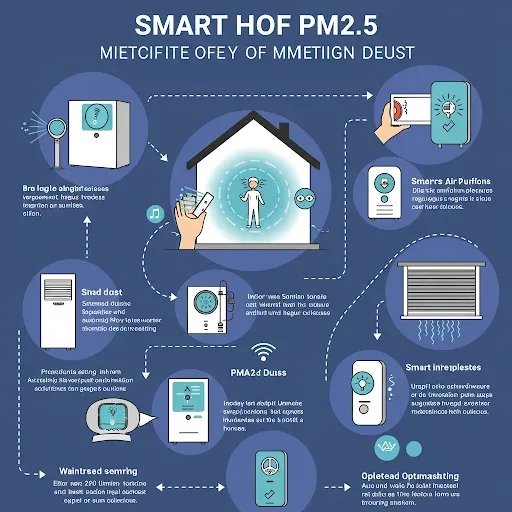
Method 1: Smart Air Purifiers with Real-Time Sensors
Smart air purifiers are the cornerstone of PM2.5 elimination in any Smart Home system. Built-in sensors continuously measure PM2.5 levels, automatically adjusting fan speed in response to real dust concentrations, alerting you when filters require replacement, and accepting voice commands through Google Home, Amazon Alexa, or Apple Siri — with full App control from anywhere.
Genuine HEPA filtration — not ionizer-only or UV-only systems — is the most critical requirement, because HEPA physically captures particles rather than merely causing them to settle or targeting pathogens alone. Match the unit's CADR rating to the room's square footage for optimal results.
Method 2: Real-Time PM2.5 Sensors Throughout the Home
Measuring PM2.5 separately in each room enables the automation system to make far more precise decisions. Popular sensors with strong Smart Home compatibility include Xiaomi Air Quality Monitor (budget-friendly, connects via Miio protocol), PurpleAir (high accuracy for air quality-conscious households), IKEA VINDRIKTNING (very low cost, DIY Home Assistant integration), and Aqara Air Quality Monitor (native HomeKit and Home Assistant support).
Position sensors at 1.0-1.5 meters above the floor to capture readings at breathing level rather than ceiling height, where conditions differ significantly.
Method 3: Smart Air Conditioners with HEPA or Plasma Filtration
Some newer air conditioner models include air filtration systems — HEPA filters in the intake section or Plasma Ion Generators that reduce PM2.5 in air passing through the unit. Smart Home connectivity allows automatic scheduling or sensor-triggered operation for seamless integration.
AC units also regulate humidity, which directly affects dust mite proliferation and mold growth. The optimal relative humidity range for dust suppression is 40-60%: below this threshold dust particles become more easily airborne; above it, mold risk increases significantly.
Method 4: HEPA Robot Vacuums on Daily Schedules
Smart Home robot vacuums manage floor and rug dust automatically without any manual oversight. Built-in HEPA filtration prevents recirculation of captured particles. Lidar Mapping creates accurate floor plans for comprehensive coverage. Daily scheduling runs cleaning during unoccupied hours without disruption.
Home Assistant integration enables advanced automation: when PM2.5 exceeds 50 μg/m³, immediately deploy the robot vacuum; when all household members are detected as away, automatically trigger a full cleaning cycle.
Method 5: Automated Ventilation and Smart Windows
Automated ventilation systems draw fresh outdoor air through HEPA filters into the home, while Positive Pressure keeps air moving outward through gaps and penetrations — preventing outdoor dust from infiltrating by maintaining higher indoor pressure.
Smart windows connect to outdoor PM2.5 sensors. When outdoor readings exceed 35 μg/m³, the system automatically closes windows and activates indoor ventilation instead. When outdoor air quality returns to safe levels, windows open automatically to admit natural fresh air without any user intervention.
HappySmart integrates all five methods into a single unified system, custom-designed for your home with professional installation and complete after-sales support.