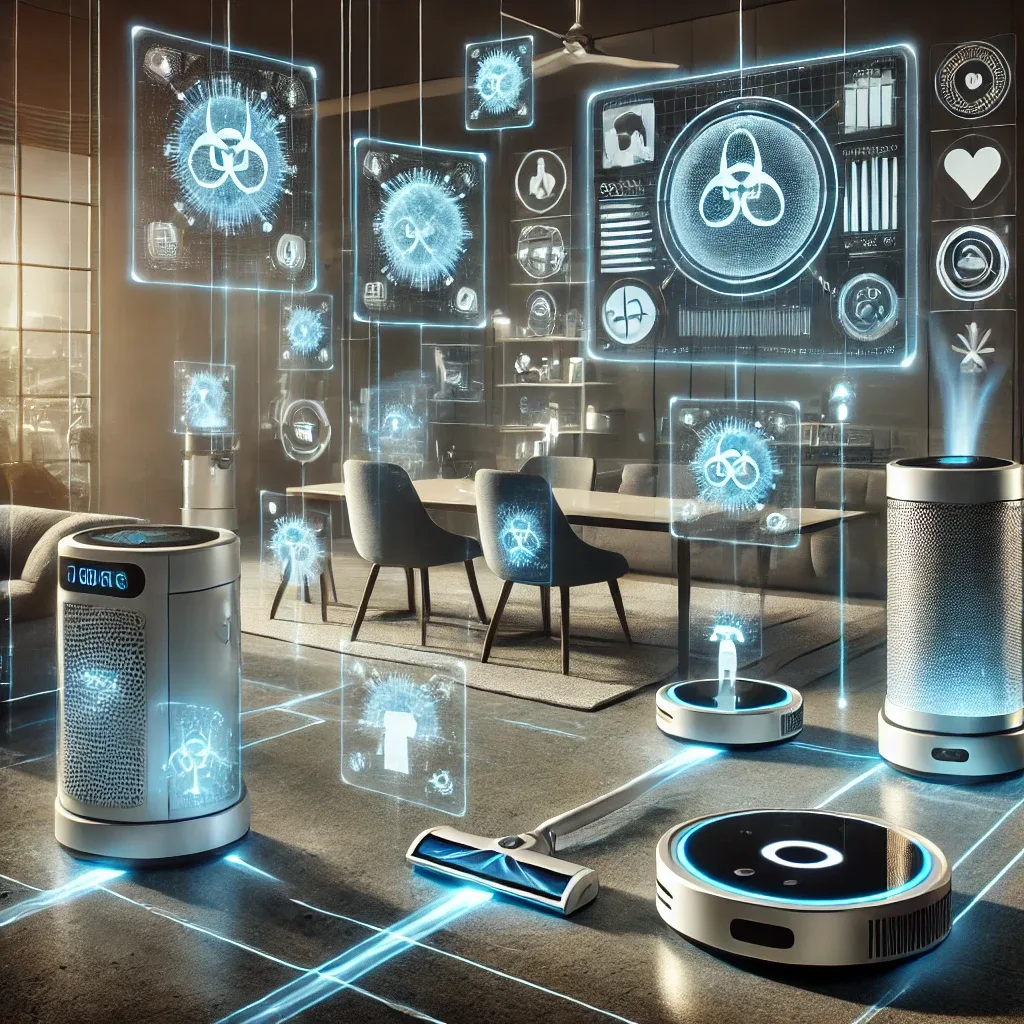
Smart Air Purifiers: The Heart of Any Dust Elimination System
Modern air purifiers have evolved far beyond simple filters. Today's technology integrates HEPA, Ionizer, and UV-C in a single unit, providing multi-layer filtration that addresses dust particles, pathogens, and odors simultaneously.
HEPA captures particles down to 0.3 microns, the ionizer charges airborne particles causing them to fall, and UV-C neutralizes bacteria and viruses. When connected to a Smart Home system via Wi-Fi, these purifiers automatically adjust fan speed in response to real-time PM2.5 sensor readings — and accept voice commands through Google Home or Amazon Alexa for hands-free control.
AI Robot Vacuums: Automated Daily Cleaning
Next-generation robot vacuums use Lidar and AI algorithms to map your home accurately and plot cleaning routes that eliminate redundancy and missed zones. Built-in HEPA filtration ensures collected dust is not re-released into the room.
Essential features to look for: daily Auto-Schedule, Zone Cleaning that prioritizes high-traffic areas, an Auto-Empty base that handles dust disposal automatically, and Home Assistant integration to trigger cleaning runs automatically when PM2.5 levels rise.
Cordless HEPA Vacuums: Flexibility for Every Surface
Cordless vacuums equipped with true HEPA filters handle areas where robots cannot reach — sofa cushions, shelving, ceiling corners, and narrow gaps. Lightweight and portable, they complement robot vacuums effectively, but must deliver sufficient suction power and carry genuine HEPA certification.
Choose models with minimum 20,000 Pa suction, at least 45 minutes of runtime per charge, and multiple attachment heads for different surface types.
Electric Air Curtains: Invisible Dust Barriers at Your Doors
Air curtains work by projecting a high-velocity airstream across doorways, creating an invisible barrier between indoor and outdoor environments. This prevents PM2.5, insects, and outdoor heat from entering whenever the door is opened.
Electrostatic-enhanced air curtains offer even better performance by capturing dust particles within the airstream before they can penetrate the indoor space. They are ideal for city homes where doors open frequently or commercial spaces with heavy foot traffic.
Automated Ventilation: Fresh Air Without the Pollutants
HRV (Heat Recovery Ventilation) and ERV (Energy Recovery Ventilation) systems introduce filtered outdoor air through HEPA filtration while simultaneously recovering heating or cooling energy — avoiding the energy penalty normally associated with ventilation. Smart Home integration enables automatic shutdown when outdoor PM2.5 exceeds safety thresholds.
Equipment Selection Guide by Home Type
Condos and small homes under 60 sqm: one air purifier in the bedroom, one robot vacuum, one cordless vacuum for spot cleaning — maximum efficiency at minimum cost.
Medium homes 60-150 sqm: two to three air purifiers covering main living areas, an automated ventilation system, one to two robot vacuums, and full Smart Home integration.
Large homes or households with elderly residents or young children: whole-house air purification, purifiers in every room, robot vacuums with Auto-Empty bases, air curtains at main entrances and internal connecting areas. HappySmart designs and installs these complete systems with long-term support included.