Why Smart Air Filtration Matters in the Digital Age
Air pollution is not merely an outdoor problem — it silently penetrates homes and workplaces. In an era when we spend over 90% of our time indoors, having an air filtration system intelligent enough to respond to pollutants in real time is a necessity, not a luxury. IoT has transformed ordinary air purifiers into systems that think, make decisions, and communicate with other devices in the home.
Real-Time Detection: The Heart of the System
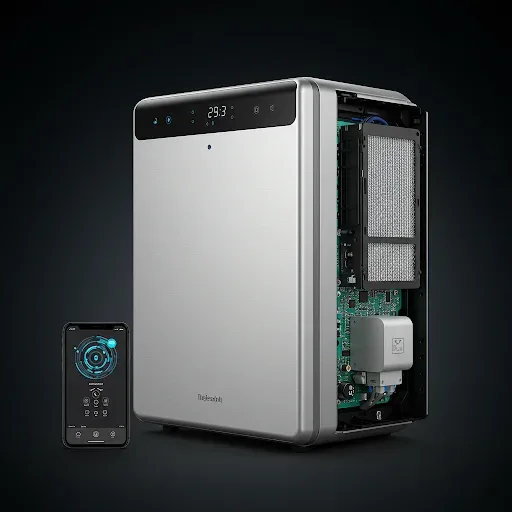
Modern IoT air purifiers contain built-in sensors capable of detecting diverse pollutants. PM2.5 and PM10 sensors measure ultrafine dust particles. Chemical sensors detect VOCs, toxins, and harmful gases. Smoke sensors alert when combustion or fire danger is present. Allergen sensors detect pollen, pet dander, and mold spores.
Data from all these sensors is processed in real time, enabling the unit to immediately decide whether to work harder or ease back.
Multi-Layer Filtration: Comprehensive Technology
Leading smart air filtration systems use multi-stage filtration. A Pre-Filter captures coarse dust and pet hair. HEPA filters PM2.5 particles down to 0.3 microns at 99.97% efficiency. Activated Carbon absorbs VOCs, chemicals, and eliminates odors. UV-C kills bacteria and viruses with ultraviolet light. An Ionizer uses negative charges to precipitate particles. Some models add Nano Technology that eliminates pollutants at the molecular level.
The combination of these filtration layers enables smart systems to handle pollutants far more comprehensively than single-layer HEPA-only units.
Automatic Adjustment and IoT Connectivity
The standout capability of IoT systems is automatic adaptation. When sensors detect high pollutants, the unit immediately increases fan speed. When air is clean, it reduces speed to save energy and minimize noise. Users can monitor real-time air quality data via smartphone app, remotely switch on/off or change modes, schedule operation, and toggle between Auto, Sleep, and Turbo modes as situations demand.
Automatic filter-replacement alerts prevent unnoticed performance degradation, and some models send notifications directly via Line or email.
Integration with Smart Home Systems
Modern IoT air purifiers support connection to diverse Smart Home platforms via Wi-Fi, Zigbee, Z-Wave, Matter, and Thread. The Matter protocol launched in 2022 is a new standard enabling devices from multiple brands to work together without compatibility concerns.
Home Assistant users can build complex Automation linking air purifiers with lighting, security systems, and HVAC seamlessly — for example: when PM2.5 is high, activate all purifiers, disable ventilation, and simultaneously send a phone alert.
Challenges and the Future of the System
Despite many advantages, IoT systems face some challenges. Budget sensor accuracy may fall below lab standards, causing data discrepancies. Cross-brand compatibility issues persist despite Matter solving some. High-quality device prices remain relatively steep for beginners.
The future focuses on AI that learns occupant behavior and adjusts proactively, linking air health data with personal health data, and full integration with central HVAC systems. HappySmart is ready to design and install an IoT air filtration system matched to your home and budget at any level.