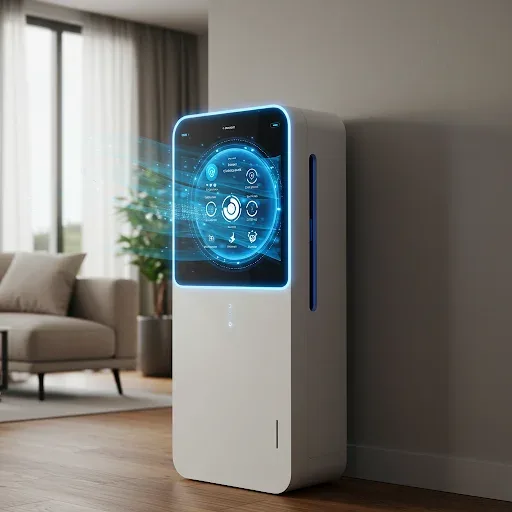
Why Indoor Air Quality Matters More Than You Think
Indoor air can be 2-5 times more polluted than outdoor air because contaminants and particles accumulate in enclosed spaces without adequate ventilation. Sources of indoor dust are numerous: textile fibers from furniture and clothing, dust mites, mold spores, pet dander, cooking smoke, and VOC chemicals from paints and furnishings.
Short-term health impacts include respiratory irritation, eye discomfort, and headaches. Long-term exposure contributes to cardiovascular disease risk, lung conditions, chronic allergies, and reduced cognitive performance. A smart air filtration system is a long-term investment in health rather than a luxury purchase.
2025 Real-Time Sensor Technology
Next-generation sensors offer significantly broader coverage: PM2.5 and PM10 measure fine and coarse particle concentrations separately; CO2 measures air freshness and ventilation adequacy; allergen sensors detect pollen, dust mites, and pet dander; VOC sensors identify volatile chemical compounds. All data displays on a mobile app and feeds the automation system for real-time decision-making.
Some 2025 sensor models use Laser Particle Counters — significantly more accurate than older LED-based designs — providing measurement data reliable enough to inform meaningful health decisions.
2025 Multi-Layer Filtration Technology
Modern air filtration systems layer multiple complementary technologies:
HEPA now filters to 0.1 microns in premium models (surpassing the original H13 standard), capturing fine PM2.5 dust, dust mites, and pathogens. Activated Carbon adsorbs odors and VOCs including formaldehyde and paint chemicals. UV-C eliminates bacteria, viruses, and mold spores that reach this stage. Ionizer causes ultra-fine particles to aggregate into larger masses that fall from the air. Plasma breaks down pollutant and odor molecules at the molecular level. Nano-filter captures nanoparticles smaller than conventional HEPA can address.
Smart Home Connectivity
2025 air purifiers connect to iOS and Android apps, accept voice commands through Google Home, Amazon Alexa, and Apple Siri, support the Matter standard and HomeKit for brand-agnostic interoperability, integrate with Home Assistant for advanced automation, and display historical air quality data on customizable dashboards.
AI and Machine Learning in Air Purifiers
The latest AI technology learns household behavior patterns — cooking schedules, sleep times, and periods when the home is empty — to adjust operation proactively before dust levels rise rather than reactively after they do. Energy consumption is reduced without compromising performance. Filter replacement alerts are based on actual usage data rather than calendar dates, preventing both early waste and late replacement.
Smart Air Filter System Buying Guide
Evaluate nine key factors:
Room size — CADR must be adequate for the floor area (calculate: CADR = sqm × 2.5). Filter type — must include genuine HEPA, not a marketing label. Smart features — App control, voice integration, and Matter support. Noise level — should be below 35 dB in Sleep Mode. Energy efficiency — Energy Star certification or equivalent. Replacement filter cost — calculate annual ownership cost, not only purchase price. Warranty — minimum 2 years on the unit itself. Design — compatibility with your interior aesthetic. Total budget — calculate the 3-year ownership cost including maintenance.
HappySmart provides expert consultation on selecting the right air filtration system for your home and budget, including complete Smart Home integration and professional installation.