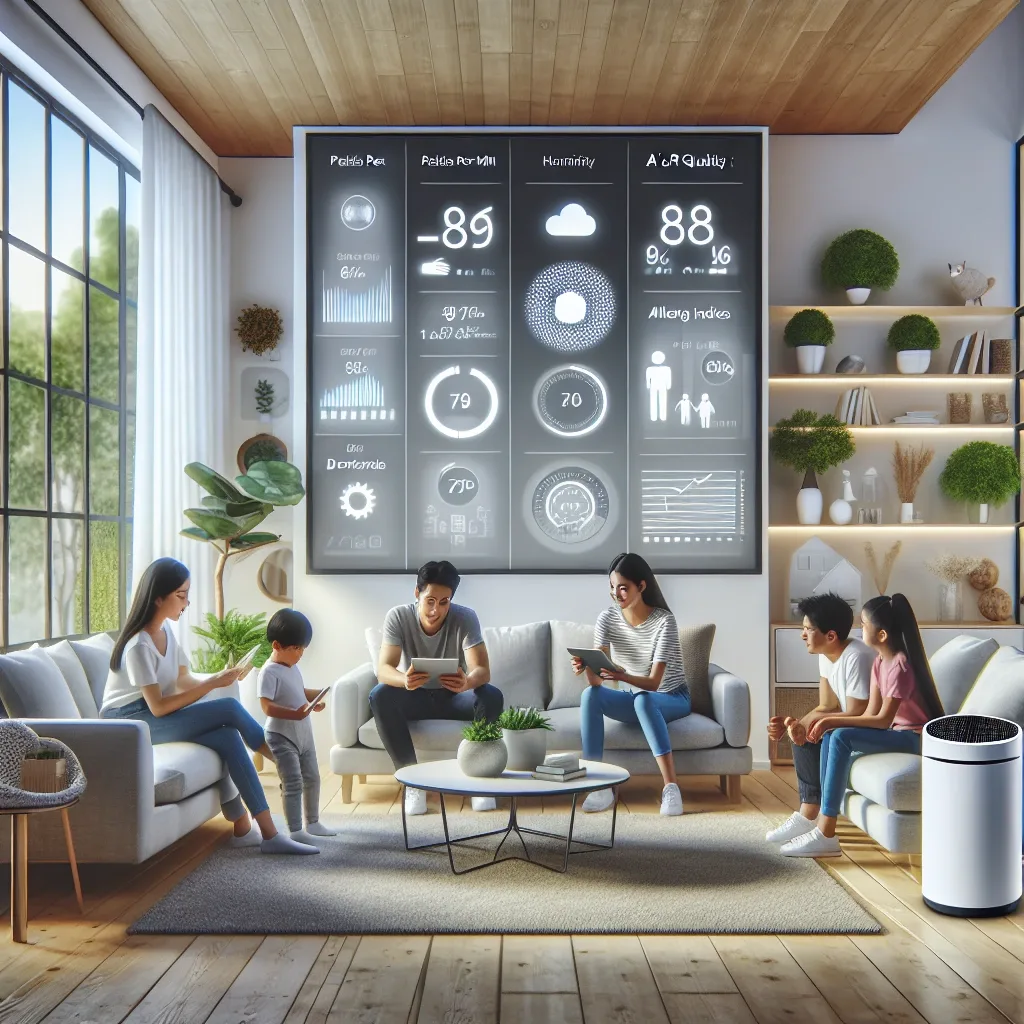
Indoor air quality directly impacts the health of everyone in your home, especially in Bangkok where PM2.5 pollution and year-round heat and humidity create ongoing challenges. Modern Smart Home technology enables you to monitor and manage air quality in real time without manual intervention.
Essential Air Quality Sensors
The foundation of a Smart Home air system is the right sensors. NDIR (Non-Dispersive Infrared) CO2 sensors are far more accurate than MOS types. The Sensirion SCD40 at 600-800 THB measures CO2, temperature, and humidity simultaneously. CO2 values exceeding 900 ppm indicate the room needs fresh air.
The Aqara TVOC sensor at 2,500-3,000 THB measures PM2.5, CO2, and VOC compounds in one device and connects via Zigbee directly to Home Assistant. The IKEA VINDSTYRKA at 1,200 THB is a budget-friendly option for beginners that performs reliably.
Smart Home Devices for Air Quality
A complete system includes several components. The hub — recommended as Raspberry Pi 5 at 3,500-5,500 THB running Home Assistant OS — serves as the central controller. Security cameras like Reolink or Amcrest at 2,500-5,000 THB, plus water leak sensors at 500-1,500 THB for bathrooms and kitchens, complete the safety layer.
Smart AC controllers such as Sensibo Sky at 3,500-4,500 THB or tado° at 4,000-6,000 THB add intelligence to existing air conditioners without replacement. Smart bulbs like Yeelight or Philips Hue at 500-3,500 THB per bulb and Smart Plugs at 300-800 THB for energy monitoring round out the system.
Smart Ventilation Systems
IoT-connected ventilation represents the highest health ROI investment. IoT ventilation fans like Panasonic Smart Fan at 3,000-6,000 THB integrate directly with Home Assistant. ERV systems at 30,000-80,000 THB suit Bangkok homes because they recover cooling energy from exhaust air, saving 15-25% on air conditioning costs.
Home Assistant automations handle the logic: when CO2 exceeds 900 ppm, activate the ventilation fan and send a LINE notification. When outdoor PM2.5 exceeds 100 µg/m³, close fresh air intake and switch to internal air recirculation mode.
Smart Air Purifiers
Smart air purifiers integrate directly with Home Assistant. The Xiaomi Smart Air Purifier 4 Pro at 8,500-12,000 THB supports Mi Home API and integrates via the xiaomi_miot integration. The Dyson Pure Cool TP07 at 15,000-25,000 THB has built-in PM2.5, NO2, and VOC sensors with API connectivity.
Automating purifier fan speed based on live sensor readings — Speed 1 at PM2.5 below 25, Speed 2 at 25-50, Speed 3 above 50 — saves electricity and significantly extends filter life.
Health Benefits of Automated Air Management
Automatic Smart Home air quality management delivers measurable health benefits. Well-controlled CO2 levels improve focus and work efficiency by 15-20% (Harvard research). Reduced PM2.5 lowers respiratory disease risk. Maintained humidity of 40-60% prevents mold growth and dust mites.
A complete Smart Home air system investment of 30,000-120,000 THB yields healthcare savings of 15,000-40,000 THB annually, achieving payback within 2-5 years.