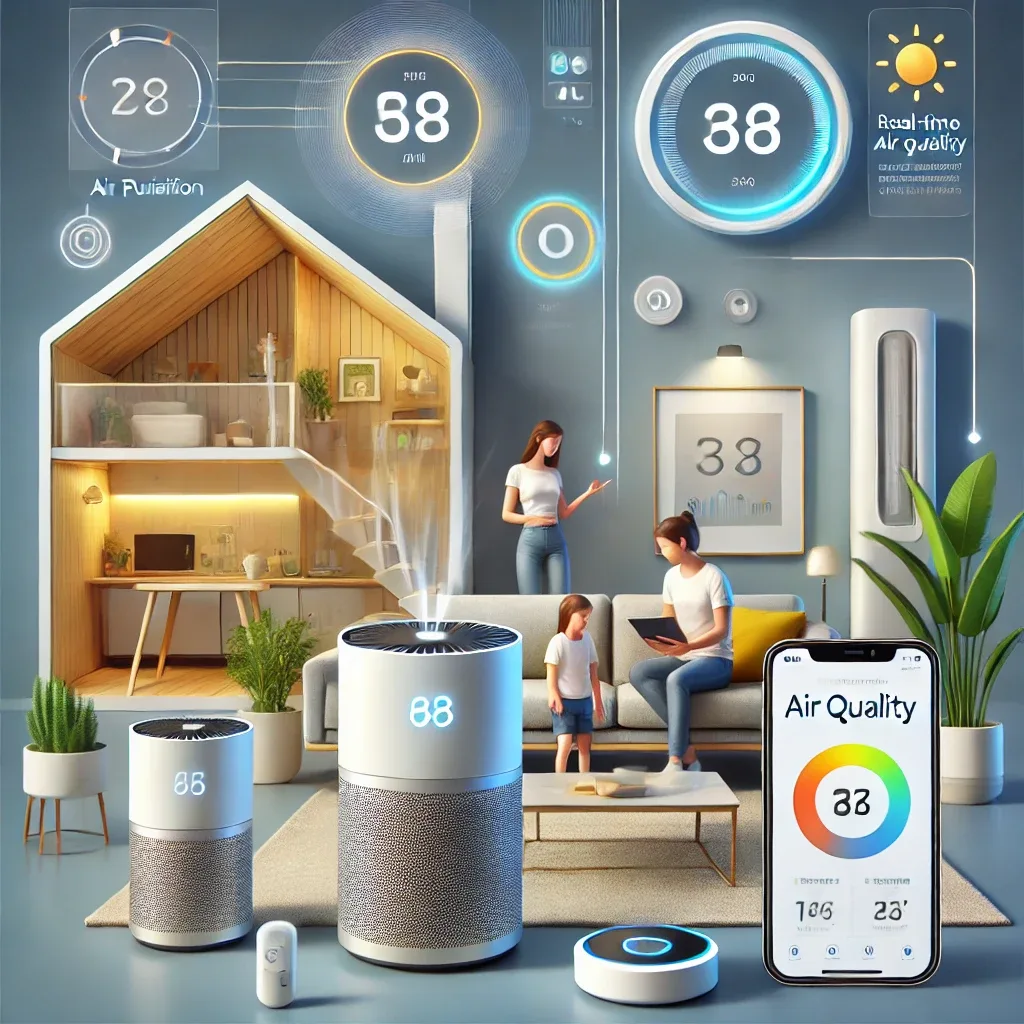
Choosing clean air equipment for Smart Home involves overwhelming options. This guide helps you decide systematically, focusing on devices that actually connect to Home Assistant and deliver value in Bangkok's context.
Step 1: Assess Your Needs Before Buying
Before opening Shopee or Lazada, answer these questions first. What is your home's primary problem: high PM2.5, CO2 accumulation, excessive humidity, or VOC from new furniture? What room size (square meters) determines the required CADR? Does anyone in the home have allergies, asthma, or respiratory conditions? What is your budget for the air system?
These answers determine priorities. Families with young children should invest in TVOC sensors first. Those with asthma should prioritize premium HEPA H13 filtration.
Air Purifiers: Choose by CADR and Features
CADR (Clean Air Delivery Rate) measures how quickly a purifier delivers clean air. A basic formula: CADR should be at least room area (m²) × 3. For a 30 m² room, use a purifier with CADR of at least 90 m³/h.
Xiaomi Smart Air Purifier 4 Lite at 5,000-7,000 THB delivers CADR 360 m³/h covering 48 m², connects via Mi Home, and suits bedrooms. Philips Series 3000i at 10,000-14,000 THB delivers CADR 333 m³/h with built-in PM2.5 sensor and direct app control. Dyson Purifier Cool TP07 at 15,000-25,000 THB includes a built-in fan and measures PM2.5, NO2, VOC, and formaldehyde with a Home Assistant API.
Air Quality Sensors: The Best Value Investment
Sensors are the highest-ROI investment in a Smart Home air system because they enable all automation. Options include the Sensirion SCD40 (NDIR CO2) at 600-800 THB for DIY Home Assistant projects; the Aqara TVOC Sensor at 2,500-3,000 THB as a Zigbee-ready device measuring CO2, TVOC, temperature, and humidity; and the Awair Element at 6,500-8,500 THB as a professional multi-sensor with Local API.
Humidity Control Devices
In Bangkok, the primary problem is excessive humidity (above 70% during the rainy season), not dryness. Dehumidifiers like the Sharp DW-J20T-W at 8,000-12,000 THB extract 20 liters of moisture per day and can be controlled via Smart Plug through Home Assistant. Set automation to activate when humidity exceeds 65% and deactivate when it falls below 55%.
Smart Fans and Ventilation
IoT ventilation fans like the Panasonic FV-10VFM3 at 3,000-5,000 THB connect via Smart Plug to Home Assistant for bathrooms and kitchens requiring automatic ventilation. Set automations to activate when humidity exceeds 70% or VOC spikes after cooking.
Tips for Home Assistant Integration
Always choose devices supporting Zigbee, Z-Wave, or Wi-Fi Local API. Avoid devices that depend solely on manufacturer cloud servers — if the server goes down, all automation stops. Use Zigbee for sensors (batteries last 1-2 years) and Wi-Fi for bandwidth-intensive devices like air purifiers.