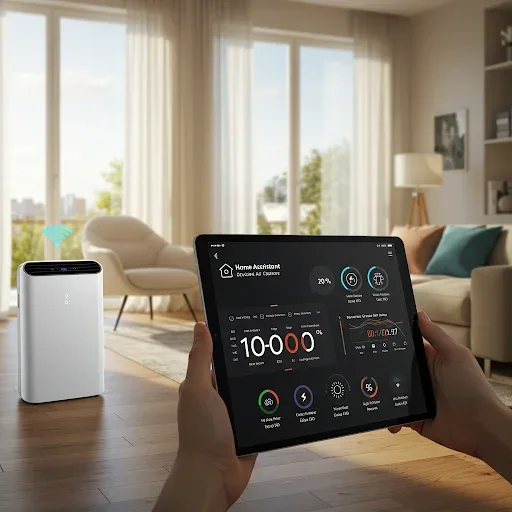
Why Home Assistant Is the Best Platform for Air Quality Management
Indoor air quality directly impacts health, sleep quality, and daily productivity. Automating air management is not a luxury — it is a measurable health investment. Home Assistant is an open-source Smart Home platform that connects air quality sensors, purifiers, fans, air conditioners, and ventilation systems, making them work together intelligently based on real data.
Compatible Devices for Air Quality Automation
Sensors that integrate well with Home Assistant include the Aqara TVOC Air Quality Monitor (Zigbee, measures TVOC/CO2/humidity), Shelly H&T (Wi-Fi, temperature and humidity), Airthings Wave Plus (Bluetooth, measures radon/CO2/VOC), and SwitchBot Meter Plus for basic temperature and humidity monitoring.
Supported purifiers include Xiaomi Mi Air Purifier series via Mi Home/Mi IO integration, Philips 2000i/3000i via HomeKit or Alexa, Dyson Pure Cool via Dyson Link, and BlueAir Blue Pure models. Air conditioners with Daikin Cloud, Mitsubishi MELCloud, or LG ThinQ support integrate directly.
Building an Air Quality Dashboard
Create a Lovelace Dashboard in Home Assistant displaying PM2.5 (target <25 μg/m³), CO2 (target <800 ppm), TVOC (target <250 μg/m³), humidity (target 40-60% RH), and room temperature in real-time. Use Gauge cards with green-yellow-red color coding for instant visual status across all zones.
Essential Automations to Configure
Four fundamental automations to implement: (1) turn purifier on when PM2.5 exceeds 25 μg/m³, off when below 15 μg/m³; (2) activate ventilation when CO2 exceeds 800 ppm, stop when below 600 ppm; (3) send LINE notification when any parameter exceeds standards for 30 consecutive minutes; (4) adjust AC mode to manage humidity when RH exceeds 65% or drops below 35%.
Benefits of a Fully Integrated System
Using Home Assistant for complete air quality management delivers several measurable benefits: fully automatic operation without manual intervention, 20-30% energy savings compared to leaving devices running continuously, historical data for trend analysis, and deep customization for each family's specific needs. Getting started requires only a Raspberry Pi 4 (approximately 2,500 THB) or a dedicated Home Assistant Green or Yellow device.