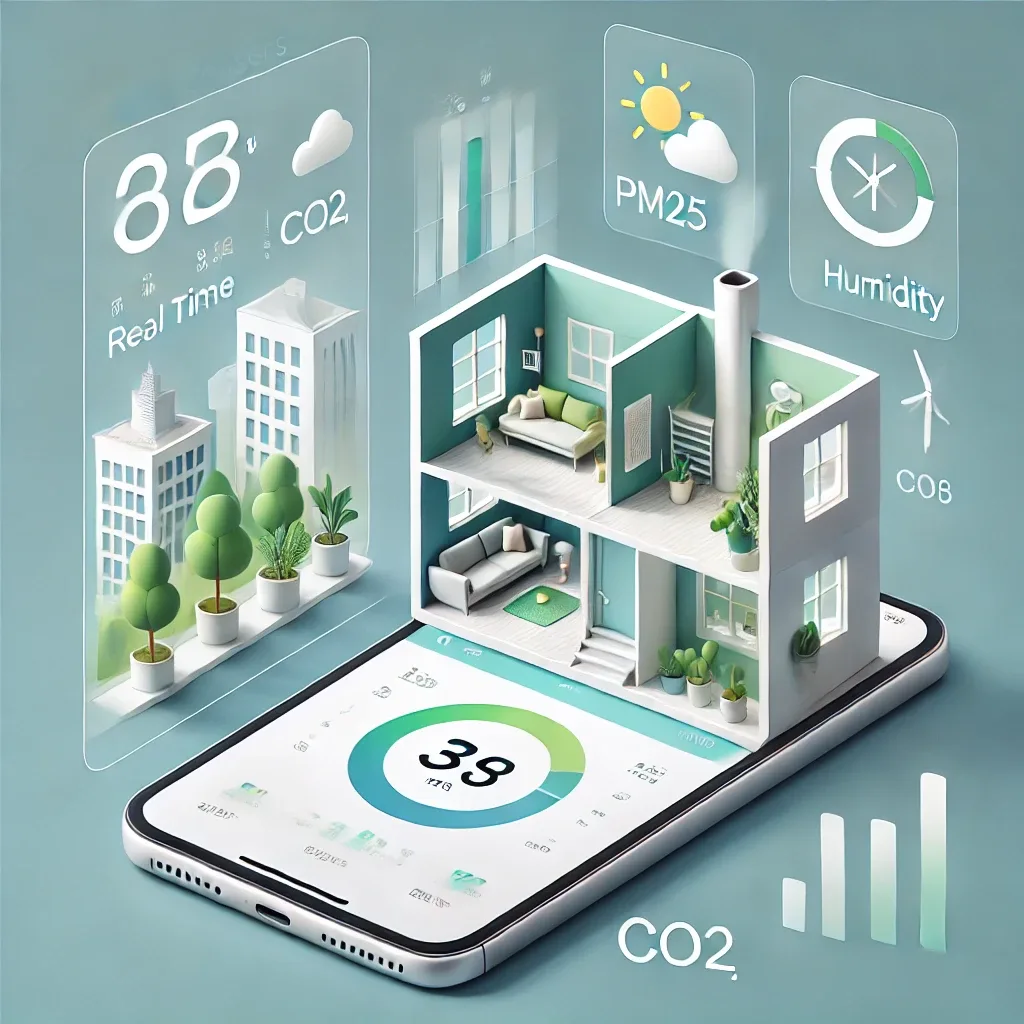
How Air Quality Sensors Actually Work
Modern air quality sensors use three core technologies. Laser Particle Counters (Optical Particle Counters) use a laser beam to detect light scattering when it strikes airborne particles, calculating particle size and count to derive PM2.5 and PM10 values. Electrochemical sensors detect target gases (CO, NO2, O3) through chemical reactions that produce measurable electrical current changes. NDIR (Non-Dispersive Infrared) sensors measure CO2 by detecting how much infrared light at the specific CO2 absorption wavelength is absorbed as the gas passes through.
What Each Sensor Type Detects
Different sensor types suit different pollutants. Laser sensors for PM2.5/PM10/PM1.0 are essential for urban homes facing traffic and biomass burning dust. NDIR sensors for CO2 are critical for closed rooms and bedrooms with multiple occupants — CO2 above 800 ppm measurably reduces cognitive performance by up to 15%. MOX (Metal Oxide Semiconductor) sensors for VOC/TVOC detect volatile compounds from furniture, cleaning products, and fresh paint. Capacitive sensors for humidity enable maintaining 40-60% RH to prevent mold growth and reduce dust mite populations.
Benefits of Real-Time Measurement
Real-time air quality data enables timely action across four key areas: knowing whether to activate a purifier immediately or wait; pinpointing specific pollution sources (for example, PM2.5 spikes after cooking); verifying that a purifier is actually performing as expected; and building automations that respond to actual conditions rather than fixed time schedules.
Recommended Sensor Models for 2025-2026
Top recommended home sensors include the Airthings Wave Plus measuring 7 parameters including radon via Bluetooth and app at approximately 9,500 THB; Aqara TVOC Air Quality Monitor using Zigbee for seamless HA integration measuring TVOC/CO2/humidity at approximately 2,000 THB; Kaiterra Laser Egg+ covering PM2.5/PM10/TVOC/CO2/temperature suitable for both home and commercial use at approximately 8,000 THB; and Netatmo Smart Indoor measuring CO2/humidity/temperature/noise with HomeKit support at approximately 5,500 THB.
The Future of Air Sensors and AI
The 2026 trend toward Edge AI integration in new sensor models enables pattern analysis and predictive alerts — warning before PM2.5 exceeds standards based on outdoor data and household behavior patterns. Integration with Thailand's Pollution Control Department Smart City API will enable home systems to automatically respond to outdoor air quality changes in real time.