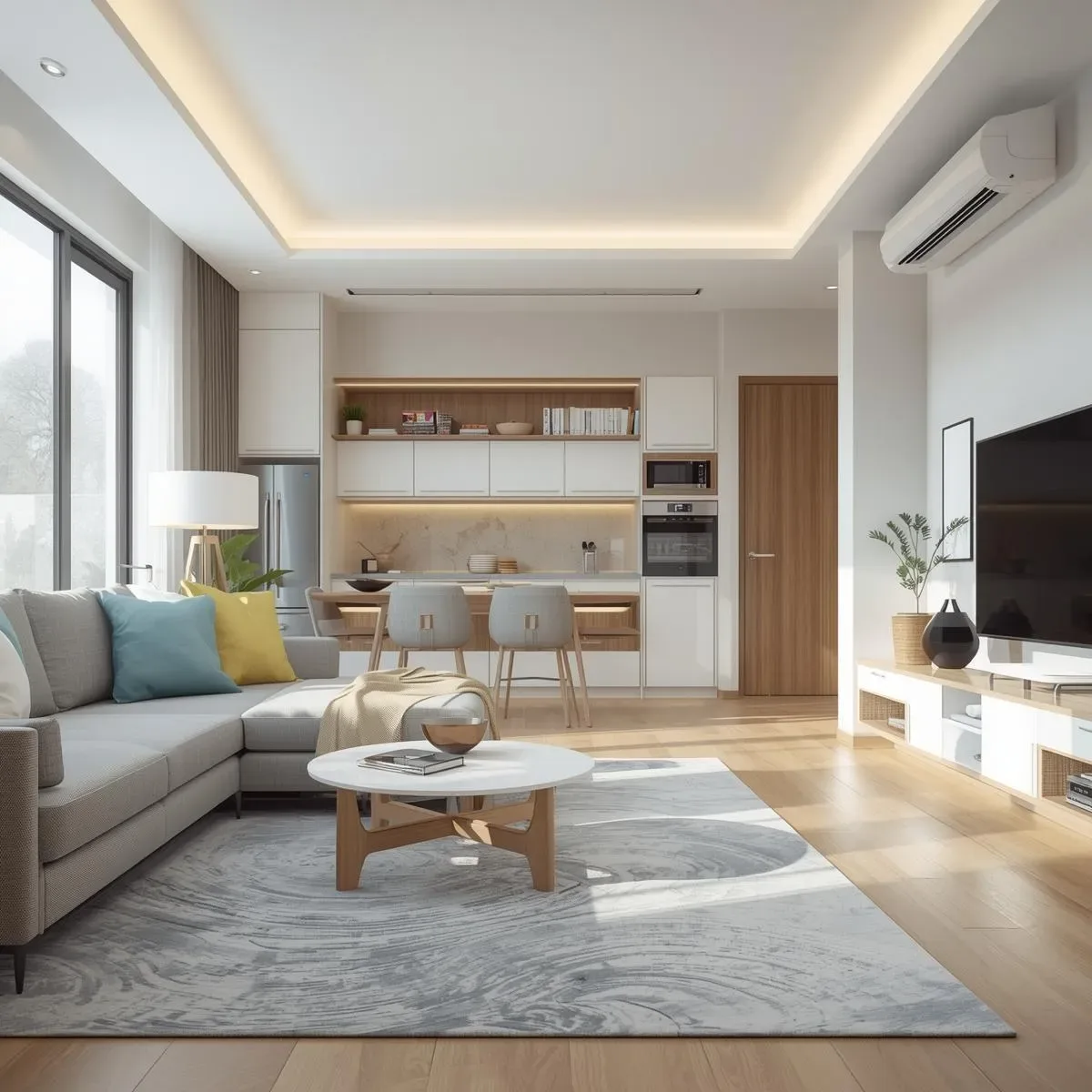
Most Thai homes still rely on single-room split-type air conditioners with no zoning or intelligent control — cooling unoccupied rooms, wasting energy, and failing to address varied comfort needs across different areas of the home.
Why Radiant Cooling Suits Bangkok
Radiant cooling uses chilled water panels (16–18°C) on ceilings or walls to absorb heat via radiation without blowing cold air. Advantages for Bangkok conditions: near-silent operation (no fan noise), no direct airflow (better for elderly and children), and more even temperature distribution (reduced hot/cold spots).
However, Bangkok’s high humidity (80–90% RH) is radiant cooling’s main challenge: if the panel surface drops below dew point, condensation forms. The solution is pairing radiant cooling with a DOAS.
DOAS: The Key to Humid Tropical Climates
A DOAS (Dedicated Outdoor Air System) is a separate AHU handling only dehumidification and fresh air supply. This lets radiant panels manage sensible heat only, without carrying the latent heat (moisture) load. A Desiccant Wheel plus ERV (Enthalpy Recovery Ventilator) reduces dehumidification energy by 40–60%.
Zehnder, Uponor, and Barcol-Air DOAS + Radiant Ceiling systems designed for humid tropical climates achieve EUI below 80 kWh/m²/year — versus below 120 kWh for conventional split-type systems in Bangkok.
Smart HVAC Zoning in Home Assistant
Zone configuration by occupancy pattern: Zone A (bedroom): active 22:00–07:00 at 22–24°C; Zone B (living room): triggered by PIR occupancy sensor; Zone C (home office): active 09:00–18:00 weekdays; Zone D (bathrooms/corridors): off at all times.
Smart Thermostat: KNX Room Controller (Siemens QMX3) or ecobee SmartThermostat Premium, integrated with Home Assistant via KNX integration or HomeKit/MQTT.
PMV Comfort Targeting with ASHRAE 55
PMV (Predicted Mean Vote) target of -0.5 to +0.5 indicates 90% of occupants feel comfortable. Radiant cooling controls MRT (Mean Radiant Temperature) more precisely than convective cooling, allowing higher dry-bulb air temperature setpoints (26–28°C air, 22–24°C MRT) while maintaining perceived comfort — directly reducing compressor energy consumption.
Cost and ROI
DOAS plus Radiant Ceiling system for a 200 sqm Bangkok home costs THB 800,000–1,500,000 to install — 3–5x higher than split-type. Annual energy savings of 25–35% (approximately THB 40,000–80,000/year) deliver a payback period of 10–18 years, making this most appropriate for new builds planned for long-term occupancy.