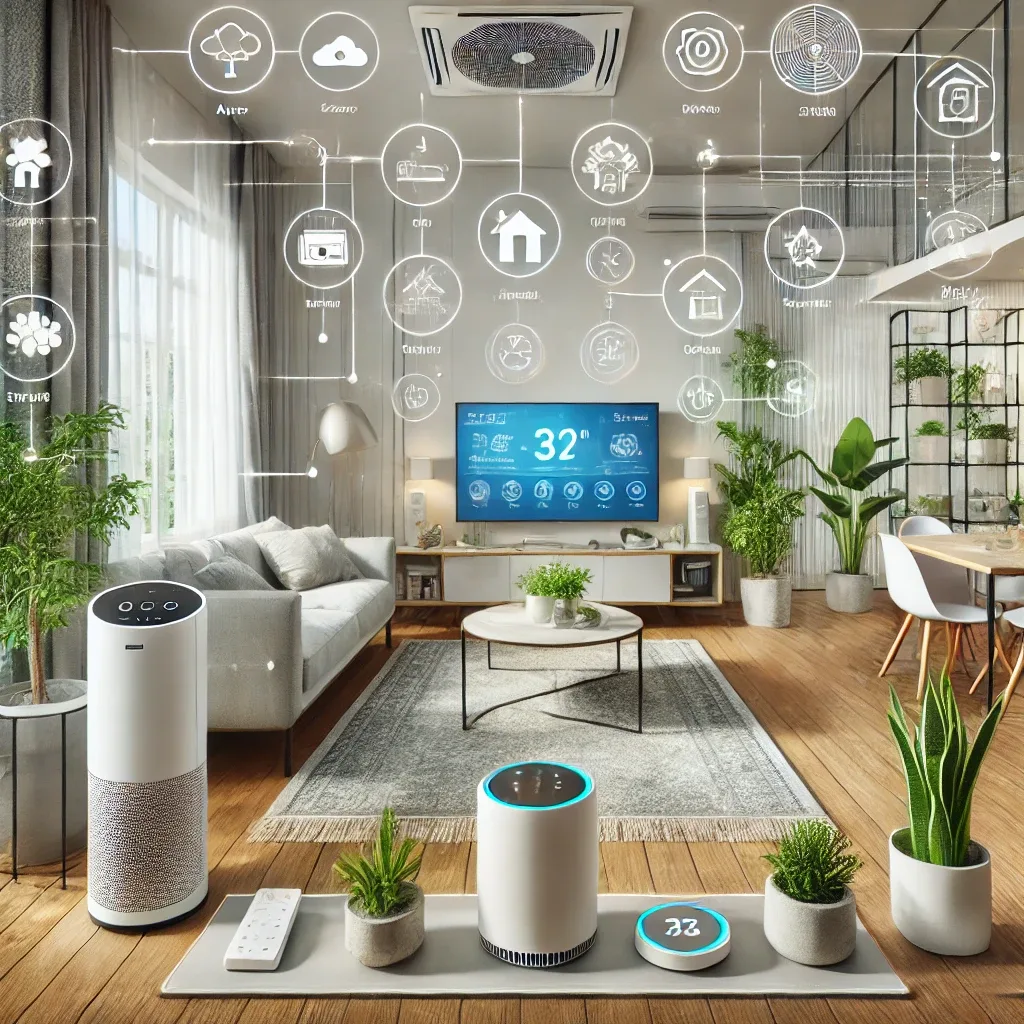
How Smart Home Technology Transforms Air Quality Management
Standard air purifiers run at fixed speeds regardless of actual air conditions. Smart home technology changes this entirely — using sensors, AI algorithms, and inter-device communication to keep indoor air clean automatically and intelligently.
For Bangkok, where PM2.5 spikes seasonally (especially December through March) and CO2 accumulates in sealed air-conditioned homes, this technology isn't luxury — it's a genuine health necessity.
Recommended Smart Air Purifiers
The Dyson Purifier Cool Formaldehyde TP09 is the premium choice, simultaneously measuring Formaldehyde, PM2.5, VOC, NO2, and CO2. Its HEPA H13 filter captures 99.95% of particles down to 0.1 microns. It connects natively with Amazon Alexa, Google Home, and Apple Siri.
The Xiaomi Mi Air Purifier 4 Pro suits Home Assistant users due to MiIO Protocol support and a large developer community for integration. The Philips AC3033 (Series 3000i) includes the CleanHome+ app showing real-time AQI and supports automatic scheduling.
Smart Ventilation Systems
Purification alone is insufficient — accumulated CO2 requires fresh outdoor air exchange. The Airthings Wave Plus monitors Radon, CO2, VOC, temperature, and humidity, transmitting data via Bluetooth BLE to a Wi-Fi-connected hub.
The Panasonic WhisperGreen Select supports speed control via 0-10V signal, controllable from Home Assistant through an ESPHome and D/A converter setup. This enables fully automatic ventilation responding directly to real-time air quality measurements.
Air Quality Automation Rules
Good Morning Routine: At 06:00-08:00, activate high-speed ventilation to exchange overnight accumulated air. First check outdoor AQI from the IQAir API — if outdoor PM2.5 is below 25 µg/m³, open windows with ventilation running; if above 75 µg/m³, close windows and activate purifier Turbo mode.
Sleep Mode Automation: At 22:00, reduce noise by switching the air purifier to Sleep mode (low speed, under 30 dB), lower AC temperature by 1°C, and shift lighting to 2700K before full shutoff. If CO2 exceeds 800 ppm overnight, the system automatically increases ERV speed without waking the household.
Voice Assistants for Air Quality Control
"Alexa, what's the air quality today?" — Amazon Echo connected to Airthings or Dyson responds immediately. Google Nest Hub displays real-time air quality graphs on its touchscreen. Samsung SmartThings supports complex routines for households with multiple Samsung devices.
Conclusion
Smart home air quality technology works best when all systems work together — not just a single standalone purifier. Integrating sensors, purifiers, ventilation, voice assistants, and automation creates an intelligent system that manages indoor air quality around the clock without manual intervention.