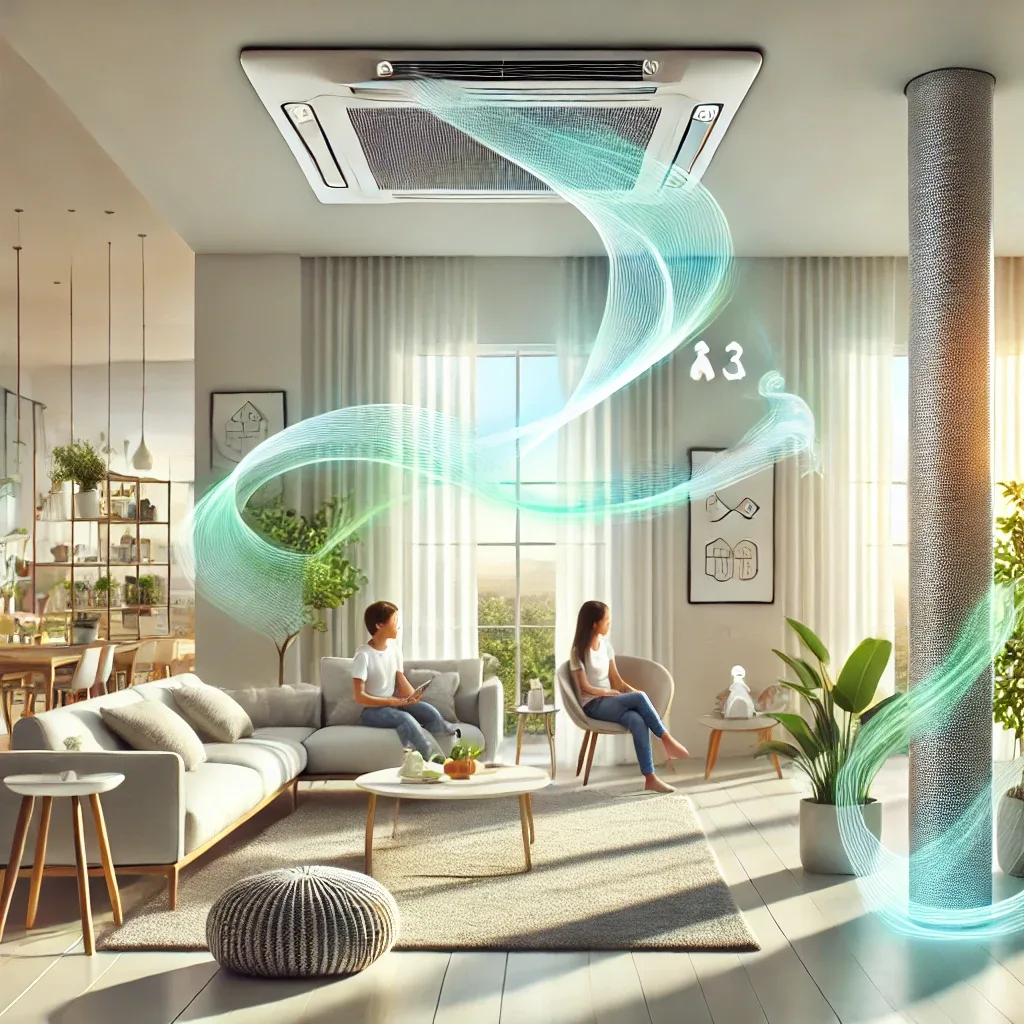
What Is a Fresh Air System and Why Does It Matter?
A sealed home doesn't mean clean air. Indoor air often contains pollutant concentrations 2-5 times higher than outdoors due to accumulated CO2, VOC, formaldehyde, and PM2.5 from indoor sources.
A Fresh Air System exchanges stale indoor air with purified outdoor air, filtering pollutants before they enter living spaces. This fundamentally differs from standard HVAC, which merely recirculates existing indoor air without replacing it.
The 5 Core Components of a Fresh Air System
Component 1 is Air Filtration. A HEPA H13 filter captures 99.97% of particles ≥0.3 microns — covering PM2.5, mold spores, and bacteria. Combined with Activated Carbon, it also adsorbs VOC and formaldehyde.
Component 2 is Humidity Control. Relative humidity of 40-60% is optimal for health. Below 30% dries nasal membranes and causes irritation; above 70% promotes mold growth. ERV systems manage humidity exchange simultaneously with air exchange.
Component 3 is the Heat Recovery Ventilator (HRV) or Energy Recovery Ventilator (ERV). HRV exchanges heat between incoming and outgoing air, reducing HVAC energy loss by 15-25% while maintaining fresh air supply. ERV additionally exchanges moisture, making it ideal for humid Bangkok conditions.
Component 4 is the Ventilation Controller, which receives signals from CO2 and PM2.5 sensors and commands fans automatically. Advanced systems use Modbus RS-485 for precise control through Home Assistant.
Component 5 is the Air Quality Monitor, displaying PM2.5, CO2, VOC, temperature, and humidity in real time — keeping residents informed about indoor conditions continuously.
Long-Term Health Benefits
Research from Harvard T.H. Chan School of Public Health found that improving indoor air quality increases cognitive performance by 61%, reduces respiratory disease risk by 40-60%, and significantly reduces asthma and allergy symptoms in children.
For Bangkok homes sealed with air conditioning throughout the day, Fresh Air Systems prevent CO2 accumulation (which can reach 2,000-3,000 ppm in bedrooms overnight) and unfiltered PM2.5 infiltration from outside.
Integrating Fresh Air Systems with Smart Home
Home Assistant controls Fresh Air Systems automatically through intelligent Automation Rules: activate ventilation when CO2 exceeds 800 ppm, increase fan speed when PM2.5 rises above 35 µg/m³, and stop the system when outdoor PM2.5 exceeds 75 µg/m³ to prevent pollution entry.
Configuring Morning Ventilation from 06:00-08:00 efficiently clears accumulated overnight air before residents begin their day.
Conclusion
A complete Fresh Air System combines filtration, humidity control, HRV/ERV ventilation, air quality monitoring, and automated control. This investment in long-term health returns value through reduced medical costs and substantially improved quality of life for everyone in the home.