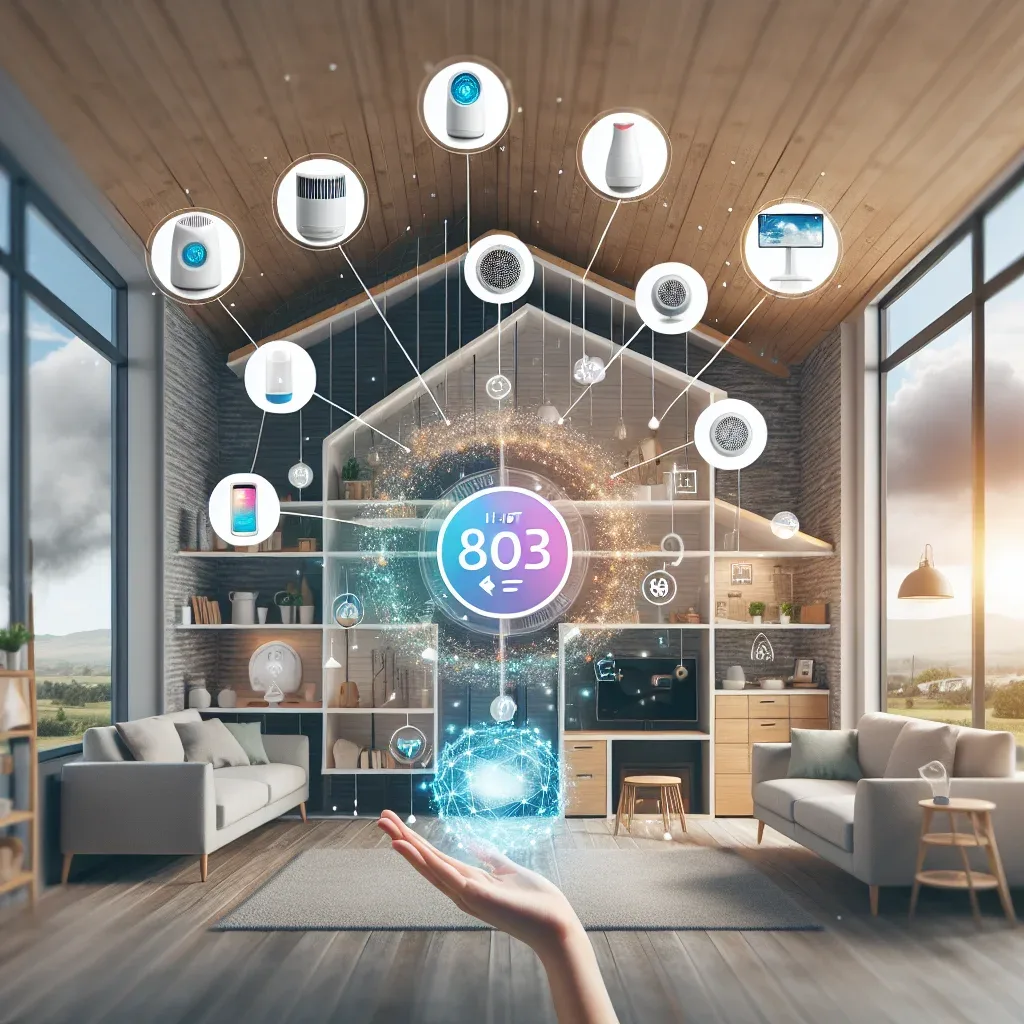
Why Indoor Air Quality Matters More Than You Think
Bangkok residents spend over 90% of their day indoors, yet most are unaware that indoor air can be 2–5 times more polluted than outdoor air. PM2.5 accumulates from cooking, CO2 rises from occupants' respiration, VOCs off-gas from furniture and wall paint, and formaldehyde leaches from building materials. IoT technology makes real-time, automated monitoring and control of indoor air quality not just possible but practical.
Air Quality Monitoring Systems
The essential sensor suite for a modern smart home includes the Sensirion SPS30 for PM2.5/PM10 using Laser Optical Detection at laboratory-grade accuracy, the Sensirion SCD40 for true CO2 measurement via Photoacoustic Sensing, and the SGP30 or SGP41 for VOC and TVOC levels.
All sensor data streams via MQTT to Home Assistant, displayed in real time on the Lovelace Dashboard and triggering automations when thresholds are breached. When PM2.5 exceeds 35 µg/m³, the air purifier activates. When CO2 exceeds 1000ppm, ERV fan speed increases. No manual intervention needed.
Smart Air Purifiers
IoT-connected air purifiers receive commands from Home Assistant to adjust their operating level based on live PM2.5 sensor readings, rather than running on a fixed timer. HEPA H13 filters capture 99.95% of particles down to 0.1 microns — essential for Bangkok, where AQI frequently exceeds 100 from November through March.
Automation-driven purifiers that run only when needed extend filter life and reduce electricity consumption by 30–40% compared to running continuously at a fixed speed.
Smart Ventilation Systems
ERV (Energy Recovery Ventilation) and HRV (Heat Recovery Ventilation) systems bring fresh outdoor air into the home while recovering thermal energy from exhaust air, reducing air conditioning energy consumption by 15–25% versus simply opening windows.
When integrated with IoT, the ERV responds directly to CO2 sensors: activating at CO2 > 800ppm and stopping at < 600ppm. It also monitors outdoor AQI via the IQAir API — if outdoor AQI exceeds 100, the system temporarily suspends ventilation and increases indoor air purifier capacity instead.
Positive Air Pressure: Advanced Indoor Air Defense
Positive Air Pressure Devices (PAPD) draw filtered air through HEPA H13 filters into the room, maintaining slightly higher indoor air pressure than outside. This prevents unfiltered outdoor air from infiltrating through building cracks and gaps — a significant factor in Bangkok's older condominium and house stock.
A well-implemented Positive Air Pressure system keeps indoor PM2.5 below 10 µg/m³ even when outdoor AQI reaches 150+. During periods of good outdoor air quality, the system automatically adjusts to a lower power mode to conserve energy.
Integrating IoT and Positive Air Pressure
Combining IoT data with Positive Air Pressure creates a fully dynamic air quality system: when the IQAir API reports outdoor AQI > 100, the PAPD shifts to High Mode and ERV pauses; when indoor PM2.5 rises above 35 µg/m³ — signaling reduced pressure effectiveness — the system alerts and auto-adjusts. This closed-loop system operates 24/7 without human oversight, consistently maintaining healthy indoor air regardless of Bangkok's seasonal pollution cycles.