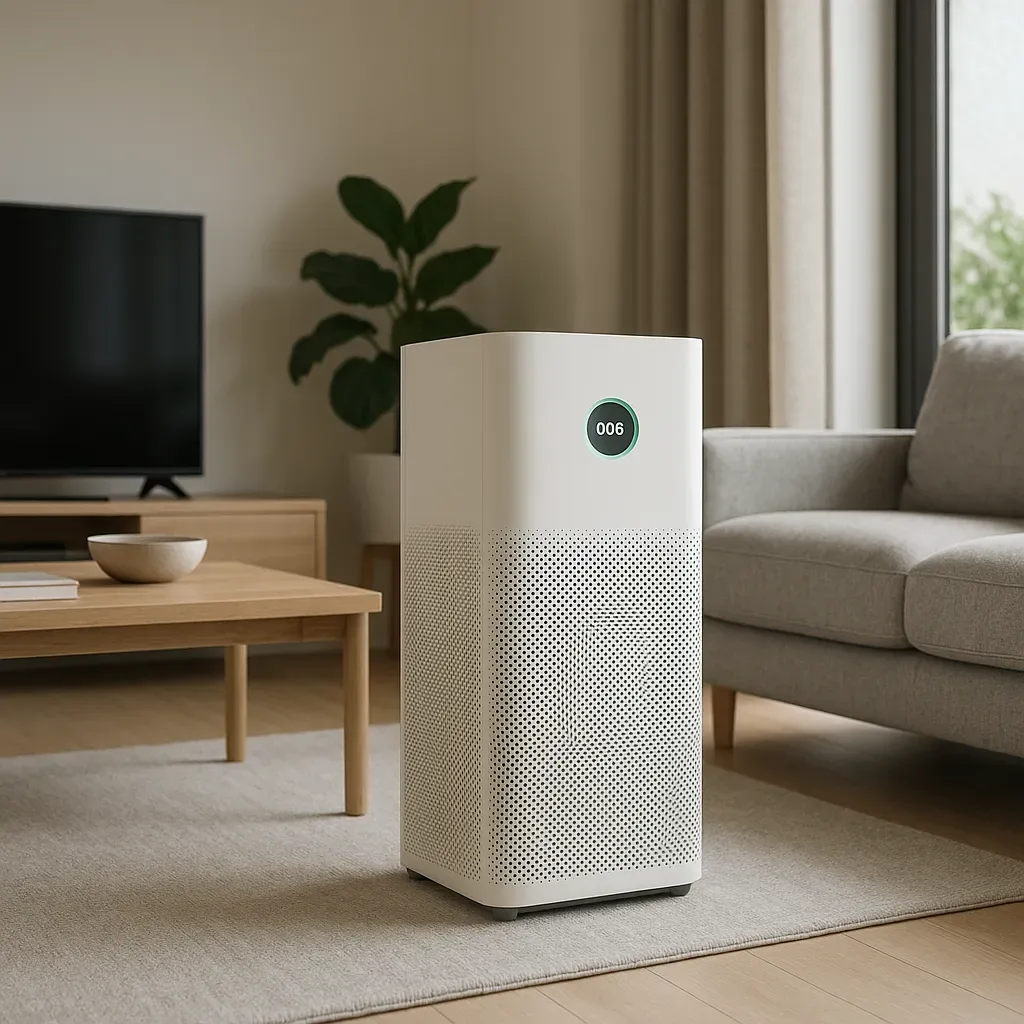
Why Bangkok Homes Need a Smart Air Purifier
During the haze season (January–March), Bangkok’s PM2.5 regularly exceeds 75 µg/m³ — five times the WHO guideline. A conventional air purifier running at full speed 24/7 wastes energy and filter life. A smart air purifier linked to a PM2.5 sensor and Home Assistant dynamically adjusts fan speed based on real air quality data, cutting energy consumption 30–50% compared to a standard Auto mode.
Filter Technology: HEPA H13 vs H14 — Which Should You Choose?
Under EN 1822, HEPA grades are: H11 captures ≥95% of 0.3 µm particles, H13 captures 99.95%, H14 captures 99.995%. For most Bangkok homes, H13 is sufficient for PM2.5, pathogens, and allergens. H14 is recommended for households with infants, elderly residents, or people with respiratory conditions. Always choose a unit with a pre-filter (catches coarse dust first) and a carbon layer (absorbs VOCs and odours) to extend the primary HEPA filter’s life.
Sizing: How to Calculate the Right CADR for Your Room
CADR (Clean Air Delivery Rate) measures purified air output in m³/hour. Formula: CADR = Room Area (m²) × Ceiling Height (m) × 5 air changes/hour. Example: a 20 m² bedroom with 2.7 m ceilings needs CADR ≥ 270 m³/h. Reference sizing: bedroom 15–25 m² → CADR 200–350; living room 30–50 m² → CADR 400–700; open-plan 50–80 m² → CADR ≥ 800 or two units in a zoned setup.
IoT Connectivity: Wi-Fi vs Zigbee vs Matter
Wi-Fi (2.4 GHz) — Easy setup, works immediately with brand apps (Xiaomi Mi Home, Philips AirMatters). Downside: depends on cloud servers. Local API available for Xiaomi via the xiaomi_miot integration in HA.
Zigbee — Low power, low latency, 100% local operation. Example: IKEA Starkvind connects directly via Zigbee2MQTT.
Matter (over Wi-Fi/Thread) — Emerging open standard supported by Apple, Google, Amazon, and HA simultaneously. Dyson and Blueair 2025–2026 models are beginning to support Matter natively.
Home Assistant Automation for Smart Air Purifier Control
Example automation for Xiaomi Air Purifier + outdoor PM2.5 sensor (Air4Thai API):
yaml
alias: "Smart Air Purifier - PM2.5 Auto Control"
trigger:
  - platform: numeric_state
    entity_id: sensor.outdoor_pm25_air4thai
    above: 50
condition:
  - condition: state
    entity_id: input_boolean.home_occupied
    state: "on"
action:
  - service: fan.set_percentage
    target:
      entity_id: fan.xiaomi_air_purifier
    data:
      percentage: 75
  - service: notify.line_notify
    data:
      message: "PM2.5 outdoor {{ states('sensor.outdoor_pm25_air4thai') }} µg/m³ — purifier set to 75%"
Filter replacement reminder automation:
yaml
alias: "Filter Change Reminder"
trigger:
  - platform: numeric_state
    entity_id: sensor.air_purifier_filter_life_remaining
    below: 10
action:
  - service: notify.line_notify
    data:
      message: "HEPA filter at {{ states('sensor.air_purifier_filter_life_remaining') }}% — replacement needed"
Top Smart Air Purifiers for the Thai Market (2025–2026)
Xiaomi Smart Air Purifier 4 Pro — HEPA H13, CADR 500 m³/h, Wi-Fi 2.4G, ~฿4,500, Local API via xiaomi_miot. Best for living rooms 30–40 m².
Philips AC3858/70 — HEPA FY3433, CADR 400 m³/h, Wi-Fi, Alexa/Google compatible, ~฿8,900. Good mid-range option.
IKEA Starkvind — HEPA E12, CADR 260 m³/h, Zigbee, ~฿3,500. 100% local via Zigbee2MQTT+HA — ideal for privacy-conscious users.
Dyson Purifier Hot+Cool HP07 — HEPA H13 + carbon, CADR 290 m³/h, heating/cooling combo, ~฿25,000. Premium bedroom choice.
Summary: Choosing a Smart Air Purifier for a Bangkok Home
Start by measuring room dimensions and calculating required CADR. Set HEPA H13 as the minimum standard. Choose your connectivity protocol to match your existing Smart Home ecosystem (Zigbee for HA power users, Wi-Fi for beginners). Budget for running costs: HEPA H13 filters cost ฿800–2,500 each and should be replaced every 6–12 months depending on air quality. Pairing with Home Assistant typically extends filter life by 20–30% because the purifier only runs when truly needed.