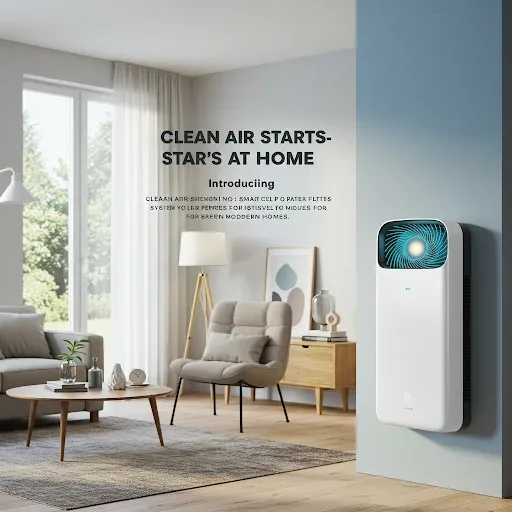
Why Choosing the Right Air Filtration System Matters More Than You Think
Clean indoor air measurably impacts health, sleep quality, and focus — especially for those with respiratory conditions, young children, and the elderly. However, choosing a purifier or filtration system that is poorly matched to your space and needs risks investing money without the intended health outcomes. Seven key factors should guide every purchase decision.
7 Key Factors for Choosing a Smart Air Filtration System
Factor 1: Room size and CADR rating — choose a unit with CADR (m³/h) at least equal to room area (m²) × 2.5, ensuring 4-5 complete air changes per hour. Example: a 25 sqm room requires CADR ≥ 62 m³/h.
Factor 2: Filter type and quality — HEPA H13 captures 99.97% of 0.3-micron particles for PM2.5 removal; Carbon filters absorb VOCs and odors; pre-filters trap coarse dust to extend the life of the main filter.
Factor 3: Smart features — built-in PM2.5/CO2 sensors, app connectivity, Home Assistant/Alexa/Google Home compatibility, and an Auto Mode that adjusts fan speed based on real measured values rather than fixed schedules.
Factor 4: Noise level — Sleep Mode should measure below 35 dB to avoid disturbing sleep; standard operation should stay below 50 dB in office environments.
Factor 5: Total long-term cost — calculate purchase price plus filter replacement every 6-12 months plus electricity over a 5-year period before committing to a model.
Factor 6: Certifications — look for AHAM VERIFIDE, Energy Star, or CARB Certified status to confirm genuine performance claims.
Factor 7: After-sales service — assess installation support, parts warranty, and ease of sourcing replacement filters locally.
Components of a Complete Smart Air Filtration System
A well-specified system includes a pre-filter for coarse dust, HEPA H13 for PM2.5 capture, a Carbon filter for VOCs and odors, built-in air quality sensors, and smartphone or Smart Home control. Premium models also integrate UV-C sterilization and ionizers for additional protection.
Model Recommendations by User Category
For small rooms of 15-25 sqm: Xiaomi Mi Air Purifier 4 Compact (CADR 230 m³/h, approximately 4,500 THB). For living rooms of 25-40 sqm: Philips Series 2000i (CADR 270 m³/h, approximately 9,000 THB). For whole-home coverage or allergy sufferers: Dyson Pure Cool TP07 (HEPA H13 plus Carbon plus full sensor suite, approximately 30,000 THB).