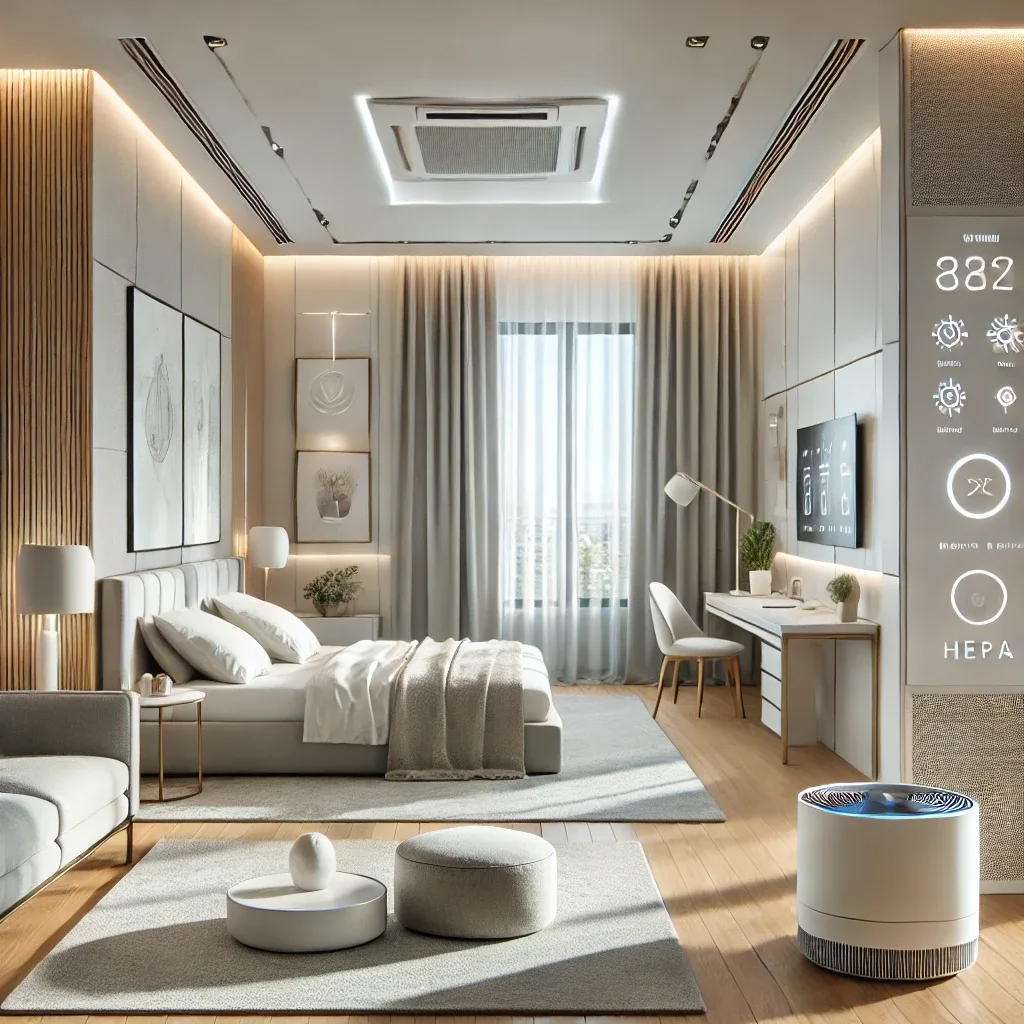
Why Smart Home Is Especially Important for Allergy Patients
Allergy patients have immune systems that react disproportionately to allergens — PM2.5, dust mites, pollen, pet dander, and mold spores all trigger responses. Manual management is inherently inconsistent, and Smart Home systems solve this by monitoring and responding to environmental conditions around the clock without depending on personal memory or discipline.
Research from the American Journal of Respiratory and Critical Care Medicine found that maintaining consistent indoor air quality can reduce hospital admissions for asthma patients by up to 40% and significantly decrease inhaler use — making the investment in smart air management genuinely cost-effective for allergy households.
Smart Air Purifiers for Allergy Patients
Purifiers for allergy patients must meet higher standards than general use. Filters should be HEPA H13 or H14, filtering 0.3μm particles at 99.97-99.995% efficiency, capturing dust mites, pollen, pet dander and dander, and mold spores.
Additional essential features for allergy sufferers: activated carbon filter absorbing VOCs from cleaning products and wall paints; noise below 35 dB in Sleep mode to avoid disrupting rest; and high-accuracy laser PM2.5 sensors that provide reliable data for automation decisions.
For placement, allergy patients should have a dedicated bedroom unit positioned 1-2 meters from the bed without direct airflow toward the sleeper, plus a second unit in the main living area where most daytime hours are spent.
Humidity Control for Allergy Patients
Relative humidity at 40-50% RH is the optimal range for allergy patients. At this level, dust mites cannot reproduce efficiently, mold cannot grow well, and respiratory mucous membranes function at full capacity — all three being critical for allergy management.
Smart Home humidity automation: if humidity exceeds 60%, activate Dehumidifier until it reaches 50%; if humidity drops below 35%, activate Humidifier to 45%. Wi-Fi or Zigbee-compatible dehumidifiers and humidifiers integrate directly with Home Assistant without additional hardware.
Smart Ventilation and Allergen Reduction
Smart ventilation systems expel accumulated CO2 and VOCs while protecting against incoming outdoor PM2.5. The best approach is an ERV or HRV that filters PM2.5 while exchanging air — providing ventilation benefits without pollution risk.
For homes without ERV, smart window automation can open windows only when outdoor PM2.5 is below 25 μg/m³, verified in real-time from Air4Thai or AirVisual stations via Home Assistant integration. Smart curtains automated to close when outdoor PM2.5 is high add another passive protection layer.
Expected Results and System Maintenance
Allergy patients using complete Smart Home solutions typically report significantly reduced nighttime coughing, sneezing, and runny nose within 2-4 weeks. Sleep quality improves with consistently lower bedroom PM2.5 and dust mite levels, and antihistamine use frequency decreases noticeably.
Key maintenance: replace HEPA filters every 6 months; clean pre-filters every 1-2 months; wash bedding weekly at 60°C to kill dust mites; vacuum with HEPA-filtered vacuum cleaners at least twice weekly. Home Assistant can automate reminders for each maintenance task, ensuring nothing is overlooked.