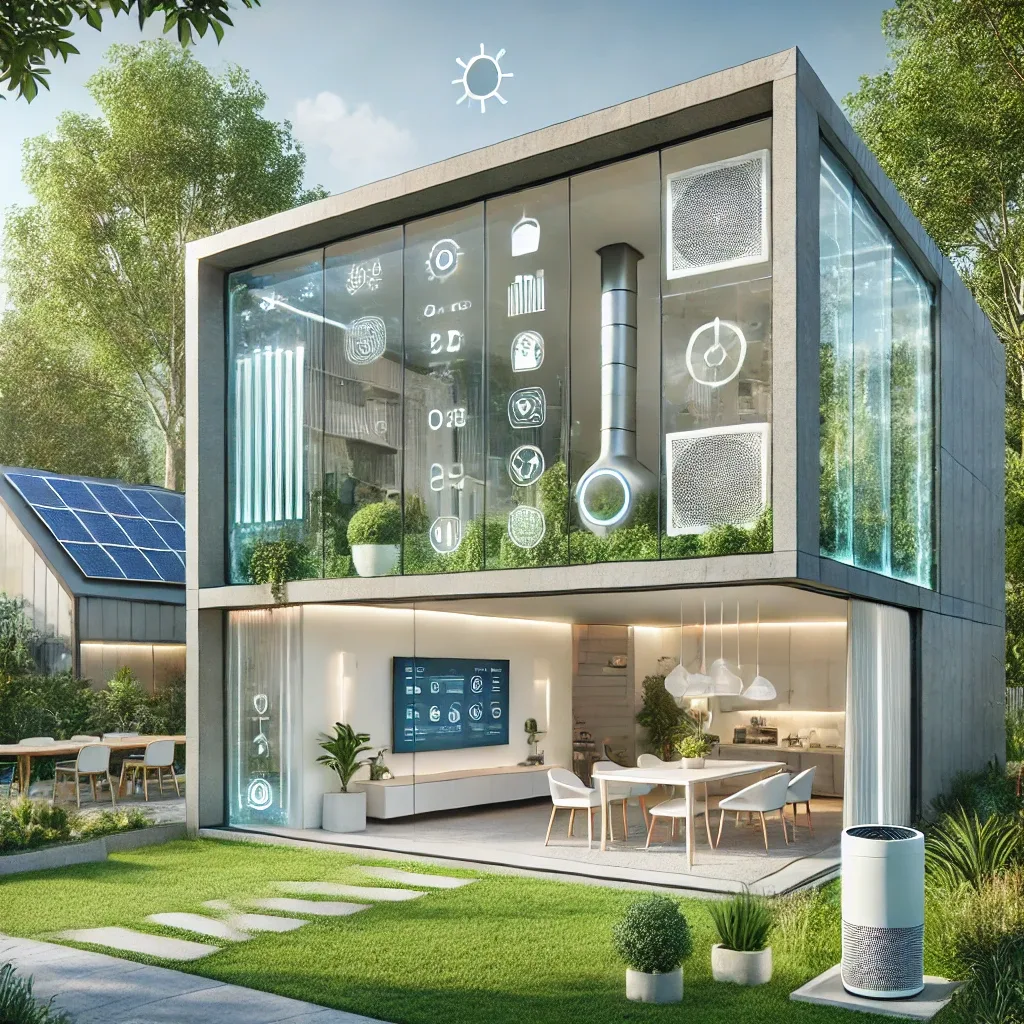
Why Design Air Quality as an Ecosystem
Buying a single air purifier solves only part of the problem. An air purifier captures existing dust particles but cannot replace CO2-saturated stale air, cannot control the moisture that causes mold, and cannot prevent new pollutants from entering when doors open.
A complete Clean Air Ecosystem must simultaneously address five areas: eliminating existing pollutants, introducing fresh outdoor air, monitoring and alerting in real-time, controlling humidity, and operating automatically together through Home Assistant.
The 5 Technologies That Complete the System
Technology 1, Smart Air Purifier: the first line of defense, eliminating pollutants from existing room air. Choose a model with HEPA H13 and Activated Carbon that connects to Home Assistant via Wi-Fi. Recommended: Xiaomi Smart Air Purifier 4 Pro (200-250 USD) or Philips AC2939 (370-460 USD) for large rooms.
Technology 2, Air Quality Sensor: the brain of the system, measuring PM2.5, CO2, TVOC, temperature, and humidity in real-time and triggering other devices to act. Aqara TVOC Air Quality Monitor (75-110 USD) communicates via Zigbee and connects directly to Home Assistant. The Sensirion SEN55 is a Pro-tier option for those wanting granular multi-parameter data.
Technology 3, Fresh Air ERV: the most important layer for Bangkok homes, bringing filtered outdoor air inside while managing humidity. Panasonic WhisperComfort ERV costs 1,000-1,500 USD including installation and reduces AC load by 15-25%.
Technology 4, Smart Ventilation: smart exhaust fans for bathrooms and kitchens — the primary sources of moisture and odor. Connect to Home Assistant via Smart Switch and auto-activate when humidity exceeds 70% or CO2 exceeds 1,000 ppm. Smart Switch cost is approximately 9-15 USD per point.
Technology 5, Smart Thermostat with Humidity Control: controls the air conditioner to maintain humidity at 45-55%, the optimal range for mold prevention without excessive dryness. Sensibo Sky or Tado converts existing AC units into Smart AC and integrates with Home Assistant at 75-140 USD.
Room-by-Room Placement Plan
Bedroom (highest priority): Smart Air Purifier plus Air Quality Sensor in the room plus ERV duct supply during sleeping hours. Low CO2 during sleep is the single most important factor for sleep quality and morning recovery.
Living room (primary shared area): large Smart Air Purifier plus Air Quality Sensor plus main ERV duct. With multiple family members present simultaneously, CO2 accumulates faster here than anywhere else.
Home office workspace: Air Quality Sensor is Priority #1 because CO2 directly impacts concentration and cognitive performance. Share the same Smart Air Purifier and ERV duct with the living room.
Bathroom and kitchen: Smart Ventilation Fan is the essential element here, auto-activating when humidity exceeds 70% to prevent moisture migrating to other rooms.
Home Assistant Automation Examples
Practical automations ready to deploy: when bedroom CO2 exceeds 1,000 ppm → increase ERV to High Speed and send LINE notification; when living room PM2.5 exceeds 35 μg/m³ → activate Air Purifier Speed 3; when outdoor AQI exceeds 150 → close ERV outdoor intake and switch to Recirculation Mode; when bathroom humidity exceeds 70% → auto-activate Smart Ventilation Fan. Total budget for a complete 4-room system: 1,800-4,000 USD. Payback period from reduced electricity bills and healthcare costs is approximately 3-5 years.