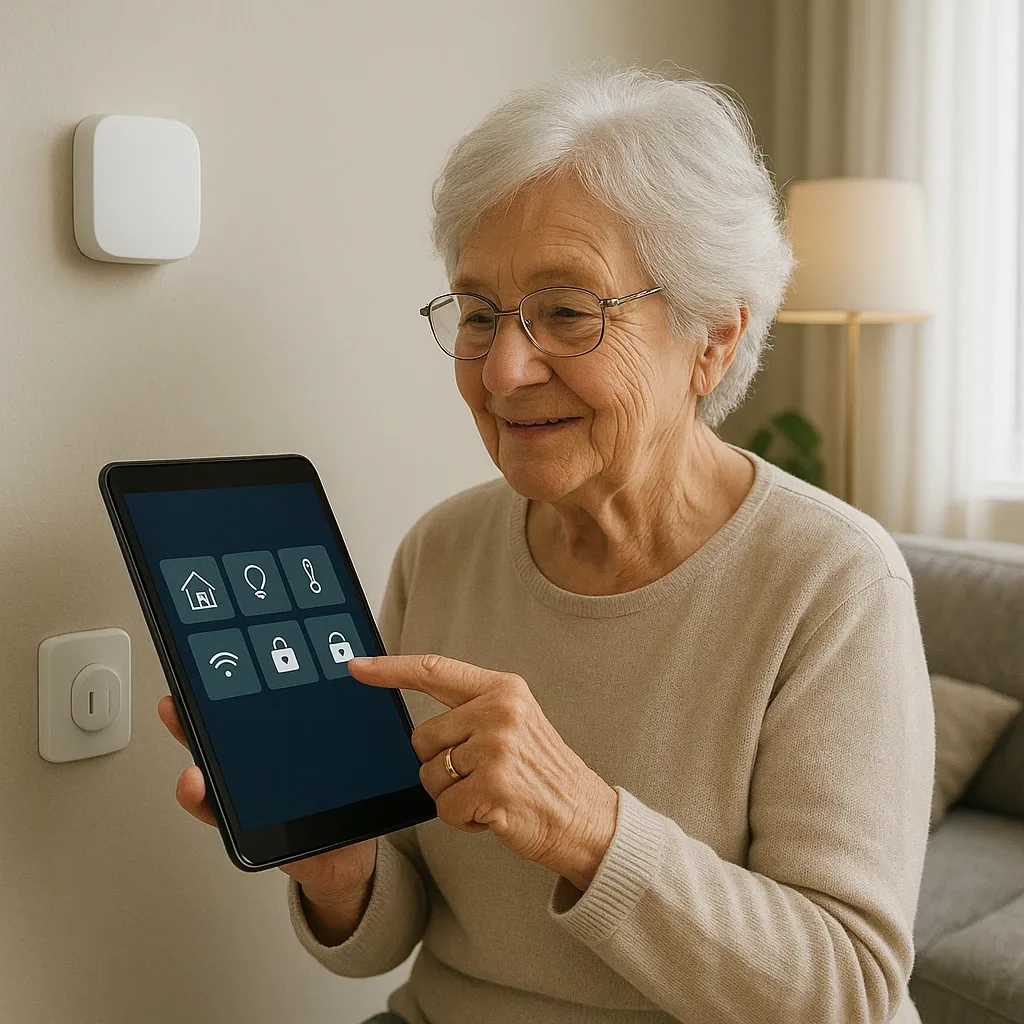
Thailand’s Aging Society: Why Modern Homes Must Evolve
Thailand’s Department of Provincial Administration projects that over 20% of the national population will be aged 60 or above by 2031 — meaning 1 in 5 Thais will be seniors. The WHO identifies falls at home as the leading cause of injury-related mortality in older adults, with a 30% hospitalization rate after a single fall. These statistics make "elderly-ready homes" not a luxury but a necessity for Thai families today.
HappySmart addresses this with a two-dimensional approach: SmartInterior, which applies Universal Design principles to the physical environment, and SmartHome, which layers intelligent technology across all devices. The result is a home that actively cares for its elderly residents around the clock without requiring a full-time caregiver.
SmartInterior: Universal Design Principles Applied
Universal Design means spaces usable by everyone — children, adults, seniors, and people with disabilities. For elderly-focused homes, five domains matter most:
Flooring and Pathways Select materials with a Coefficient of Friction (COF) of at least 0.6, such as matte ceramic tiles or LVT vinyl planks. Remove all door thresholds and ensure corridors are at least 90 cm wide to accommodate wheelchairs and walkers.
Lighting Seniors require up to three times more light than younger adults due to age-related vision decline. Install LED fixtures delivering 300–500 lux in living areas and 100–150 lux in night-time corridors, triggered automatically by motion sensors.
Bathroom Safety Stainless-steel Grade 304 grab bars at 75–85 cm height, wet-rated anti-slip flooring with COF ≥ 0.8, and thermostatic water heaters capped at 38–42°C prevent scalding incidents.
Furniture Dimensions Beds at 50–55 cm from floor and chairs at 44–48 cm with armrests allow elderly users to rise without excessive muscle effort — critical for those with arthritis or reduced lower-body strength.
Kitchen Layout Counters at 85 cm with knee clearance below, shallow 50 cm-depth lower cabinets, and induction cooktops replacing gas burners reduce both reach injuries and fire risk.
SmartHome: Technology That Becomes a Caregiver
HappySmart deploys Home Assistant as the central platform, connecting devices via Zigbee and Wi-Fi. Key devices for elderly safety include:
Aqara FP2 mmWave Radar (3,500–5,000 THB) detects falls and abnormal stillness without cameras — ideal for bedrooms and bathrooms where privacy matters.
Smart Locks (Yale/Schlage) (4,000–8,000 THB) support PIN, NFC, and mobile app access, eliminating physical keys and allowing remote unlock by family members.
Sonoff ZBMINIL2 (350–500 THB per switch) converts standard light switches to smart automation without rewiring.
Xiaomi Temperature & Humidity Sensor (300–500 THB) monitors ambient conditions and alerts when the environment is unsuitable for elderly residents with respiratory conditions.
A night-path lighting YAML automation activates hallway and bathroom LEDs at 40% warm-white brightness whenever the mmWave sensor detects movement between 21:00 and 06:00, then auto-turns off after three minutes — providing safe navigation without disturbing sleep.
ROI: A Worthwhile Investment
A starter smart-elderly package (two mmWave zones, smart lighting, smart lock) costs approximately 25,000–45,000 THB. Compared with the 200,000–500,000 THB cost of hip fracture surgery following a preventable fall, the investment pays for itself rapidly. Additional ROI comes from 15–25% electricity savings through automated lighting and reduced reliance on daily paid caregivers through real-time remote monitoring.
HappySmart delivers end-to-end service: site survey, SmartInterior design, SmartHome installation, and after-sale support — all in Thai, making the transition to an intelligent elderly-ready home accessible to every family.