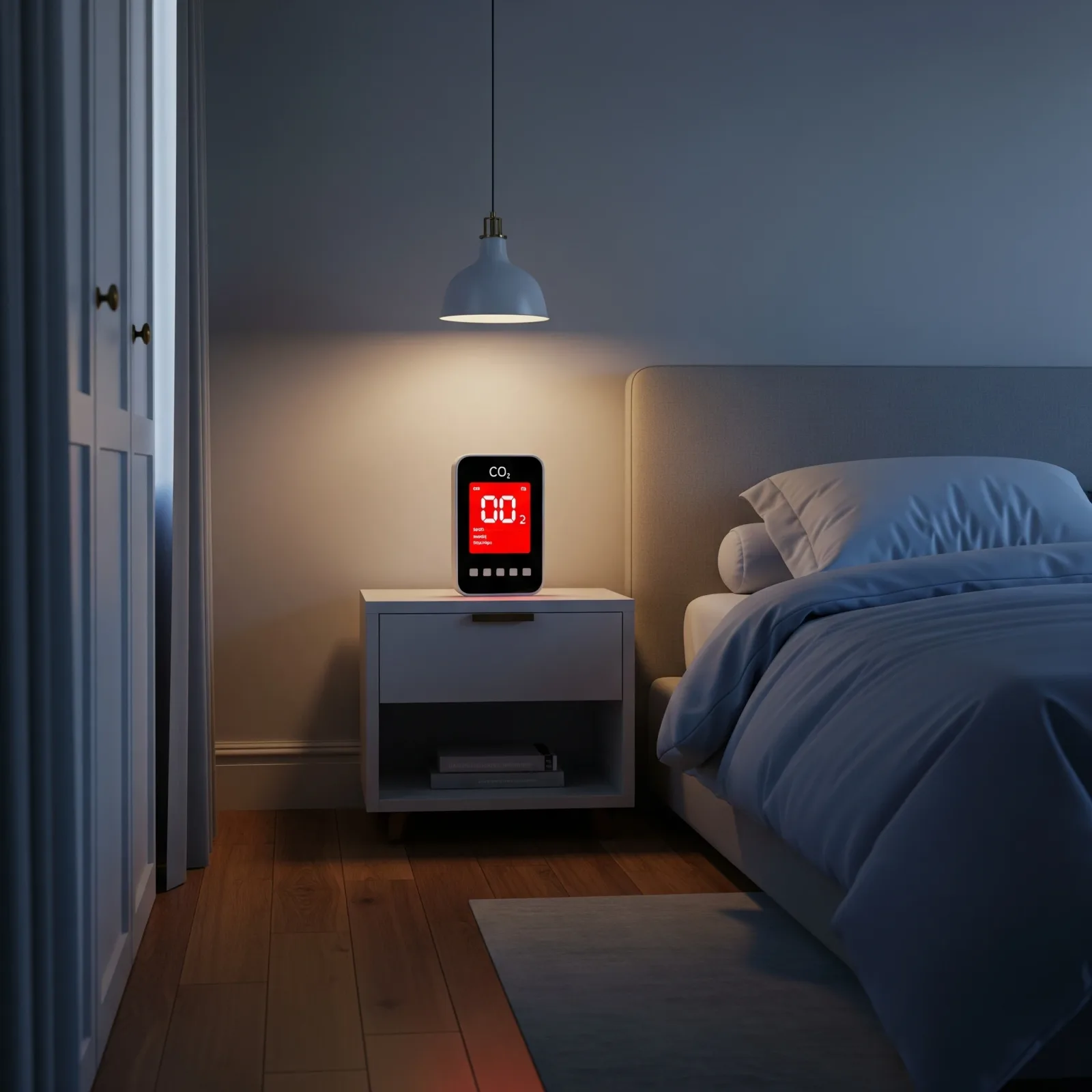
The Invisible CO2 Threat in Bangkok Bedrooms
Every exhale adds CO2 to the air. In a sealed Bangkok condo with no ventilation, levels can climb from a safe 400 ppm at bedtime to over 1,500 ppm by 3 AM. You wake up with a headache, feeling unrested despite a full eight hours of sleep — and CO2 is often the culprit no one measures.
CO2 Thresholds and the Health Risks They Carry
CO2 concentration is measured in parts per million (ppm). The key reference points for a bedroom are: 400–600 ppm (fresh, ideal for sleep), 600–1,000 ppm (slightly stuffy, mild cognitive slowdown), 1,000–2,000 ppm (disrupted sleep, morning headaches, fatigue), 2,000–5,000 ppm (marked drowsiness, significantly impaired decision-making), and above 5,000 ppm (dangerous to the nervous system and airways). Research from the Harvard T.H. Chan School of Public Health found that CO2 at just 1,000 ppm reduces strategic thinking performance by up to 15% — directly impacting the next day's productivity.
Detecting CO2 with NDIR Sensor Technology
High-quality CO2 sensors use Non-Dispersive Infrared (NDIR) technology: an infrared beam passes through the air sample and the sensor measures how much CO2 molecules absorb. This method is far more accurate and stable than electrochemical sensors. Recommended models for 2026 include the Aranet4 Home (approx. 4,500–5,500 THB), which connects via Bluetooth and displays CO2, temperature, and humidity on an E-Ink screen; the Aqara TVOC Air Quality Monitor (approx. 2,500 THB) connecting via Zigbee, ideal for Home Assistant users; and the Netatmo Smart Indoor Air Quality Monitor (approx. 3,800 THB), measuring CO2, temperature, humidity, and noise. Place sensors near the headboard at 1–1.5 metres height, away from AC vents or open windows to avoid skewed readings.
Smart CO2 Reduction with Home Assistant
The most immediately effective remedy is ventilation — opening a window for 15–30 minutes before bed can dramatically lower CO2. In Bangkok, where heat and PM2.5 dust complicate open windows, automating an exhaust fan via Home Assistant is smarter. Practical automation examples: when CO2 exceeds 1,000 ppm, activate an exhaust fan connected via Smart Plug; when CO2 exceeds 1,500 ppm, send a Telegram alert and trigger a smart window motor if installed; when CO2 drops below 800 ppm, shut the fan off to save energy. Plants such as snake plants, pothos, and aloe vera provide minor supplementary absorption but cannot replace a proper ventilation system.