Why Indoor Dust Is a Health Problem That Demands Serious Management
Fine dust, particularly PM2.5, is a significant health concern for families in Bangkok. Particles smaller than 2.5 microns can penetrate deep into the respiratory system and lungs, causing long-term effects for those with allergies, asthma, or chronic respiratory conditions.
Fortunately, modern technology makes home dust management genuinely achievable without constant manual cleaning. Dust-blocking curtains, air purifiers, robot vacuums, and Smart Home systems work together as an automated network that monitors and maintains indoor air quality around the clock.
Dust-Blocking Curtains and Air Filtration: The First Line of Defense
Effective dust-blocking curtains need three qualities: dust-resistant material with anti-dust coating or fine-weave fibers, sufficient density to block particles entering through windows and doors, and smart motor capability to open and close automatically via Home Assistant or Google Home when outdoor air quality deteriorates.
HEPA filter air purifiers capture 99.97 percent of particles as small as 0.3 microns, covering PM2.5, pollen, pet dander, and mold spores. Models with built-in air quality sensors automatically adjust filtration intensity based on real-time dust levels and connect to Smart Home platforms for remote app control from anywhere.
AI Robot Vacuums: Daily Automatic Floor Cleaning
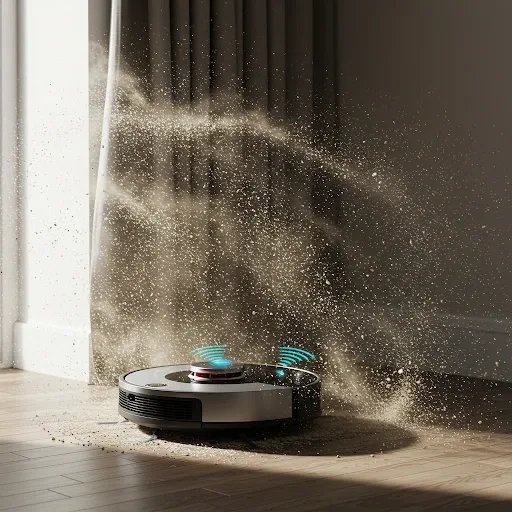
Smart robot vacuums address dust accumulation on floors and carpets, which are a primary source of PM2.5 in the home. Lidar or camera-based mapping navigation plans systematic cleaning routes without repetition. Scheduling and control work via app or voice commands through Alexa or Google Assistant, and smart dust sensors increase suction automatically when a dirtier area is detected.
Recommended robot vacuums for 2025 include the Roborock S8 Pro Ultra, iRobot Roomba i7+, and Ecovacs Deebot X1 Omni. All support Smart Home platform integration and include Auto-Empty Stations that eliminate frequent manual bin emptying.
Configuring Your Smart Home for Automatic Dust Control
Connecting all devices through Home Assistant or Google Home unlocks genuine automated dust management. Four powerful automation examples:
When the air quality sensor detects PM2.5 above the set threshold, the air purifier activates automatically and the smart curtain closes to block outside dust. The robot vacuum is scheduled to run during daytime hours when no one is home. Smart curtains open during peak sunlight hours to allow natural UV sterilization of indoor spaces. And the homeowner receives an app notification when air quality drops below the defined safety standard. The combined result is consistently clean floors, purified indoor air, and energy savings since devices only run when genuinely needed.