PM2.5 and IoT: Technology That Actually Solves Home Dust Problems
PM2.5 dust is a major health challenge for urban residents worldwide, including those in Bangkok where dust levels spike from late in the year through early spring. Internet of Things technology plays a central role in detecting, analyzing, and managing indoor dust intelligently and automatically.
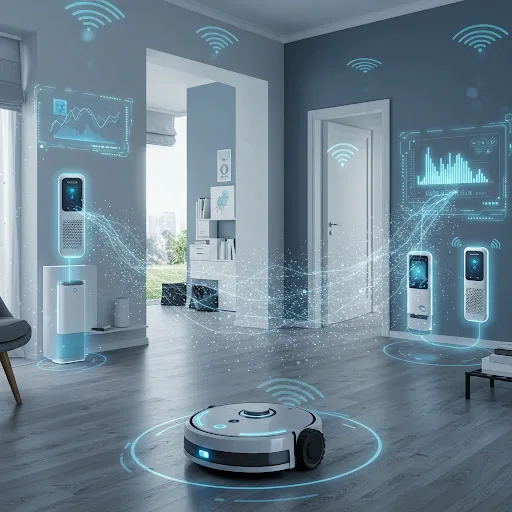
The key difference between traditional dust management and IoT is that connected devices respond to real conditions in real time instead of waiting for human commands each time. When a sensor detects rising dust, the air purifier activates immediately. When the floor accumulates dust, the robot vacuum runs on its preset schedule. All of this happens without manual intervention.
Key IoT Devices for Detecting and Reducing Home Dust
The Air Quality Sensor is the heart of the system. It measures PM2.5 and airborne pollutants in real time and sends data to the Smart Home system to automatically command other devices. Recommended models include the Xiaomi Mi Air Quality Monitor, Awair Element, and Honeywell Air Quality Sensor, all of which connect directly to Home Assistant or HomeBridge.
Smart air purifiers link to Google Assistant, Alexa, or Home Assistant, automatically detecting dust levels and adjusting filtration intensity accordingly. Remote control via app and flexible scheduling are standard features.
Smart robot vacuums such as the Roborock S8 Pro Ultra reduce PM2.5 that accumulates on floors and carpets, which are a primary dust reservoir in the home. They run on programmable schedules or on-demand via app.
Configuration via Home Assistant and HomeBridge
Home Assistant connects all IoT devices into one unified platform, supporting brands including Xiaomi, Philips, Dyson, and Honeywell. Powerful automation examples include: auto-starting the air purifier when the sensor detects PM2.5 above the set threshold, scheduling the robot vacuum during hours when the home is unoccupied, and triggering an alert notification when air quality deteriorates.
For Apple users, HomeBridge connects a Xiaomi air purifier or other non-HomeKit devices to the Home app on iPhone and Siri control. Apple Watch notifications can be configured to alert when indoor PM2.5 exceeds the safety standard.
The Benefits of an IoT Dust Management System
Five measurable benefits: reduced respiratory disease risk through real-time air quality control; remote air quality monitoring and adjustment via smartphone from anywhere; energy savings because automation only activates devices when genuinely needed; increased convenience through Smart Home platforms such as Google Assistant or Apple HomeKit; and lifestyle customization such as silent air purifier mode at night, robot vacuum running during daytime, and lights dimming at sleep time.