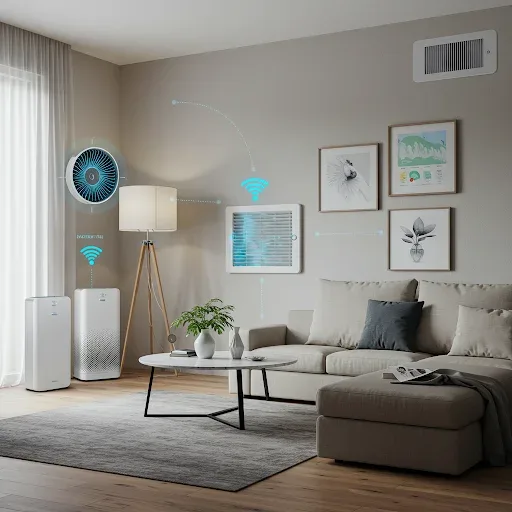
Why IoT Is Transforming Home Air Quality Management
With Bangkok experiencing over 150 days per year where PM2.5 exceeds WHO standards, waiting until you can see or smell the problem is no longer sufficient. HappySmart's Smart Home IoT system was designed specifically for this challenge, collecting data from multiple sensor types and processing it in real-time to automatically control devices before you notice any issues.
Four Categories of IoT Devices for Complete Coverage
HappySmart supports four main device groups: air quality sensors (PM2.5, VOC, CO2, humidity, temperature), smart air purifiers with five-speed fan control, Smart AC units connected via IR Blaster or direct Wi-Fi, and ERV/HRV ventilation systems that exchange heat before bringing outdoor air inside.
Each sensor transmits data every 30-60 seconds via MQTT Protocol to Home Assistant, creating a comprehensive dataset for trend analysis and automated decision-making.
AI That Learns Your Living Patterns
HappySmart's standout feature is an AI system that analyzes 30 days of usage data to establish your personal air quality baseline for different time periods. During morning cooking hours (6-8 AM), VOC levels typically spike, so the system pre-emptively increases purifier speed five minutes before values reach alert thresholds.
This learning extends to commute patterns as well. When your smartphone GPS detects you're heading home, the system activates 20 minutes in advance so air quality is optimal the moment you open the door.
Three Ways to Connect with Home Assistant
Users can connect HappySmart devices to Home Assistant through three methods depending on technical comfort level. Direct Wi-Fi Integration works for devices supporting HASS Discovery and takes just two minutes. MQTT Bridge suits sensors sending JSON payloads, requiring Mosquitto Broker and Node-RED for data transformation. HomeBridge is ideal for Apple HomeKit users who want Siri and Apple Home App integration.
Measurable Benefits from IoT Automation
Data from 200 HappySmart households in Bangkok showed that IoT automation reduces the time PM2.5 exceeds 15 μg/m³ by 68% compared to manual purifier operation. Energy savings reach 25-30% because devices run only when needed, and filter replacements decrease by one per year since the system avoids running at maximum speed continuously.
Historical data also empowers users to identify exactly which days, times, and activities cause PM2.5 spikes, enabling meaningful lifestyle adjustments.
Starting Your HappySmart IoT Journey
You don't need to buy everything at once. Start with an Air Sensor to collect two to four weeks of baseline data, then add a Smart Purifier with basic automations. Expand to Smart AC and Ventilation once you're comfortable with the system. HappySmart's support team provides both on-site and remote setup assistance for every customer.