Why SmartInterior Must Be Designed Room by Room, Not House-Wide
A common mistake in elderly smart home design is applying a uniform system throughout the house. In reality, each room carries entirely different risks and requirements. The bathroom accounts for 48% of all in-home accidents among the elderly according to Thailand’s Ministry of Public Health data, while the bedroom harbors hidden health risks — sleep apnea and poor air quality — that are routinely overlooked. Good SmartInterior design therefore starts with a room-by-room risk analysis before any device selection takes place.
Bathroom: The Highest-Risk Zone
In the bathroom, surface materials are the first intervention. SPC (Stone Plastic Composite) flooring 5–6 mm thick with a Coefficient of Friction (COF) ≥ 0.6 per ADA standards costs 350–550 baht per square meter, absorbs zero water, and resists mold growth. Technology requirements include a humidity sensor triggering alerts above 70% RH — a sign of insufficient ventilation — a shower temperature monitor preventing water above 42°C, which can cause fainting in elderly users, and an IP67 waterproof panic button mounted within arm’s reach from the floor. Stainless 304 grab bars 32–38 mm in diameter should be installed beside the toilet and inside the shower enclosure.
Living Room: The Daily Hub That Must Think
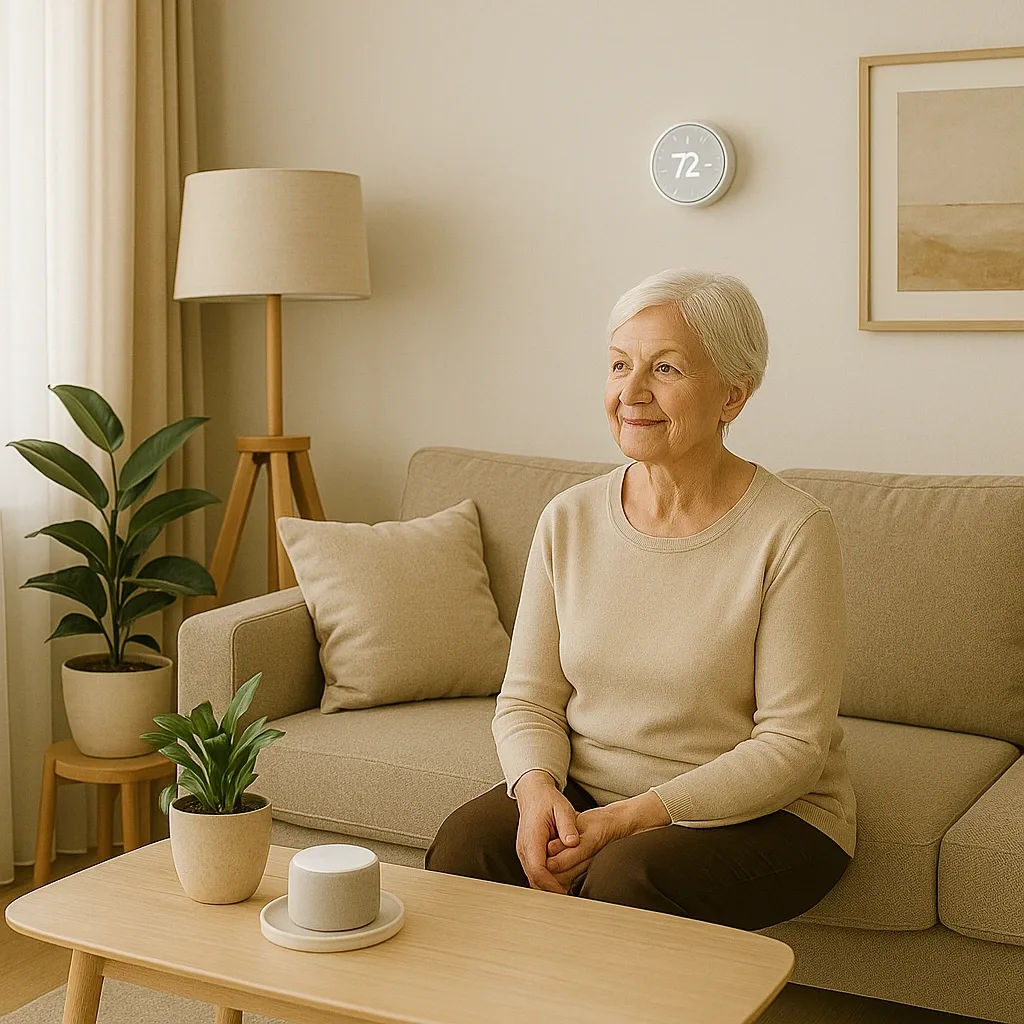
The living room is where elderly residents spend the most time. Good SmartInterior design here covers three domains. First, presence detection: use 60 GHz mmWave sensors rather than traditional PIR, because mmWave detects a seated or sleeping person — standard PIR loses signal after approximately 2 minutes without movement. Second, circadian lighting: LED fixtures that shift from Warm White (2,700K) in mornings and evenings to Cool White (5,000–6,500K) during daytime maintain the elderly resident’s circadian rhythm, which is often disrupted by reduced natural light exposure. Third, Universal Design furniture: seating height 45–50 cm, rounded table edges, and corridors at least 90 cm wide for walker users.
Bedroom: Protecting Health During Sleep
The bedroom requires technology that operates silently without disrupting rest. Three priorities stand out: an adjustable electric bed with seated height 45–50 cm and a large remote with no more than four buttons (15,000–45,000 baht); an NDIR CO₂ sensor — ten times more accurate than cheap electrochemical variants — set to alert at 800 ppm and automatically activate ventilation above 1,000 ppm; and an under-bed sensor that tracks sleep cycles, breathing rate, and detects when the resident leaves bed at night without returning within 15 minutes, which may signal a bathroom fall.
Kitchen: Safety from Fire and Gas
The kitchen requires LPG/NG gas sensors and smoke detectors integrated with Home Assistant to automatically close the gas valve upon detection. Motion-activated LED under-cabinet lighting improves work surface visibility without requiring overhead lights, and induction cooktops controllable via app are substantially safer than gas ranges for elderly users who may forget an active burner.
Conclusion: The Recommended SmartInterior Investment Sequence
For budget-constrained families, invest room by room: bathroom first (SPC flooring + panic button + grab bars: 25,000–40,000 baht), then bedroom (CO₂ sensor + under-bed sensor: 8,000–15,000 baht), then living room (mmWave + circadian lighting: 12,000–25,000 baht). Phased investment keeps budgets manageable and delivers visible safety improvements faster than waiting to renovate the whole house at once.