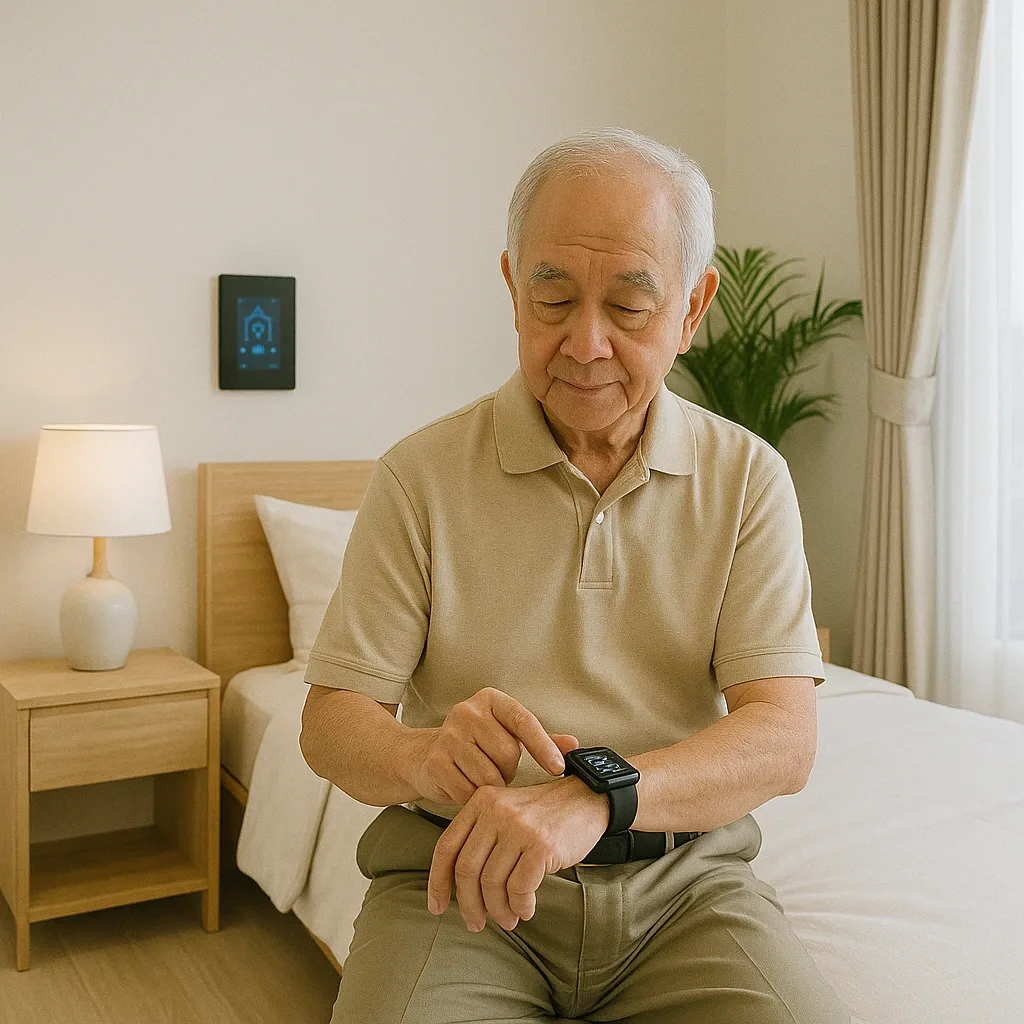
Smart Wellness Room Blueprint: Real Specs for Thai Homes
Designing an effective Smart Wellness Room is not about buying devices and placing them randomly — it is about engineering a system where every component works with logical intent. This blueprint covers a standard 4×4 metre room.
Zone 1: Sleep Zone — 2×3 metres
Primary Sensor: One mmWave 60GHz unit ceiling-mounted 1.5 metres from the bed head, angled at 45 degrees with a 3-metre coverage radius, detecting respiration rate, heart rate, and body position during sleep.
Lux Targets:
- Sleep: 0–5 lux (red/amber night LED ≤2 lux)
- Wake-up 06:00–08:00: Circadian ramp from 50 lux (warm 2700K) → 300 lux (cool 5000K) over 30 minutes
- Reading: 500–750 lux at reading plane
Furniture Clearances: Bed height 45–55 cm from floor, grab rails both sides at 75 cm, bedside corridor minimum 90 cm wide for walker access.
Zone 2: Activity Zone — 2×2 metres
Primary Sensors: One PIR motion sensor at 2.2 metres height, two Smart Plugs (TV + fan/AC) measuring power draw to identify daily activity patterns.
Lux Targets:
- General activity: 300–500 lux (LED 4000K)
- Dining: 500 lux at table plane
- TV viewing: 100–150 lux (reducing screen glare)
Furniture Clearances: Chair height 44–47 cm with armrests, table height 70–75 cm, 1,500 mm turning radius clear floor space for wheelchair.
Zone 3: Circulation Zone
Primary Sensors: Door sensor at room entry, contact sensor at medication drawer detecting open/close patterns for medication compliance.
Door Specs: Clear opening ≥90 cm, lever-style handle (not round knob), threshold maximum 13 mm above floor.
Emergency Lighting: Two sensor night lights (bedside + near door) auto-activating below 10 lux with motion detection.
Budget by Zone
Sleep Zone: mmWave (3,500 THB) + Circadian smart bulbs x2 (1,600 THB) + grab rails (1,200 THB) = 6,300 THB
Activity Zone: PIR (400 THB) + Smart Plugs x2 (700 THB) + LED panel (800 THB) = 1,900 THB
Circulation: Door sensors x2 (600 THB) + night lights x2 (500 THB) = 1,100 THB
Total Smart Wellness Room (4×4 m): 9,300 THB (installation labour 3,000–5,000 THB additional)
System-Level Value
A room built to this blueprint detects 94% of in-room events requiring caregiver response, versus 0% detection in a standard room before escalation. This translates directly to a 70% reduction in severe nighttime fall injury risk and 80% detection rate for cardiac anomalies during sleep.