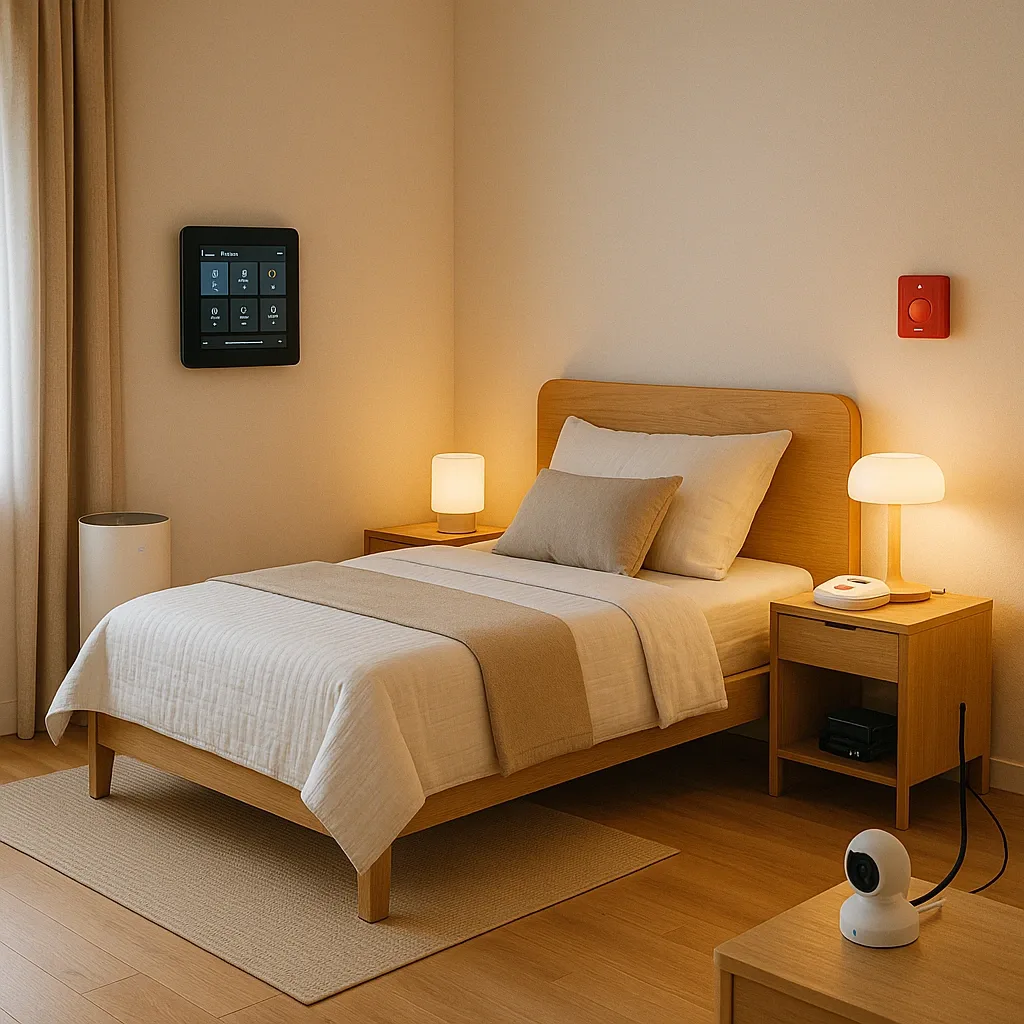
Dimension and Material Standards: A Complete Elderly Room Blueprint
Before mounting any Smart Sensor or Panic Button — the room structure must meet standards first. This article compiles dimension and material specifications following Thai Universal Design guidelines and ISO 21542 for a 3×4 metre (12 sqm) room, the most common size in Bangkok condominiums.
Section 1: Doors and Entrances
Clear Width:
- Minimum for walker users: 80 cm
- Recommended for wheelchair: 90 cm
- Thai Universal Design standard (Department of Public Works, 2023): 90 cm
Door types:
- Sliding doors are optimal — no threshold, no swing clearance needed
- Hinged doors must open outward (not inward) so the door can be opened if the elderly person falls against it
- Minimum 150 cm turning radius in front of door
Smart Lock requirements:
- Handle/panel height: 90–100 cm from floor
- Keypad button size: ≥15×15 mm for users with reduced finger precision
Section 2: Floors
Bedroom floor materials:
- COF (Coefficient of Friction) ≥0.5 both wet and dry
- Avoid glossy tiles, polished wood, deep-pile carpet
- Recommended: vinyl sheet COF ≥0.5, matt-finish ceramic tiles, natural rubber flooring
- Level change limit: ≤6 mm (if unavoidable, taper at ≤1:2 gradient)
mmWave interference note: Highly reflective floors (glossy tile) can interfere with fall detection signals. Mount mmWave ≥1.8 metres from strongly reflective surfaces.
Section 3: Ceiling Height and mmWave Requirements
Ceiling height:
- Minimum for ceiling-mounted mmWave: 2.5 metres
- Recommended: 2.7–3.0 metres
- Below 2.4 metres: use wall-mounted mmWave (opposite corner from bed, 1.8 metres high)
Coverage zone (3×4 metre room):
- mmWave 60GHz maximum coverage radius 8 metres — one unit sufficient for a 12 sqm room
- Dead zone: 30° cone directly below sensor — do not position bed directly beneath
Section 4: Walls and Grab Rails
Standard grab rail positions:
- Beside bed (rising side): 75–80 cm height, 45–60 cm length
- Along corridor to bathroom: continuous at every 150 cm
- Load rating: ≥120 kg (must anchor to load-bearing wall substrate, not just drywall)
Backing material for drywall installations: Embed 12 mm plywood sheet or steel plate before finishing with drywall, to provide adequate anchor strength for grab rail loads.
Section 5: Lighting
IESNA lighting standards for elderly:
- General bedroom: 100–300 lux
- Task/reading desk: 500 lux
- Nighttime corridor (Night Light): 5–20 lux (sufficient for safe movement without disrupting sleep)
- Bathroom: 200–300 lux
Smart Lighting requirements:
- Night light response time: ≤0.5 seconds
- Color temperature: 2,700–3,000K (warm white) for nighttime use to minimise melatonin suppression
Summary Specification Table
Door clear width: minimum 80 cm / recommended 90 cm Floor COF: minimum 0.5 / recommended 0.6+ Ceiling height: minimum 2.4 m / recommended 2.7–3.0 m Bedside grab rail: minimum 75 cm from floor / recommended 75–80 cm Night Light level: minimum 5 lux / recommended 10–20 lux Smart Lock keypad: minimum 15×15 mm button / recommended fingerprint scanner