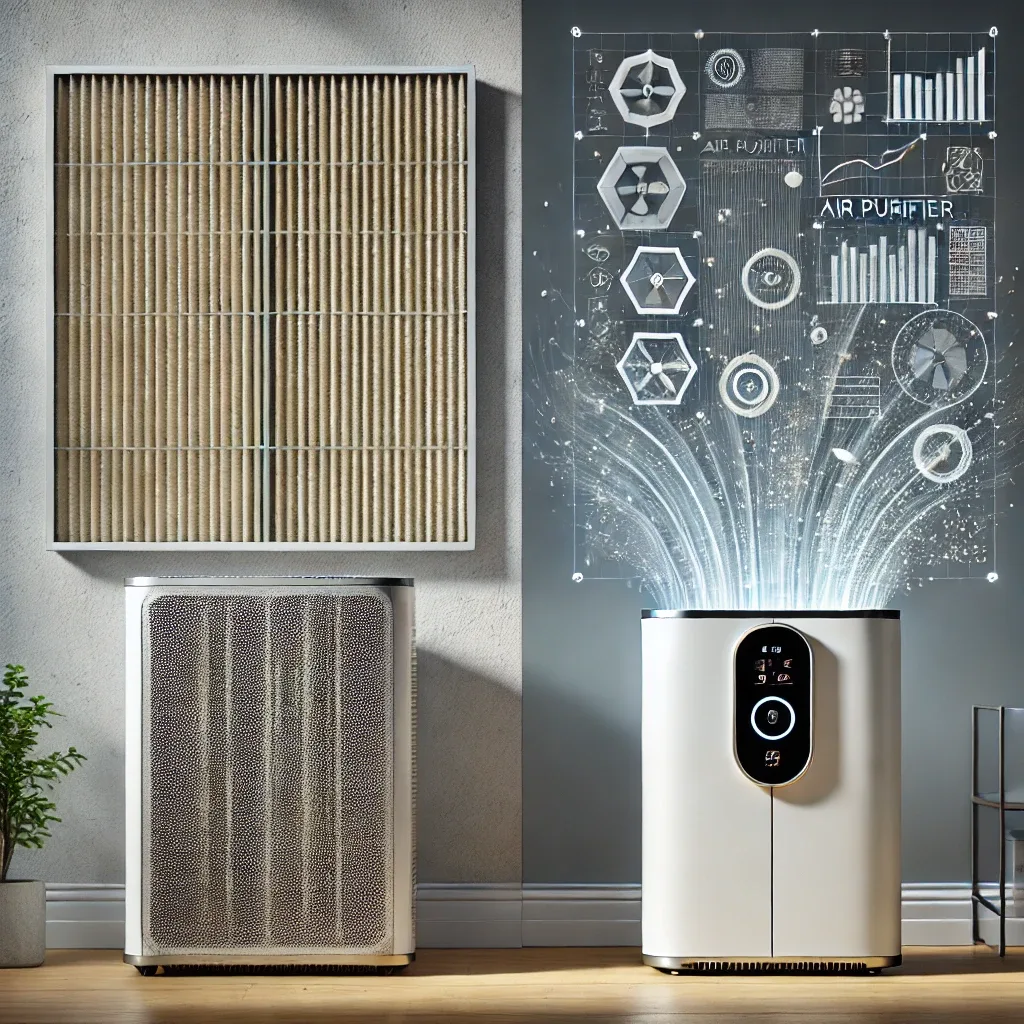
Why Your Choice of Air Purifier Matters
PM2.5 has become a public health challenge that every household must address, whether in large cities or industrial areas. Clean indoor air is no longer a luxury. Both types of air purifiers share the same goal, but their operation and capabilities differ in ways that significantly affect health outcomes and long-term value.
Traditional Air Purifiers: Strengths and Limitations
Conventional air purifiers use HEPA, Carbon, UV, or Ionizer filtration to remove dust and pollutants. Key advantages include broad price range, easy installation, room portability, and independence from internet connectivity or software — they function reliably even with unstable power.
Limitations are equally significant: only a few fixed fan speeds, no real-time response to changing dust levels, manual operation only, no automatic filter replacement reminders, and often noisy at high speeds when PM2.5 spikes.
Smart Air Filtration Systems: Features and Capabilities
Smart Air Filtration systems include real-time air quality sensors, automatic fan speed adjustment based on PM2.5 readings, Wi-Fi connectivity, app control, and voice command support through Google Home, Amazon Alexa, and Apple Siri. Automatic alerts notify users when filters are approaching end of life.
Models supporting Home Assistant or the Matter standard enable sophisticated automation: when PM2.5 > 35, automatically switch to High mode; when PM2.5 < 12, reduce to Sleep Mode. Some models incorporate AI that learns usage behavior to proactively adjust settings before dust levels rise.
Comparing How Each System Works
Traditional units pull air through filters at a fixed speed setting, with performance determined by filter quality and machine size. Smart systems pull air while simultaneously analyzing PM2.5, CO2, and other pollutant readings from sensors, then adjust fan speed to return air quality to safe levels as quickly as possible.
The critical difference: traditional units have no awareness of current air conditions; smart systems know and respond immediately. This translates to cleaner air delivered faster and lower overall energy consumption over time.
Home Assistant and IoT Integration
Smart air filtration systems that support Home Assistant enable automation scenarios impossible with traditional units: linking outdoor PM2.5 sensors (PurpleAir or Aqara) with indoor purifiers, automatically closing windows when outdoor dust rises, simultaneously activating Positive Pressure ventilation, and triggering robot vacuum cleaning when indoor PM2.5 exceeds the threshold.
Google Home and Amazon Alexa enable hands-free voice control. Apple HomeKit and Matter allow integration with iPhone and iPad, including local control that functions without internet connectivity during outages.
Selection Guide by Home Type and Budget
Choose a traditional air purifier if: your budget is limited, you prefer simplicity, you have no Smart Home plans, you live in a small space, or you need to move the unit between rooms frequently.
Choose a smart air filtration system if: you want maximum performance, you have or plan to install a Smart Home, you have high-risk household members such as children, elderly, or allergy sufferers, or you want long-term energy savings.
HappySmart evaluates your needs, recommends the right equipment, and designs complete Smart Air Filtration systems integrated with Home Assistant for a home that maintains clean air automatically, around the clock.