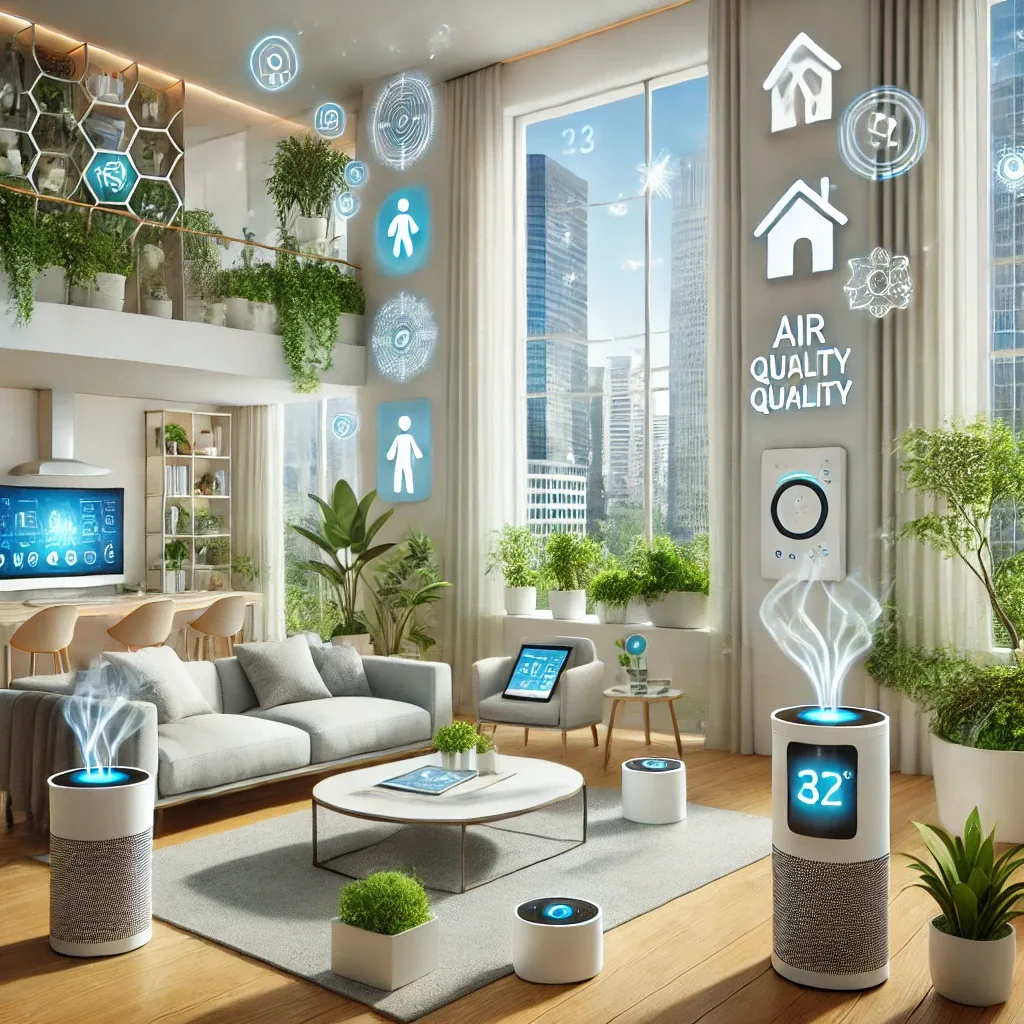
How Smart Home Improves Indoor Air Quality
Indoor air quality in Bangkok homes is often worse than it appears. PM2.5 during the dry season can exceed 100 µg/m³, CO2 in bedrooms after a night of sleep typically exceeds 1,200 ppm, and VOC from new furniture or paint accumulates in sealed air-conditioned spaces throughout the day. These conditions cause headaches, disrupted sleep, worsening allergies, and reduced cognitive performance.
Smart Home addresses these problems by integrating sensors, air quality improvement devices, and automation together, enabling the home to respond automatically rather than waiting for occupants to notice and manually correct problems.
Essential Air Quality Sensors
Sensors are the foundation of any Smart Home air quality system. Key types include CO2 sensors such as the Sensirion SCD40 providing NDIR real-time measurement at 800-1,200 THB, PM2.5 sensors such as the IKEA VINDSTYRKA at 1,500-2,000 THB using Zigbee, TVOC sensors such as the Aqara TVOC Air Quality Monitor at 1,500-2,500 THB, and comprehensive air quality stations such as the Awair Element at 5,000-7,000 THB measuring all five parameters in a single device.
Installing sensors in at least the bedroom and living area provides the baseline data needed for effective automation. The first two weeks of baseline data typically reveals exactly which pollutant is the primary problem in your specific home.
Air Improvement Devices Controlled by Smart Home
Smart air purifiers like Xiaomi 4 Pro connected via Zigbee2MQTT or Dyson through Dyson Local Integration auto-adjust speed based on sensor readings. Smart thermostats like Ecobee or Nest adjust temperature and air circulation through HVAC. ERV systems from Panasonic or Mitsubishi Lossnay connected to HA ventilate when CO2 is elevated. Additional CO sensors near kitchen stoves provide a complementary safety layer.
All devices function as a coordinated network rather than isolated appliances, with Home Assistant orchestrating their collective behavior based on real-time sensor data.
Smart HVAC and Humidity Control
Smart HVAC systems supporting Modbus or BACnet protocols can connect to Home Assistant to automatically adjust temperature and air circulation rates. When CO2 rises, HVAC increases fresh air exchange rate. When humidity drops below 40% RH, a connected humidifier activates to maintain the healthy 40-60% RH range.
Visualizin all parameters together on a Grafana Dashboard reveals relationships between different air quality metrics, enabling optimization of automation schedules to match your household's specific patterns.
AI and Machine Learning Capabilities
Home Assistant supports machine learning through AppDaemon and Python scripts that learn occupant behavior patterns and air quality trends. An intelligent system can predict when air quality will begin degrading and pre-activate ventilation or purification before reaching threshold levels, maintaining consistently better air quality rather than reacting after conditions have already declined.