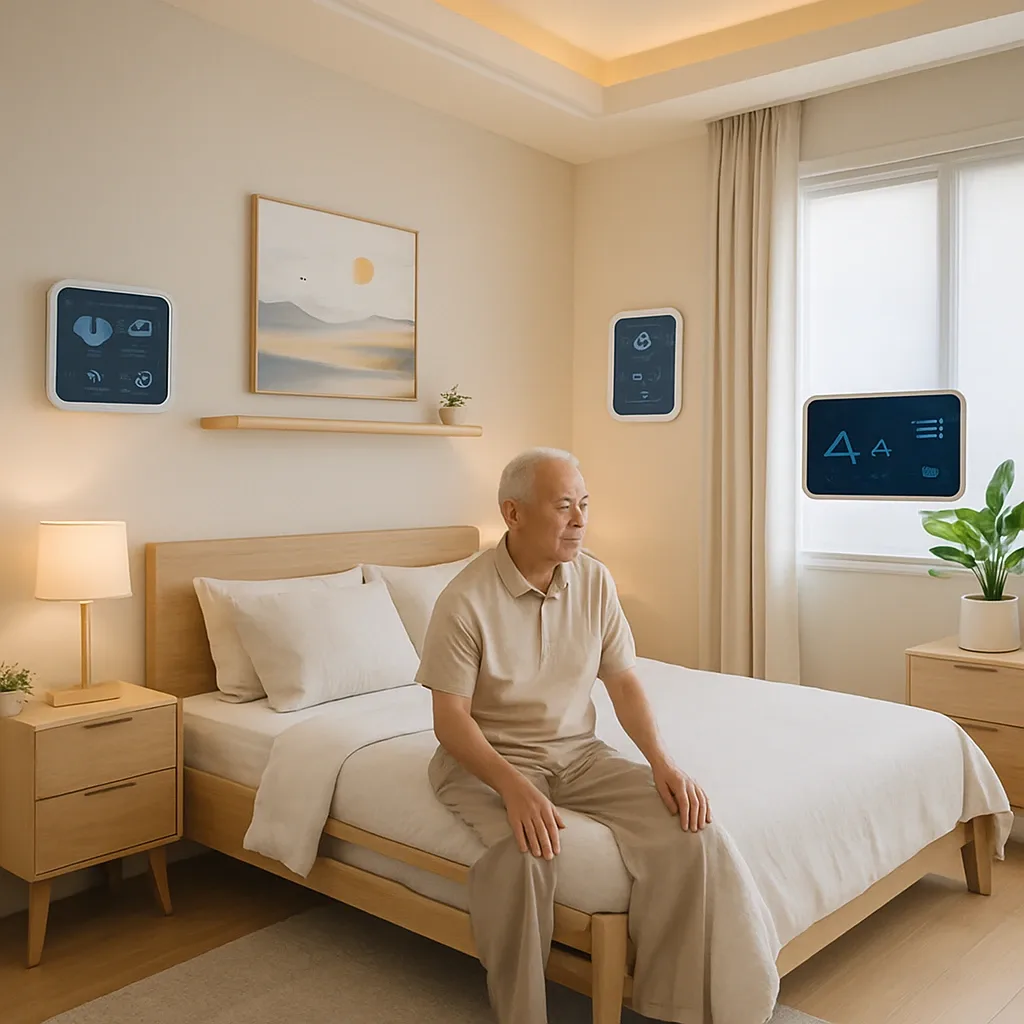
The True Definition of a Smart Wellness Room
The term Smart Wellness Room is used broadly in Senior Living and real estate, but the definition often remains vague. Some apply it to rooms with adjustable beds; others to rooms with CCTV. A comprehensive and actionable definition requires 5 foundational elements:
(1) Universal Design Foundation — physical structure that accommodates age-related decline (2) Ambient Intelligence — sensors that perceive environment and body without requiring any action from the elderly resident (3) Responsive Automation — automatic responses that adapt to real-time conditions (4) Health Data Continuity — longitudinal health records with lasting medical value (5) Human-Centered Privacy — technology that protects privacy and dignity
Element 1: Universal Design Foundation
The room must accommodate a 1,500mm Wheelchair Turning Radius even if the resident does not yet use a wheelchair — designing for this now eliminates future demolition costs. Floors must have a COF ≥ 0.6 (non-slip). Recommended materials: matte-finish tiles or SPC Flooring with 0% water absorption, suited to Bangkok’s 73–80% ambient humidity.
Door width must be at least 900mm (from Thailand’s standard 700–750mm), with wall grab rails, automatic emergency lighting during power outages, and contrasting colors between walls, floors, and doors to assist visually impaired residents.
Element 2: Ambient Intelligence
Good sensors work without the elderly resident wearing any device or pressing any button. A mmWave 60GHz Sensor detects breathing, movement, and falls even when completely still or in darkness. An SHT31 Sensor continuously monitors temperature and humidity. An NDIR CO₂ Sensor alerts when air quality deteriorates. A LUX Meter measures brightness to enable automatic Circadian Lighting adjustment.
All of this operates silently in the background — the resident is unaware of it, but the system perceives every change in the room.
Element 3: Responsive Automation
The system must respond without waiting for a human command. A good example: when the elderly resident wakes at night (detected by mmWave), Smart Night Lights automatically activate at 2700K, 30 Lux along the bathroom pathway — bright enough to navigate safely without disturbing sleep quality or causing eye strain. If the resident enters the bathroom and does not exit within 20 minutes, the system alerts family members.
The system should not use rigid fixed rules but learn patterns — if a resident typically spends 8 minutes in the bathroom, the alert threshold should be 20–25 minutes, not a fixed 10 minutes.
Element 4: Health Data Continuity
A well-designed room logs Longitudinal Data of medical value: body temperature (via Smart Thermometer), blood pressure, weight, sleep duration, and Sleep Breathing Patterns (detectable via mmWave). Accumulated over 30–90 days, this data reveals trends invisible in annual health checkups — such as gradual blood pressure increase over 3 months, or declining sleep quality since a new medication was introduced.
Element 5: Human-Centered Privacy
Good technology must not make elderly residents feel surveilled. mmWave produces no video footage. Every sensor should process data locally on Home Assistant without transmitting to foreign cloud servers. Elderly residents must have the right to mute or limit data sharing with specific family members.
Trust in technology is the prerequisite for elderly acceptance and adoption. No matter how sophisticated the system, it is useless if the resident is uncomfortable with it. A true Smart Wellness Room is not about forcing technology into a space — it is about creating an environment where life is safe, healthy, and dignified every day.