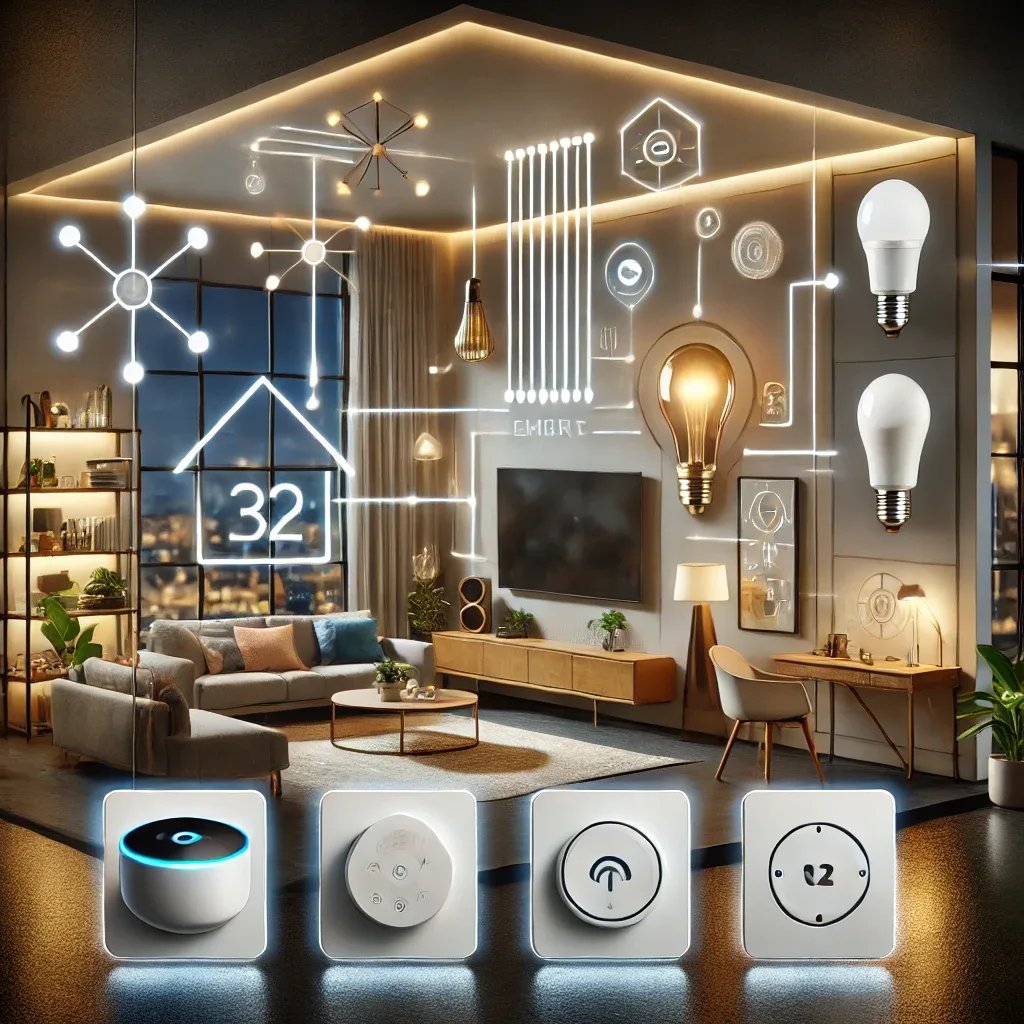
What Is Smart Lighting?
Smart Lighting connects your home's lighting to the internet and your smart home platform, enabling control via apps, tablets, and voice commands through Google Assistant, Amazon Alexa, or Siri. It also enables scheduling and complex automations that respond to your environment and behavior automatically.
Modern smart lights aren't simply bulbs you turn on remotely. They offer millions of color options, precise dimming control, and integration with sensors that make your lighting respond intelligently to occupancy, time of day, and even your mood or activity.
Benefits of Smart Lighting
First is remote control convenience. Whether you forgot to turn off lights before leaving or want lights on before you arrive home, your smartphone handles it from anywhere. No need to be inside the building.
Second is energy savings of 20-30% through automatic shutoff when rooms are empty, dimming during daylight hours when natural light is sufficient, and time-based schedule cutoffs. These savings compound across every room in the house.
Third is home security. Exterior lights that activate automatically when Motion Sensors detect nighttime movement deter intruders effectively. Vacation Mode randomizes your lighting patterns to make the home appear occupied even when you're traveling abroad.
Fourth is ambiance customization. Match your lighting to any activity — warm tones for evening relaxation, bright white for focused work, colorful scenes for entertaining — all pre-configured as Scenes that activate with a single command or voice instruction.
Choosing the Right Smart Lighting System
Compatibility with your smart home platform is the most critical factor. Zigbee-based lights like Philips Hue or IKEA TRADFRI integrate excellently with Home Assistant and Homebridge, offering high reliability and local operation even without internet connectivity.
Ease of installation matters as well. Smart bulbs that fit standard sockets and smart switches that replace existing wall switches without new wiring are the most practical choices. Consider scheduling capability, automation depth, and Motion Sensor integration compatibility when evaluating options.
Integrating Smart Lighting with Other Smart Home Systems
Smart lighting performs best when woven into your broader smart home ecosystem. Connected to Smart Cameras and Motion Sensors, exterior lights activate automatically when a person is detected at night while simultaneously sending your smartphone an alert.
AC integration creates coordinated energy management — when occupancy sensors confirm a room has been empty long enough, both lights and air conditioning shut off together automatically. Voice assistants make lighting control completely natural, eliminating the need to reach for a phone or find a switch in the dark.
Future Trends in Smart Lighting
AI will increasingly learn individual preferences and adjust lighting automatically without any manual configuration. Circadian Lighting — which shifts color temperature throughout the day to support human biological rhythms — is gaining adoption as awareness of light's impact on sleep and productivity grows. Integration with renewable energy systems will allow homes to intelligently prioritize solar-generated power for lighting loads.