Why Rank Them? Because Budgets Are Finite but Safety Is Not
One of the most frequent questions from families planning in-home elderly care is: if budget is limited, where do we start? The answer depends on each person’s risk profile — but 5 technologies are consistently highlighted by epidemiological data and in-home mortality statistics as worthy of investment above all else.
Rank 1: Fall Detection via mmWave Sensor — Budget 8,000–15,000 THB
Falling is the leading cause of death among elderly living alone worldwide — not because the fall itself kills, but because the time spent lying on the floor without help (the Long Lie) causes Rhabdomyolysis, Hypothermia, and Pressure Sores. mmWave 60GHz Sensors detect falls and abnormal inactivity without the elderly wearing any device. They work in darkness, through thin clothing, and when the person is completely motionless — something standard PIR sensors cannot do.
At 8,000–15,000 THB per point including installation and Home Assistant integration, these sensors trigger LINE Notify within 30 seconds of detecting an abnormal event. The ROI is clear: a single hip fracture emergency in Bangkok starts at 120,000 THB excluding 3–6 months of rehabilitation. An investment of 15,000 THB that prevents even one such event is exceptionally cost-effective.
Rank 2: Emergency Alert System — Budget 5,000–12,000 THB
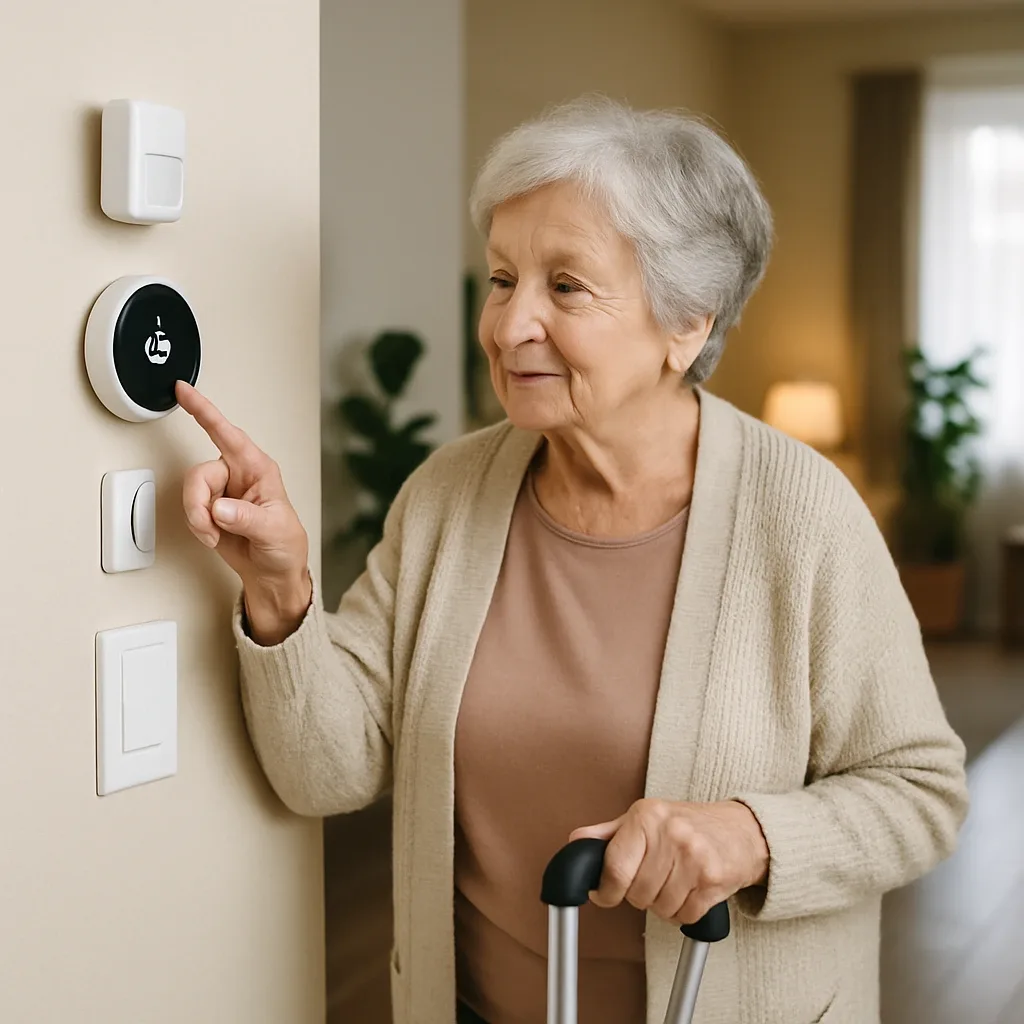
A complete emergency alert system has three components: (1) IP67 waterproof Panic Buttons mounted in bathrooms and bedrooms at 450–500mm height so they are reachable even from the floor; (2) a Pull Cord hanging from the bathroom ceiling with the cord end at 200mm from the floor; and (3) a wearable Zigbee Panic Button worn on the wrist or neck.
All three connect to Home Assistant and immediately send LINE Notify alerts with location context. Any quality system should include a minimum 72-hour battery backup to maintain coverage during power outages.
Rank 3: Voice Control Hub — Budget 3,000–8,000 THB
Elderly individuals with joint problems, Parkinson’s disease, or muscle weakness cannot always bend to pick up a phone. A Voice Control Hub — Amazon Echo, Google Nest Mini, or a Local Voice Assistant via Wyoming Protocol on Home Assistant — lets elderly residents control lighting, door locks, TV, and calls to family members using voice alone.
At 3,000–8,000 THB including the hub and 4–6 Smart Plugs, this reduces the Physical Demand of daily living by 30–40% in mobility-limited elderly populations. For Thai context, a Local-first solution is recommended to avoid dependency on foreign cloud services.
Rank 4: Smart Smoke + CO + Gas Detector — Budget 4,000–9,000 THB
Elderly individuals have diminished smell and hearing sensitivity, making independent detection of fire or gas leaks significantly slower than younger adults. A combined Zigbee Smoke Detector, Carbon Monoxide Sensor, and Gas Leak Detector at 4,000–9,000 THB for 3 installation points (kitchen and bedrooms) detects hazards and triggers LINE Notify plus an audible alarm within 3 seconds.
Integrated with Smart Home, this automatically shuts the gas valve, opens smart windows, and unlocks the front door to enable easy evacuation — a coordinated response impossible with standalone detectors.
Rank 5: Air Quality Monitor with Auto Purification — Budget 8,000–18,000 THB
Bangkok records 40–60 days per year with AQI above 100 (Unhealthy), concentrated in January through March. Elderly residents with heart or lung disease face 3–5x higher health risk on poor air quality days. The system combines an NDIR CO₂ Sensor (alert at 800 ppm), a PM2.5 Sensor, and an HEPA H13 Air Purifier with CADR ≥200 CFM — all connected to Home Assistant to automatically adjust fan speed based on real-time air quality, removing the need for manual operation.
Final priority ranking: Fall Detection → Emergency Alert → Voice Control → Smoke/CO/Gas → Air Quality, ordered by life-safety urgency. For families with constrained budgets, complete the first two items first and expand the system in subsequent years.