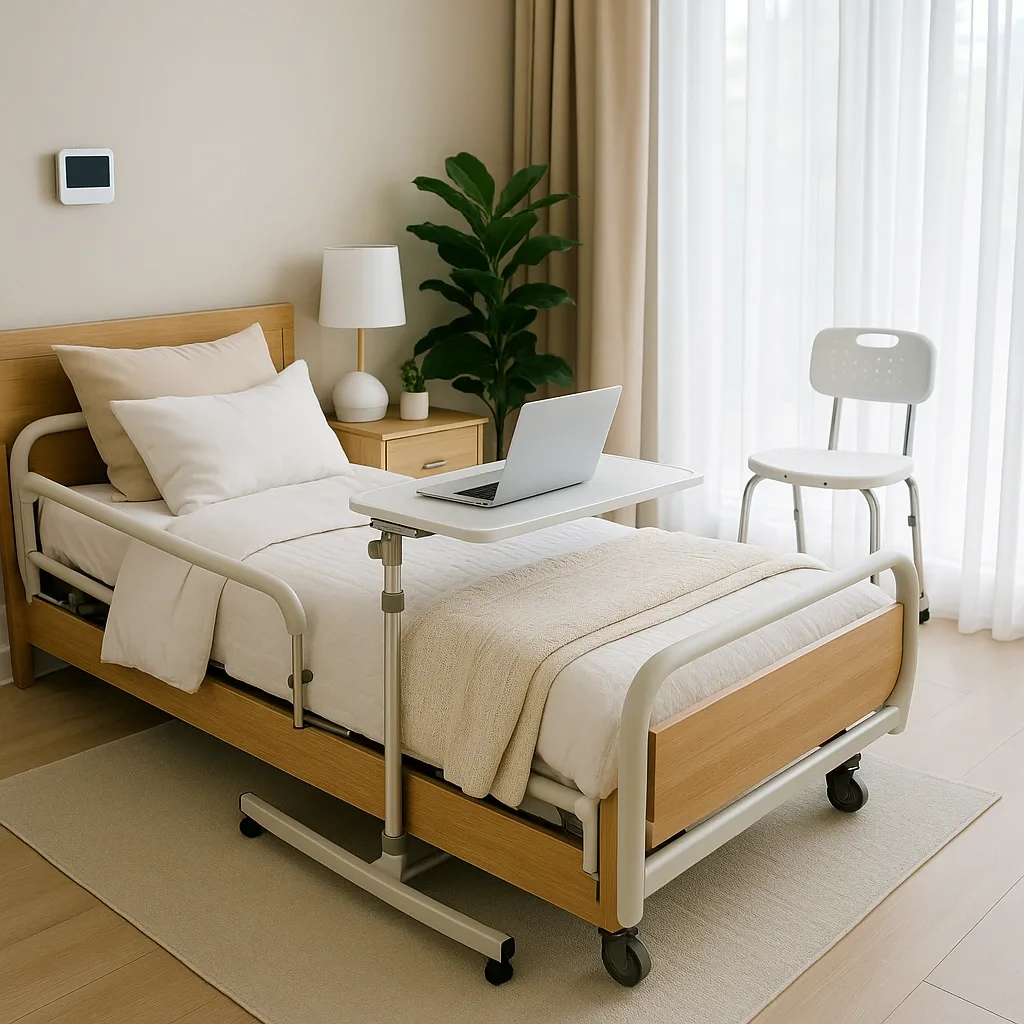
The Common Misconception: Choosing One or the Other
When families plan home adaptations for elderly residents, the debate often frames the choice as Universal Design (physical home modification) versus Smart Home Technology (buying devices). The correct answer is both — for structural reasons: UD eliminates latent hazards, Smart Tech detects what UD cannot eliminate, and Smart Tech data enables proactive care that was previously impossible.
Formula Component 1: Universal Design Eliminates Latent Hazards
Universal Design changes the physical environment to reduce risk without relying on technology. A non-slip floor (COF ≥ 0.6) prevents falls before they occur. A door ≥ 900 mm wide allows wheelchair access without sensors. Bathroom grab bars allow the resident to rise independently even if emergency lighting fails.
Universal Design works when the power is out, when the internet is down, and when a battery is dead. This is its primary advantage that Smart Technology cannot replicate.
Formula Component 2: Smart Technology Detects What UD Cannot Prevent
Even in a bathroom with non-slip floors and full grab-bar installation, some risks remain that UD cannot address — loss of consciousness from a blood pressure drop, cardiac arrest while bathing, or being trapped by a faulty door handle. An mmWave Sensor detects these situations and sends an alert within 30 seconds.
Similarly, an NDIR CO₂ sensor detects air quality problems UD cannot fix; a Wearable detects health values invisible to the naked eye; and a Smart Lock enables emergency responder access faster than forcing a reinforced door.
Formula Component 3: Smart Tech Data Enables Proactive Care
The most valuable aspect of Smart Technology is the long-term data it accumulates. A changing bathroom frequency pattern may indicate a developing condition weeks before symptoms appear. Declining sleep quality may precede depression by 2–4 weeks. Unusual room temperature may indicate the resident forgot to turn on the air conditioner or has developed a fever.
Universal Design cannot generate any of this data. Smart Technology does so automatically. When a family doctor can see a Nocturia trend rising three weeks before the patient develops symptoms, medication can be adjusted or a check-up scheduled before a crisis develops.
The Integration Formula: Investment Sequence
Recommended sequence: Month 1 — foundational UD (flooring, doorways, grab bars, threshold removal): 25,000–50,000 THB. Month 2 — foundational Smart Layer (mmWave ×2, Panic Button, Night Light): 10,000–15,000 THB. Month 3 — advanced Smart Layer (Wearable, Dashboard, AI Companion): 10,000–20,000 THB.
Implementing the Smart Layer without UD achieves approximately 60% of potential outcomes. Implementing UD without the Smart Layer achieves approximately 50%. Combining both achieves more than the sum of the two parts, because each compensates for the other’s blind spots.