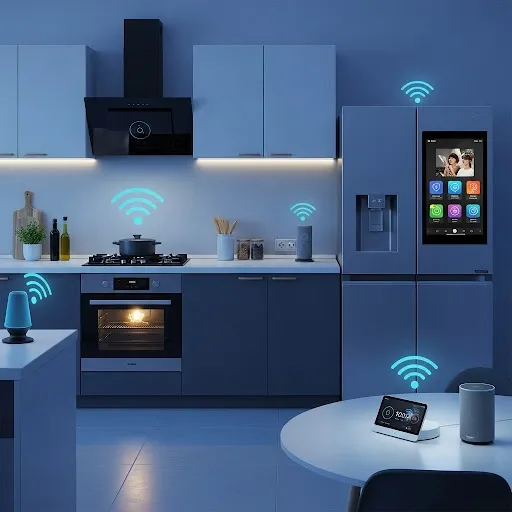
How Realistic Is DIY Smart Home in 2025?
By 2025, smart home hardware is cheaper and easier to set up than ever before. Leading brands including TP-Link Tapo, Xiaomi, Aqara, and Sonoff have launched new models supporting Matter — the new IoT standard that improves cross-brand compatibility. While not perfect yet, the trajectory clearly favours everyday users, with easier setup and fewer brand-lock frustrations each year.
Five Essential Smart Home Devices for DIY
Smart Plug (250–600 THB): the safest starting point. No wiring, immediate app connectivity, zero installation risk.
Smart Bulb (300–800 THB per bulb): swaps in seconds without touching existing switches. Supports both RGB colour and white temperature adjustment.
Door and Window Sensor (150–400 THB): monitors for intrusion and alerts you if you've left a window open.
Smart CCTV (800–2,000 THB): choose a model with Local Storage — don't rely solely on cloud. Your footage stays on your network.
Smart Switch (400–900 THB): replaces your existing wall switch to enable voice control without changing every light bulb.
Smart Speaker or Hub (1,500–2,500 THB): links all devices and accepts voice commands. Google Nest Mini is highly recommended for beginners.
Installation Steps and Wi-Fi Tips
Step 1: Check your Wi-Fi signal first. Most smart devices use 2.4GHz Wi-Fi. If your router is far from the installation area, consider a Wi-Fi Extender or Mesh Wi-Fi system first.
Step 2: Set your SSID to English characters with no spaces or special characters. This eliminates a common pairing failure cause.
Step 3: Install and test one device at a time. Adding everything at once makes troubleshooting difficult when something goes wrong.
Step 4: Name devices clearly — Living Room TV Plug or Front Door Camera. Precise names make voice commands work reliably.
Step 5: Build your first Automation before adding more devices. Understanding how the system thinks saves time later.
Platform Comparison
Google Home: best for Android beginners. Easy setup, Routines configured within the app.
Amazon Alexa: best if you want broad multi-brand compatibility without worrying too much about protocol conflicts.
Home Assistant: best for maximum privacy and complex automation. Runs locally — no internet dependency.
Common Voice Command Examples
Google: dim the living room lights by 50 percent
Alexa: set the bedroom AC to 24 degrees
Siri: turn off all the lights
Beginner Warnings
Don't buy too many devices at once. Start with two or three, expand gradually.
Confirm devices support 2.4GHz Wi-Fi — not 5GHz only.
Read Thai-language reviews before purchasing. Some brands have known ISP compatibility issues in Thailand.
Review the privacy policy of any camera brand before buying — especially for cloud-stored footage.