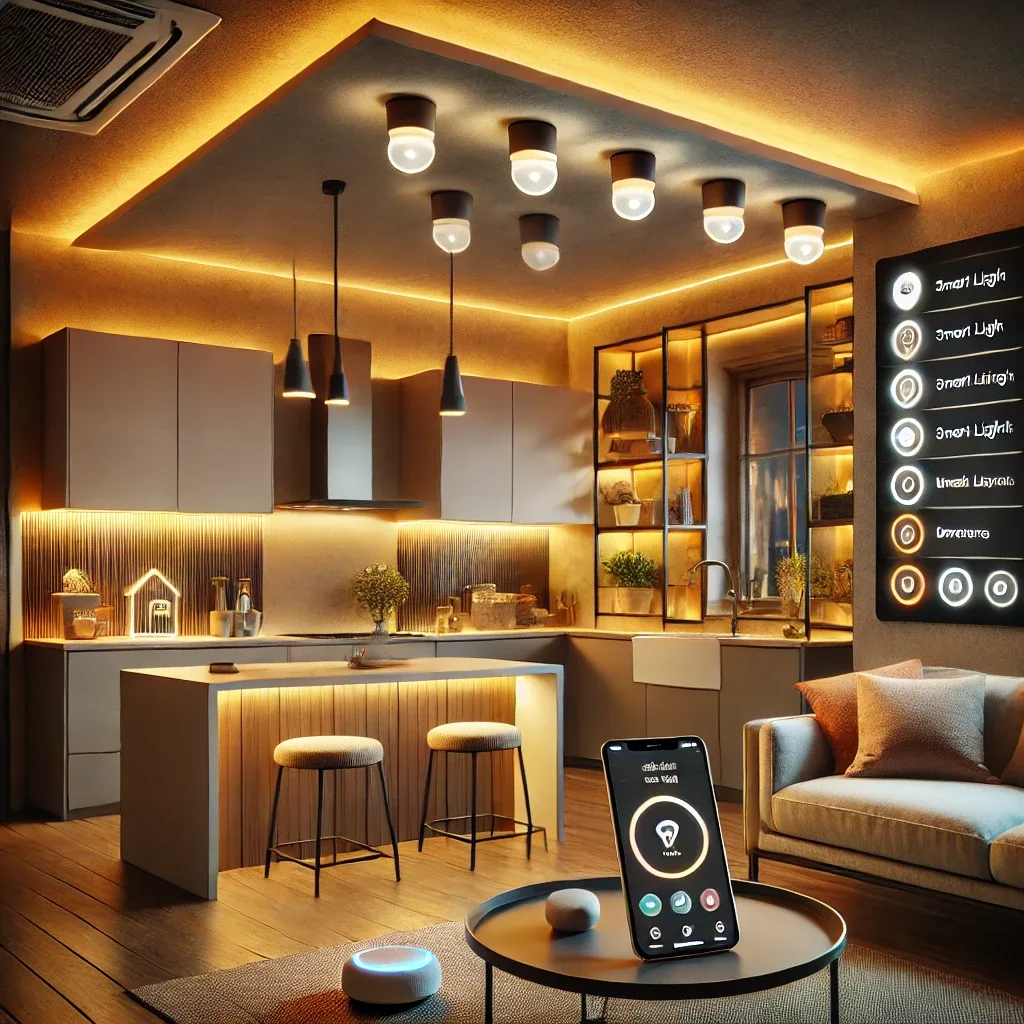
What Is Smart Lighting and Why Does It Matter
Smart Lighting refers to lighting systems that can be controlled and customized through smartphones, tablets, or voice commands via Google Assistant or Amazon Alexa. Its value extends well beyond convenience—smart lighting actively saves energy, creates appropriate ambiance for every space, and enhances security through scheduling and sensor-triggered operation.
Key Benefits of Smart Lighting
Smart lighting delivers advantages across multiple dimensions. For energy saving, scheduled on/off times and brightness adjustment eliminate unnecessary electricity consumption. For ambiance control, it adjusts light to suit any situation—warm 2700K tones in the living room during evening hours or cool 5000K white light in the home office during daytime work sessions. For remote control, lights can be adjusted from anywhere via smartphone. For security, automatically switching lights on when motion is detected near entrances serves as an effective deterrent.
Important Factors When Choosing Smart Lighting
Before purchasing, consider these key factors. Platform compatibility—verify the system works with Google Home, Alexa, Apple HomeKit, or Home Assistant, whichever you use. Control and connectivity—choose devices that support both app and voice control with stable Wi-Fi or Zigbee connectivity. Color temperature and brightness flexibility—systems that adjust across a wide range deliver significantly better experiences. Scheduling and automation capability—essential for energy saving and convenience. Long-term maintenance requirements and warranty coverage.
Types of Smart Lighting for Your Smart Home
Smart Bulbs are the most popular starting point—they replace standard bulbs immediately, support color and brightness adjustment, and accept voice commands and schedules. Smart Light Switches replace standard wall switches and control all lights in the circuit, ideal for homes with existing standard bulbs. Smart Wall Lights work well in corridors and outdoor areas, with some models integrating directly with motion sensors. Smart Under-Cabinet Lights are perfect for kitchens and bathrooms requiring targeted task lighting.
Protocols to Understand Before Buying
Protocol choice significantly affects stability and future expandability. Zigbee is ideal for larger installations—low power consumption and self-healing Mesh Network capability, though a Coordinator device is required. Wi-Fi requires no Hub and is easiest to set up, but adding many Wi-Fi devices can strain home routers. Matter Protocol is a new industry standard co-developed by Apple, Google, Amazon, and Samsung that enables seamless interoperability across brands and ecosystems—an increasingly important consideration for future-proofing.
Precautions When Selecting Smart Lighting
Despite its clear benefits, smart lighting carries data security considerations since devices connect to the internet. Choose brands with consistent security update practices and clear privacy policies. Always verify compatibility with your existing ecosystem before purchasing. Start with the highest-impact areas first—typically the living room and main entrance—then expand incrementally as familiarity and confidence grow.