Urban Air Pollution — More Complex Than It Appears
Air pollution in major cities like Bangkok extends far beyond visible PM2.5. The full spectrum of pollutants includes invisible toxic gases that are equally dangerous but far less discussed.
The four main pollutant categories are PM2.5 and PM10 from vehicles, industrial facilities, biomass burning, and construction; toxic gases CO, CO2, and NOx from engine combustion and industry; VOCs (volatile organic compounds) and formaldehyde from cleaning products, paints, new furniture, and building materials; and direct vehicle exhaust in high-traffic urban areas that creates concentrated local exposure.
Health Impacts That Demand Attention
Air pollution's health impacts span every body system. The respiratory system is affected most directly and severely — from coughing and asthma through COPD to lung cancer. IARC classifies PM2.5 as a Group 1 carcinogen, placing it in the same category as tobacco smoke.
The cardiovascular system is affected through chronic inflammation, raising risks of heart disease, stroke, and hypertension. For children, early-life pollution exposure impairs brain and neurological development, measurably reducing IQ and increasing ADHD risk. Long-term cumulative exposure significantly increases dementia risk in older adults.
AI Technology in Smart Home Addresses Pollution
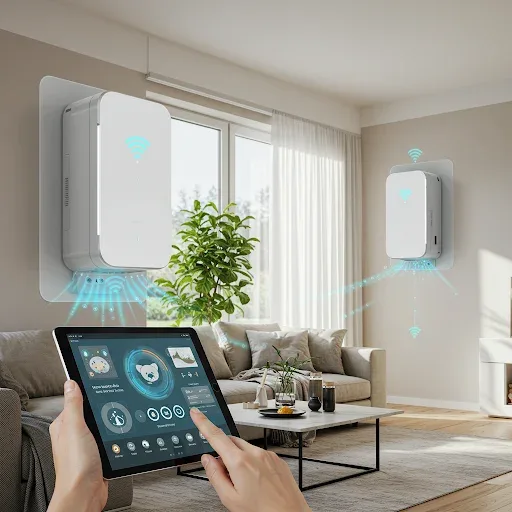
AI transforms smart home pollution response from reactive to predictive. Smart sensors continuously gather PM2.5, CO2, CO, VOC, and humidity data. AI analyzes patterns and forecasts air quality 1-4 hours ahead using meteorological data, seasonal patterns, and traffic flow information.
Devices respond pre-emptively — increasing purifier speed before rush hour peaks, closing windows before wind shifts bring PM2.5 from neighboring areas, activating PAP systems before outdoor conditions deteriorate. AI also learns occupant behavior patterns, optimizing operation for each household's specific lifestyle, typically reducing energy consumption by 20-40% compared to fixed schedules.
Advanced Sensors and Home Assistant Integration
Next-generation sensors cover the full pollution spectrum in single devices: PM1, PM2.5, PM10, CO2, CO, VOCs, formaldehyde, ozone, NO2, plus temperature and humidity. Real-time response and immediate Smart Home connectivity make these far more capable than earlier generation single-metric sensors.
Home Assistant integration enables automatic activation of purifiers and ventilation systems when any pollution threshold is detected, automatic deactivation when air is clean, and continuous learning of preferred settings. High-impact automation examples: PM2.5>35 triggers maximum speed plus LINE notification; CO2>1000 activates ERV; VOC>500ppb increases purifier speed and opens windows if outdoor PM2.5 is simultaneously low.
Future Trends — Clean Energy and Health Data Integration
The future of Smart Home air quality management evolves in two important directions. On clean energy: solar panels and battery storage will integrate with air quality control systems, enabling homes to maintain clean air using renewable energy — reducing both pollution and electricity costs simultaneously.
On health data integration: wearables detecting abnormal breathing patterns will feed data to Smart Home systems for automatic response — detecting a resident's respiratory distress and immediately maximizing purifier speed. Homes will evolve from passive environments into active, personalized health protection systems.