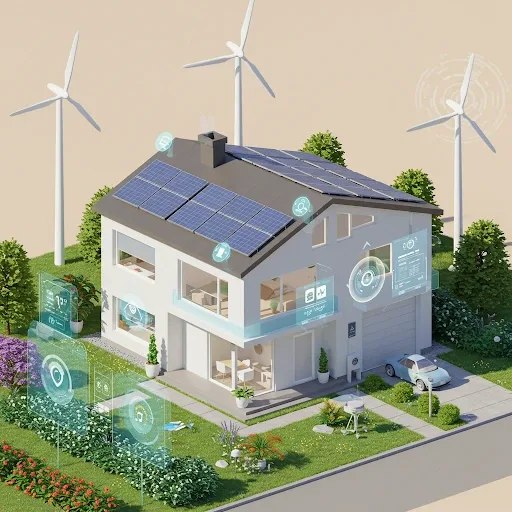
Why Modern Homes Should Integrate Smart Home with Clean Energy
As electricity costs in Thailand continue to rise, investing in a smart home connected to clean energy systems is not simply a lifestyle choice — it is a financially sound decision. Beyond reducing electricity bills, it lowers greenhouse gas emissions and increases resilience against energy price volatility.
Intelligent Solar Panels: Generating and Managing Power in Your Hands
New-generation solar panels integrate smart systems to maximize electricity production. Automatic angle adjustment tracks sunlight throughout the day for peak capture. Smartphone apps display real-time data on energy generation, consumption, and battery reserves. Battery storage integration enables electricity generated during the day to power the home at night, reducing reliance on the grid.
In Bangkok, where UV index remains high year-round, rooftop solar panels typically generate 4-6 units per panel per day. Combined with a smart home system, this delivers significant reductions in monthly electricity costs.
Energy Storage Systems: AI That Allocates Power Intelligently
AI-driven energy storage systems calculate power allocation smartly, prioritizing devices that require continuous power — such as medical equipment and security systems — before distributing to other appliances. The system also calculates when to draw from battery reserves versus the grid to minimize cost based on time-of-use pricing.
Grid independence planning reduces household dependence on external electricity, providing resilience against power outages and future tariff increases.
Smart Plug: Controlling Energy Use Device by Device
Smart plugs are essential energy management tools. Key features include remote on/off control through a smartphone, automatic scheduling to cut power during idle periods, and real-time per-device energy consumption tracking. The TP-Link Tapo P110 and Xiaomi Mi Smart Plug are consistently popular choices in Thailand for their comprehensive features and accessible pricing.
Smart Lighting and Smart Thermostat: Automatic Energy Savings
Smart lighting adjusts brightness automatically based on available natural light, reducing electricity use when sunlight through windows is sufficient. Scheduling and voice or phone control align lighting with daily routines. Smart thermostats combine outdoor temperature sensing, AI behavior learning, and remote control to minimize AC energy consumption without sacrificing comfort.
Building an Eco-Friendly Home Sustainably
Start with high-efficiency appliances — LED lighting and inverter-type AC units with strong energy efficiency ratings. Install renewable energy generation when budget allows. Use automation to eliminate energy waste without affecting quality of life. Monitor and analyze usage data through companion apps to identify and act on continuous improvement opportunities.