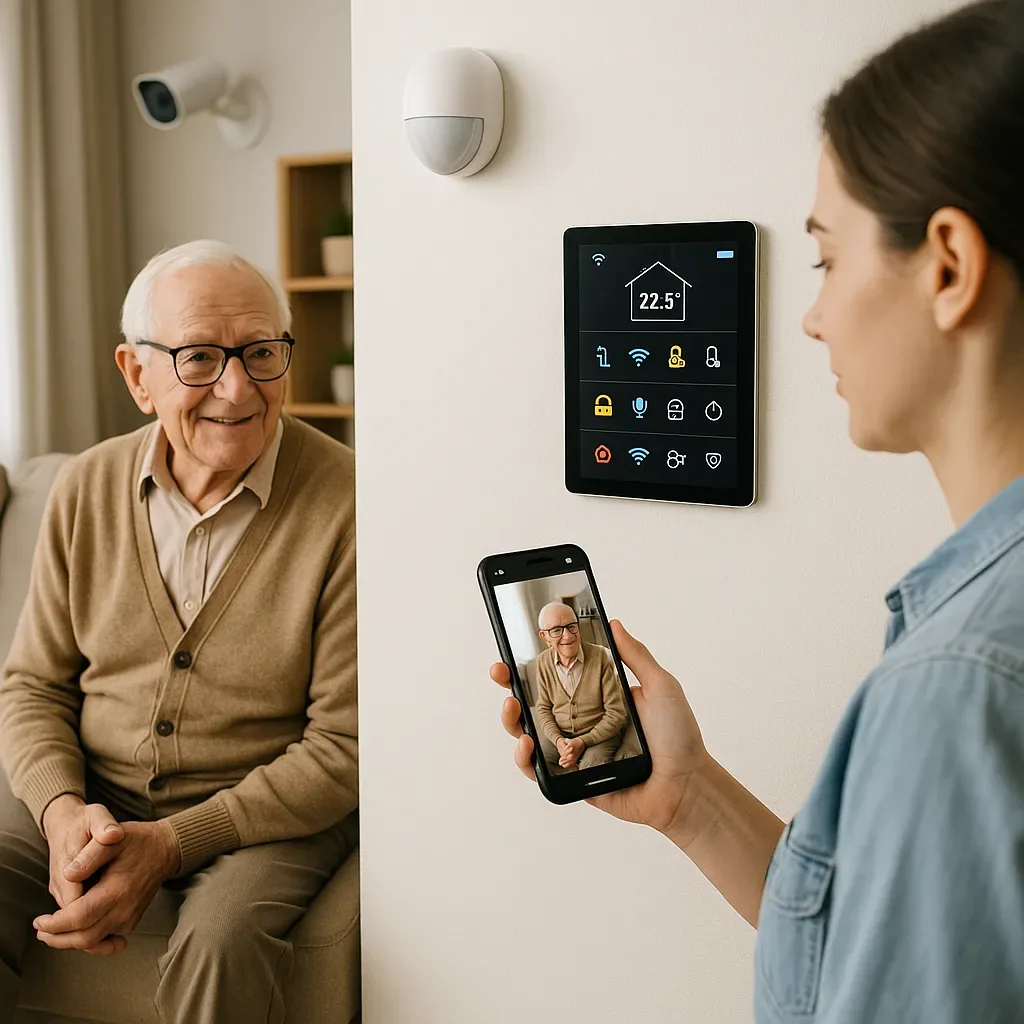
Advanced Technology for Elderly Care
Beyond basic fall detection sensors and panic buttons, modern smart home technology offers significantly more sophisticated capabilities — from AI that learns elderly behavioral patterns to wearable device data integration for comprehensive health monitoring.
AI Anomaly Detection: A System That Knows the Resident Better Than They Know Themselves
AI systems that learn an elderly resident’s normal behavior can detect anomalies with remarkable precision. Behavioral Baseline Learning analyzes 30–60 days of sensor data to establish normal patterns — wake times, movement routes, time spent in each room. Statistical Deviation Alerts trigger when behavior deviates more than 2 standard deviations from baseline, such as when a resident who normally wakes at 06:30 shows no movement by 09:00. Trend Analysis detects gradual changes — progressively shorter walking distances or increasingly extended bathroom sessions — that may indicate deteriorating physical condition before a crisis occurs.
Wearable Integration: 24/7 Health Data
Integrating elderly residents’ wearable devices with Home Assistant provides clinically valuable health data. The Garmin Health API delivers heart rate, sleep score, stress level, SpO2, and daily step counts for continuous health trend graphs accessible to family and physicians. Sleep quality automations alert families when sleep scores fall below 60 for three consecutive nights. Activity level alerts trigger when daily step count drops dramatically from a resident’s established baseline — a potential indicator of illness or injury.
Circadian Rhythm Lighting: Light for Sleep Health
Elderly residents frequently experience sleep difficulties. Circadian Rhythm-adjusted lighting provides measurable benefit. A morning graduation from soft 10% brightness at 5,000K at 06:00 to full 80% brightness at 6,500K by 06:30 supports natural wake cycles. Lighting then shifts through neutral 4,000K during the day, warm 3,000K in the early evening, and amber 2,200K minimal-blue-light settings before bed — all automated through Home Assistant time-triggered scenes.
Cognitive Support: Assisting Dementia Patients in Daily Life
A Smart Reminder System delivers familiar-sounding spoken reminders through home speakers in simple, clear language for daily activities — "Mother, it is lunchtime. Your meal is on the kitchen table." Familiar Route Lighting automatically illuminates the path from bedroom to bathroom, living room, or kitchen based on established routines, guiding disoriented residents in the dark. Exit Prevention plays a recorded message from a familiar family member when the patient approaches an exit door, while simultaneously sending an emergency alert to caregivers.
Conclusion
Modern smart home technology for the elderly has moved well beyond basic accident prevention into comprehensive health monitoring that integrates home sensor data, wearable devices, and AI analysis — giving families and physicians the information needed for the highest quality of care.