Curtains: Your First Line of Defense Against Dust
Curtains are among the largest dust-accumulating surfaces in any home, yet with the right material selection, they can become effective dust-trapping tools rather than dust reservoirs. Tightly woven microfiber and polyester fabrics capture dust particles far better than loosely woven alternatives, while velvet and thick pile fabrics should be avoided entirely — they attract excessive dust and are notoriously difficult to clean thoroughly.
Wash curtains every 2-4 weeks during high PM2.5 periods and every 1-2 months under normal conditions. Use cold water and mild detergent to preserve fabric integrity. If frequent washing is impractical, roller blinds with smooth surfaces are significantly easier to maintain than pleated curtain styles.
Rugs That Trap Dust Intelligently
Rugs are often considered an allergy sufferer's enemy, but the right rug actually prevents dust from becoming airborne when people walk across it. Electrostatic rugs attract and hold dust particles effectively — quite unlike deep-pile rugs that trap dust too deeply for conventional vacuums to extract.
Choose low-pile or flat-weave rugs with pile height no greater than 10mm, allowing HEPA vacuums to work at full efficiency. Vacuum rugs at least 2-3 times weekly and schedule deep cleaning every 3-6 months to maintain their dust-capturing performance.
Dust Capture Solution: A Technique Used by Professionals
Dust capture solutions — spray or liquid coatings applied to surfaces — cause dust to adhere rather than scatter when surfaces are wiped. Paired with microfiber cloths, these products deliver significantly better results than dry dusting alone.
Proper technique matters: spray the solution onto the microfiber cloth rather than directly onto surfaces to avoid residue buildup. Always wipe in a single direction rather than circular motions to prevent redistributing dust. Replace or rinse the cloth when it visibly darkens to avoid spreading collected particles.
The Bedroom: Your Most Critical Zone
We spend roughly one-third of our lives in the bedroom, making dust and dust mites in this space directly responsible for respiratory health during the most vulnerable hours of sleep. The body breathes continuously during sleep, making air quality here disproportionately impactful.
Wash bed linens and pillowcases weekly in water at 60°C or above to kill dust mites. Use dust mite-proof mattress and pillow covers as a barrier layer. Clean under the bed and beside furniture consistently. Close windows when outdoor PM2.5 is elevated and run an air purifier in the bedroom throughout the night.
The Right Equipment for Professional-Level Results
A HEPA H13 vacuum is the minimum recommended standard for dust-sensitive households, filtering 99.95% of particles at 0.3 microns and preventing trapped dust from recirculating through the machine. AI-powered robot vacuums with Lidar mapping handle daily automated cleaning without any manual intervention.
Position air purifiers in rooms where the most time is spent — bedrooms and living rooms take priority. Select units with genuine HEPA filtration rather than ionizer-only or UV-only systems that do not physically capture particles.
Your Maintenance Schedule
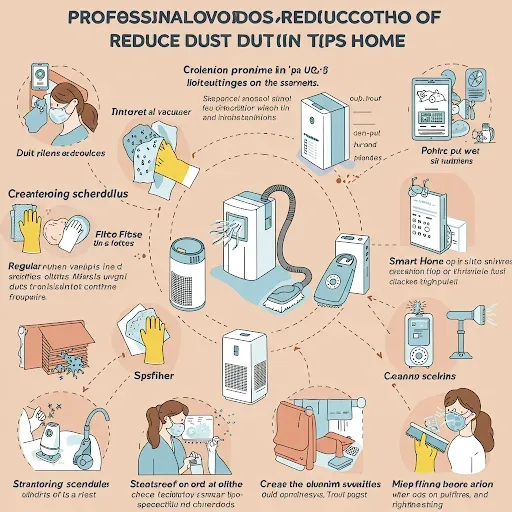
Daily: wipe high-touch surfaces, run the air purifier. Weekly: vacuum rugs and sofas, wash bed linens, clean ceiling fans. Monthly: wash curtains, service the vacuum, replace filters per schedule. Quarterly: deep-clean rugs, sofas, and upholstered furniture.
HappySmart provides Smart Home consultation integrating air purifiers, robot vacuums, and PM2.5 sensors into fully automated systems that respond to real-time dust readings in your home — no manual monitoring required.