The Hidden Cost of Vacant Rooms
Data from the Metropolitan Electricity Authority indicates that leaving lights and air conditioning running in unoccupied rooms accounts for 20–35% of unnecessary household electricity consumption in Thailand. In homes with multiple family members and several rooms in simultaneous use, this waste compounds with every additional space left unmonitored. Smart home usage detection solves this structurally rather than relying on individual discipline.
How PIR Sensors and Occupancy Detection Work
Passive Infrared (PIR) sensors detect changes in the infrared signature of a space — in practical terms, body heat moving through the sensor's field of view. When no movement is detected for a defined period, typically 5–10 minutes, the system automatically switches off lights and shifts air conditioning to Eco Mode. When occupancy resumes, devices return to their previous settings instantly.
By 2026, millimetre-wave (mmWave) radar sensors have largely replaced standard PIR in premium installations. Devices such as the Aqara FP2 and TP-Link Tapo T315 detect occupancy even from a stationary seated or sleeping person — eliminating false negatives that cause lights to cut out unexpectedly. Both devices support Matter 1.4 and integrate directly with HomeKit or Tuya ecosystems.
Smart Lighting: Where Savings Are Most Immediate
Installing smart bulbs with PIR sensors in every room reduces lighting electricity consumption by 40–60% on average, based on an observed pattern of lights being left on in unoccupied rooms for 3–5 hours per day in households of 3–4 people. The return is immediate and requires no behavioural change from household members.
HappySmart AI SmartHome supports smart bulbs from Philips Hue, Xiaomi, TP-Link Tapo, and Yeelight — all connected through Matter 1.4 so they are managed from a single app. Lighting scenes can be programmed by time of day: 40% brightness in the morning with cool white, transitioning to warm amber in the evening, all switching off automatically when each room falls vacant.
Smart Thermostat Management for Air Conditioning
Air conditioning accounts for 60–70% of total electricity consumption in a typical 150 sqm Bangkok home running four to five units. Smart thermostats address this through several coordinated strategies: - Automatic shut-off: The unit stops when occupancy is undetected for more than 10 minutes, rather than running until someone remembers to turn it off. - Pre-cooling: The system cools a room 20–30 minutes before the occupant's historical arrival time, avoiding the burst of high-draw operation that occurs when a hot room needs rapid cooling. - Time-based set points: Automatic adjustment between 26°C during the day and 24°C at night, eliminating over-cooling during working hours. - Whole-home Eco mode: Geofencing triggers all air conditioning to shift to 30°C holding mode when the last family member leaves the property, restoring set points automatically on return.
MEA Time-of-Use Scheduling
The Metropolitan Electricity Authority offers a Time-of-Use tariff for residential customers who install TOU meters. Peak rates (09:00–22:00 on working days) are substantially higher than off-peak rates, making smart scheduling of high-draw appliances directly economical. HappySmart AI SmartHome can automatically schedule washing machines, dishwashers, and water heaters to run after 22:00, reducing electricity cost for those appliances by 30–40%.
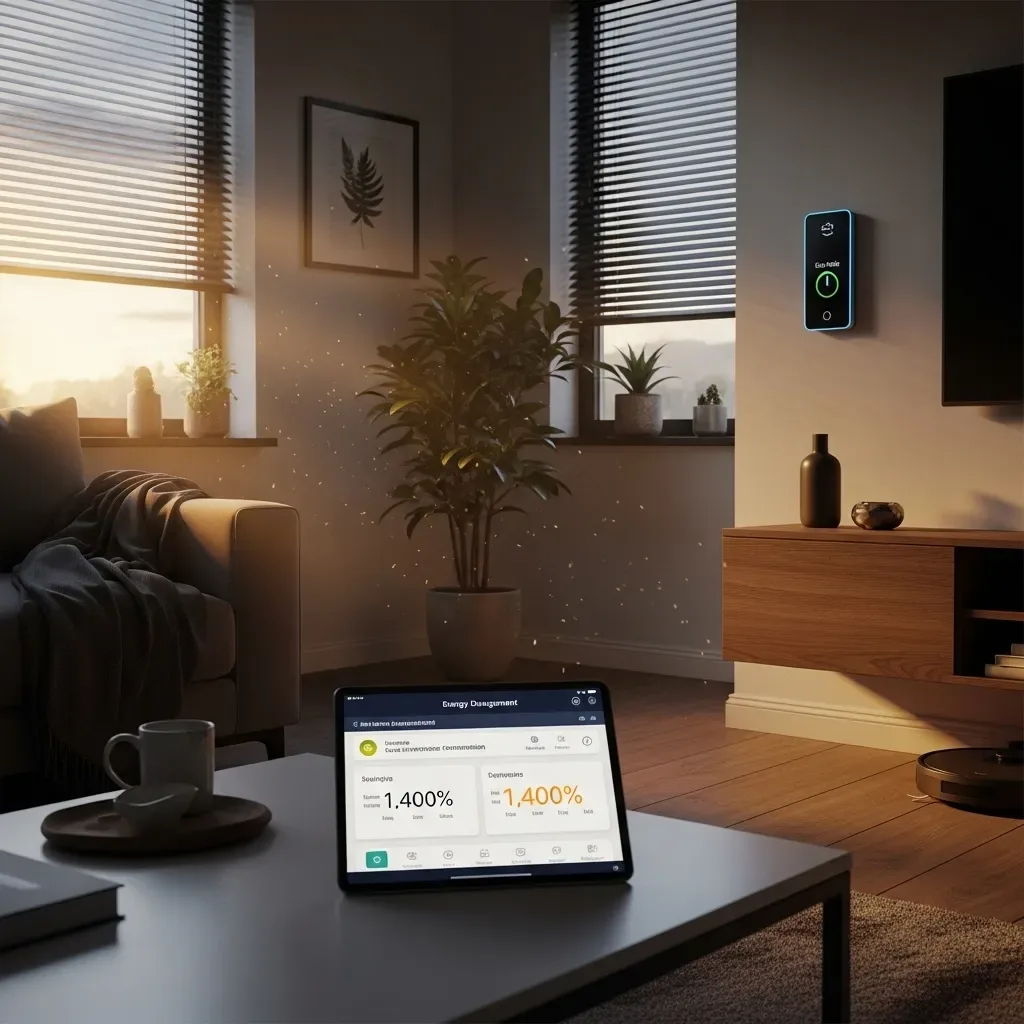
The platform's real-time energy dashboard breaks down consumption by device, allowing homeowners to identify the highest draws and make informed decisions about upgrades or usage habit changes.