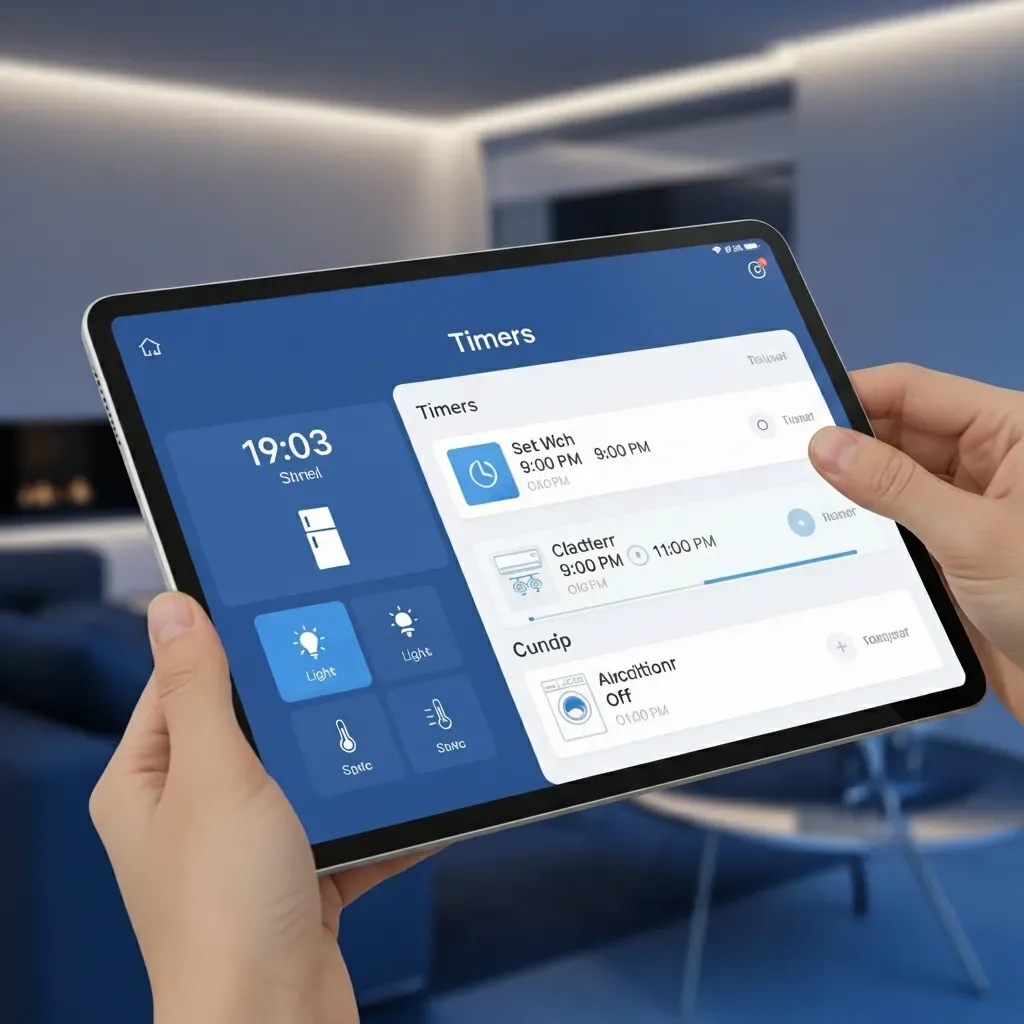
When You Use Electricity Matters as Much as How Much You Use
For households on a MEA Time-of-Use meter, the time at which an appliance runs is as significant a cost determinant as the appliance's power rating. Peak tariff rates (09:00–22:00 on working days) are substantially higher than off-peak rates. Shifting high-draw appliance operation to off-peak hours reduces electricity cost directly — without consuming any less energy in total. The same washing machine cycle, the same EV charge, just timed differently.
In a home without automation, timer discipline requires memory and consistency that most households cannot sustain reliably. Smart home scheduling removes human variability from the equation entirely.
Which Appliances Benefit Most from Timer Scheduling
Not every appliance is a candidate for timer scheduling. The selection principle is straightforward: appliances whose function can be deferred without affecting occupant comfort or safety are candidates; those that must respond to real-time need are not.
Well-suited to off-peak scheduling: - Washing machine: Run at 23:00, cycle complete by morning with no occupant impact. - Tumble dryer: High draw, substantial off-peak saving per cycle. - Dishwasher: Delay start after dinner to 22:00. - Storage water heater: Heat overnight, maintain temperature, reduce daytime heating cycles. - EV charger: Automated off-peak charging every night. - Solar battery: Grid charging limited to off-peak hours when solar generation is insufficient.
Not suited to fixed scheduling: - Refrigerator: Must run continuously, but defrost cycles can be scheduled to off-peak. - Air conditioning: Occupancy-responsive, not time-fixed — better managed by thermostat automation.
Building Smart Automation Schedules in HomeKit and Tuya
HappySmart AI SmartHome supports automation schedules significantly more sophisticated than simple on/off timers: - Compound conditions: Start the washing machine at 23:00 "and" solar surplus exists, "or" if the tariff rate is off-peak. - Adaptive scheduling: The system learns which days carry the lowest household load and automatically shifts deferrable tasks to those days. - Pre-start notification: A LINE alert 15 minutes before a scheduled operation, allowing the homeowner to delay if circumstances have changed. - Easy override: A single button in LINE or the app skips a scheduled cycle without disrupting the ongoing automation programme.
Pre-Conditioning: Comfort Without the Peak-Rate Cost
One of the highest-value scheduling applications in Thailand's climate is HVAC pre-conditioning. Rather than arriving home to a hot house and running the air conditioning at full power until the space cools — the most electricity-intensive use pattern — geofencing detects when the homeowner leaves the office and starts the AC 20 minutes early in economy mode. The room is comfortable on arrival using less electricity than an immediate full-power start would require, and the peak-rate exposure is avoided if the return trip falls before 22:00.
Measure and Refine
Effective scheduling requires feedback. HappySmart's energy dashboard displays daily cost by appliance group, compares pre- and post-installation periods, and identifies which schedules are delivering the highest saving. This data enables continuous monthly refinement rather than a set-and-forget approach that gradually loses accuracy as household patterns change.