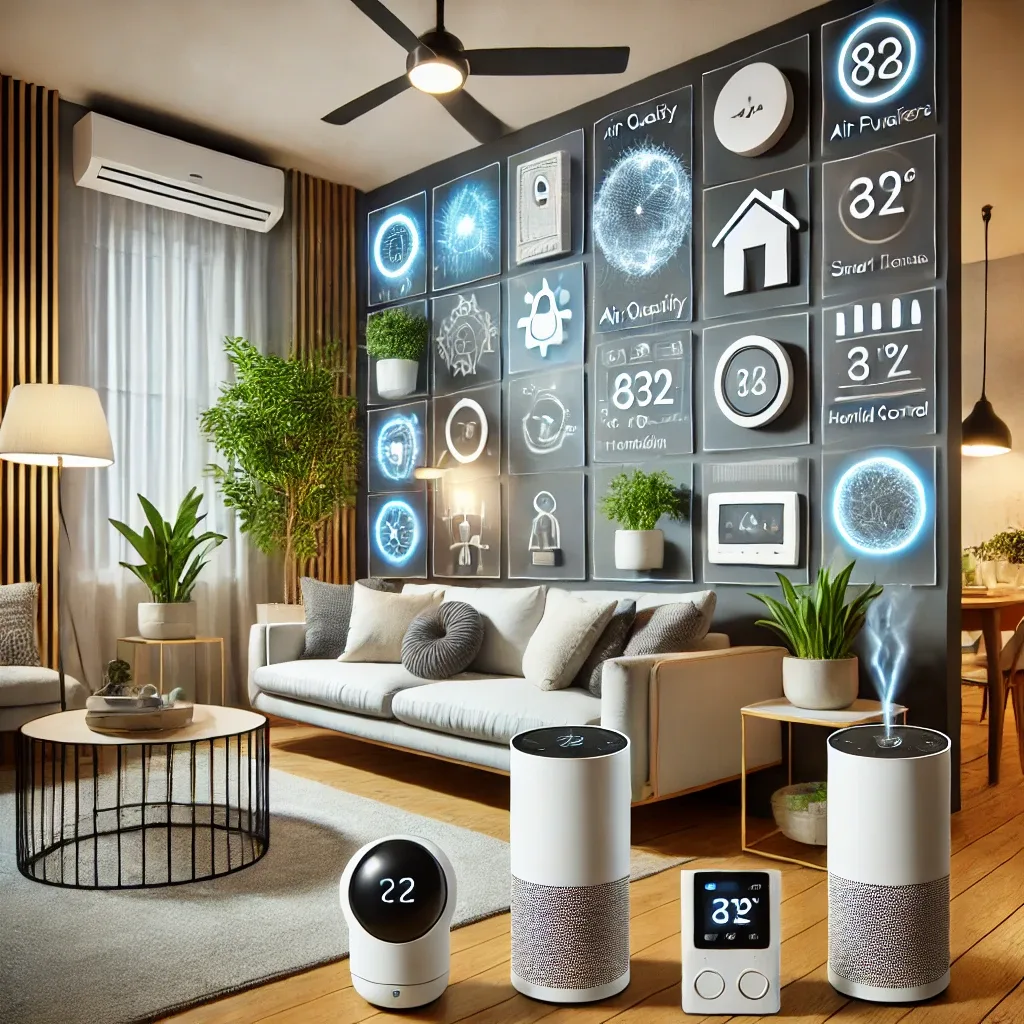
From Reactive to Proactive: The Smart Air Management Difference
Traditional air management is reactive: open the purifier when you feel the air is bad, open a window when you feel stuffy. The problem is that by the time you 'feel' it, your body has already absorbed pollutants.
Smart Home Technology makes air management proactive: sensors measure PM2.5 every minute, and when values begin rising — even before reaching dangerous levels — the system automatically begins correcting before you notice anything.
Technology 1 — Air Quality Sensors
Sensors are the foundation of everything. A complete setup measures 5 parameters:
PM2.5/PM10: Laser particle counters measure fine particulates. Quality sensors use 650nm laser wavelength with precise photodetectors. Recommended: Aqara TVOC or Sensirion SEN55 (PM1.0 to PM10).
VOC/Formaldehyde: Metal oxide semiconductor (MOS) sensors detect organic compounds. Recommended: Aqara TVOC for total TVOC measurement; Airthings Wave Plus for TVOC + Radon.
CO2/O2: NDIR (Non-Dispersive Infrared) sensors for CO2 are significantly more accurate than MOS sensors. Recommended: Sensirion SCD40 precision CO2 sensor at approximately 600-800 THB per module.
Temperature and Humidity: Used with RH thresholds for ventilation fan automation.
Technology 2 — Smart Air Purifiers with Auto-Speed Adjustment
Dyson Pure Cool Link TP07 (22,000-28,000 THB): HEPA H13 + Carbon filter, built-in PM2.5/VOC/NO2 measurement, supports Apple HomeKit, Google Home, and Dyson integration in Home Assistant with auto-speed adjustment from sensor data.
Xiaomi Mi Air Purifier 4 Pro (8,000-12,000 THB): HEPA H13 + Carbon, built-in laser PM2.5 sensor, Wi-Fi with Mi Home integration in Home Assistant, Auto mode responding well to sensor data.
Philips Series 3000i AC3033 (9,000-14,000 THB): HEPA + NanoProtect Carbon, VitalSight real-time display, supports Alexa and Google Assistant.
Technology 3 — Smart Ventilation Systems
Intelligent ventilation systems that monitor O2/CO2 and automatically open/close vents:
Zigbee Smart Switch + ERV Controller: Controls Fresh Air Systems through Home Assistant automations that step up or down speed based on sensor values — suitable for ERV units with remote control protocols.
Smart Exhaust Fan with Humidity Sensor: Devices like Panasonic FV-15VQ6 or Broan smartSTEP auto-adjust speed by humidity to prevent mold, connectable to Home Assistant via Zigbee relay.
Technology 4 — Smart Thermostats for Humidity Control
Nest Learning Thermostat (9,000-13,000 THB): Learns occupancy patterns within 1 week and auto-adjusts schedules. Supports Nest integration in Home Assistant and controls humidity through connected humidifiers/dehumidifiers.
Ecobee SmartThermostat Premium (8,000-12,000 THB): Built-in humidity sensor, separate room SmartSensors, Matter Protocol support. Works with Apple HomeKit, Google Home, Amazon Alexa, and Home Assistant simultaneously.
IoT Platform Integration
Google Home / Amazon Alexa: Connect Smart Purifiers, Smart Thermostats, and Smart Ventilation with voice control. Create Routines like 'Good Morning' to activate purifier and Fresh Air System simultaneously.
Apple HomeKit: Privacy-first automation processing in Home Hub (HomePod/Apple TV) without sending sensor data to external cloud — recommended for privacy-conscious users.
Home Assistant: Most powerful platform, supporting every sensor brand. Build complex automations, LINE notifications, and custom dashboards via Lovelace UI.
Airthings Dashboard: For users wanting easy-to-use cloud-based air quality monitoring, especially for homes with Radon risk.