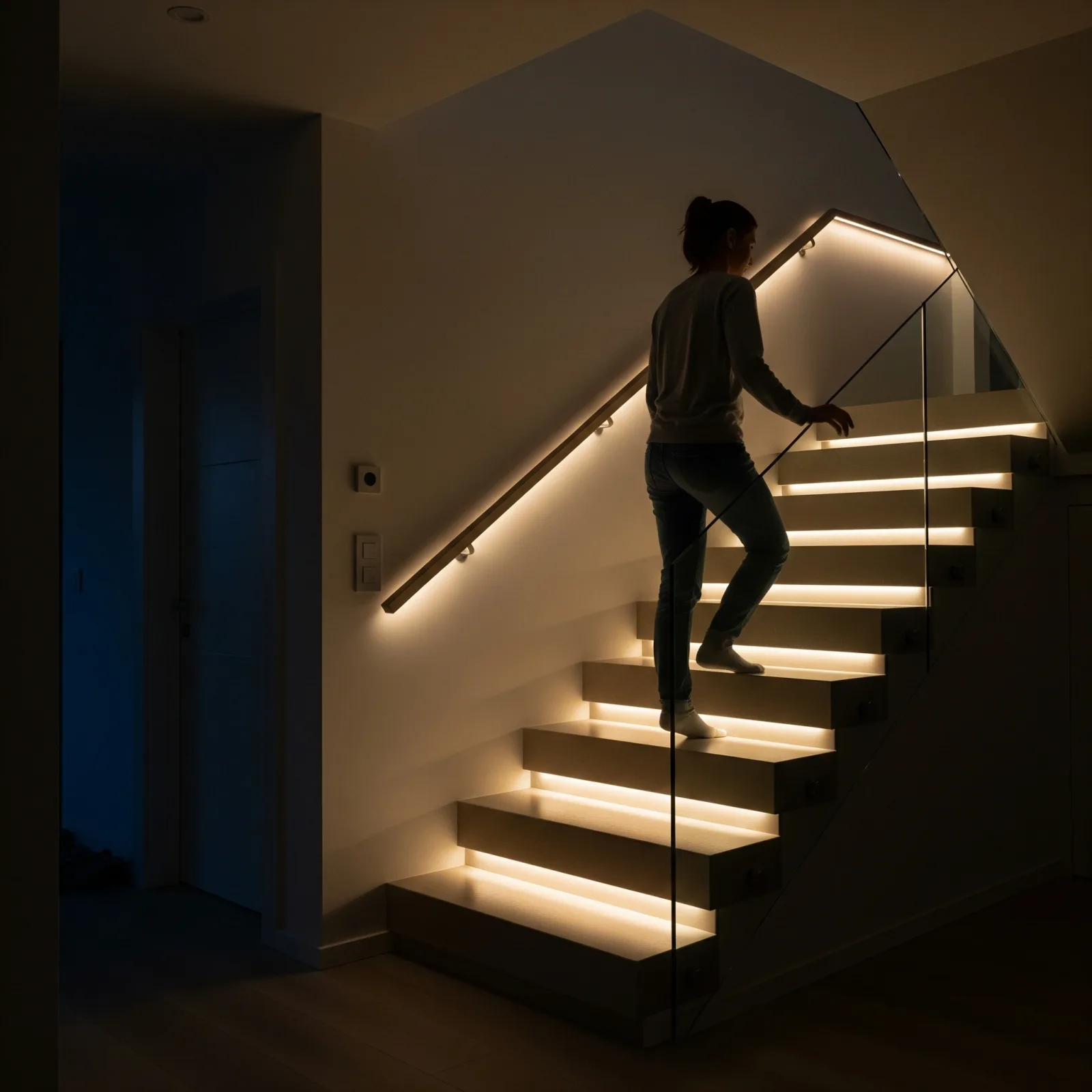
Automatic Home Guide Lights: Small Lights That Can Prevent Big Accidents
Getting up in the middle of the night to walk to the bathroom in complete darkness is a risk most people overlook. For elderly residents with balance challenges or young children wandering at night, tripping over unseen obstacles or missing a step on the stairs can cause serious injuries. Automatic guide lights are a simple, affordable, and highly effective solution to this preventable hazard.
High-Risk Areas in the Home That Need Guide Lighting
The most common nighttime accident zones in residential homes include the hallway between bedroom and bathroom — the most frequently used path at night — stairs where missing a step in darkness is a leading cause of serious falls, the floor around the bed when rising in the middle of the night, entryways used after dark, and kitchens visited for late-night needs.
Motion Sensor + LED Strip: The Safety Partnership
The core of an automatic guide light system is a Motion Sensor (PIR or mmWave) that detects movement and instantly activates an LED strip. LED strips offer multiple advantages: slim and flexible enough to install anywhere, soft light that guides without blinding in darkness, far more energy-efficient than conventional bulbs, and automatic shutoff when movement ceases — no need to walk back and turn them off.
Recommended Installation Positions
HappySmart recommends positions that deliver maximum safety benefit: under the bed frame, providing light the moment feet touch the floor when rising; along every stair tread, preventing missed steps in the dark; under corridor cabinets, casting a low-level path toward the bathroom; at bathroom doorways, triggering automatically when the door opens at night; and along room perimeters for ambient safety lighting in living areas and children's rooms.
Control and Configuration via Home Assistant
Guide lights connected to Home Assistant offer precise customization: schedule activation only between 9 PM and 6 AM to conserve daytime energy; adjust LED brightness to a level that guides without disturbing sleep; set a post-movement delay of 1–5 minutes before lights extinguish; and configure each sensor zone independently so lights activate only in the relevant area at the right time.
HappySmart: Complete Guide Light Installation Service
HappySmart provides end-to-end design and installation of automatic LED guide light systems — site survey, optimal placement selection, high-quality Motion Sensor and LED strip installation, Home Assistant integration with custom automation, and reliable after-sales service to ensure your home stays safely lit, night after night.