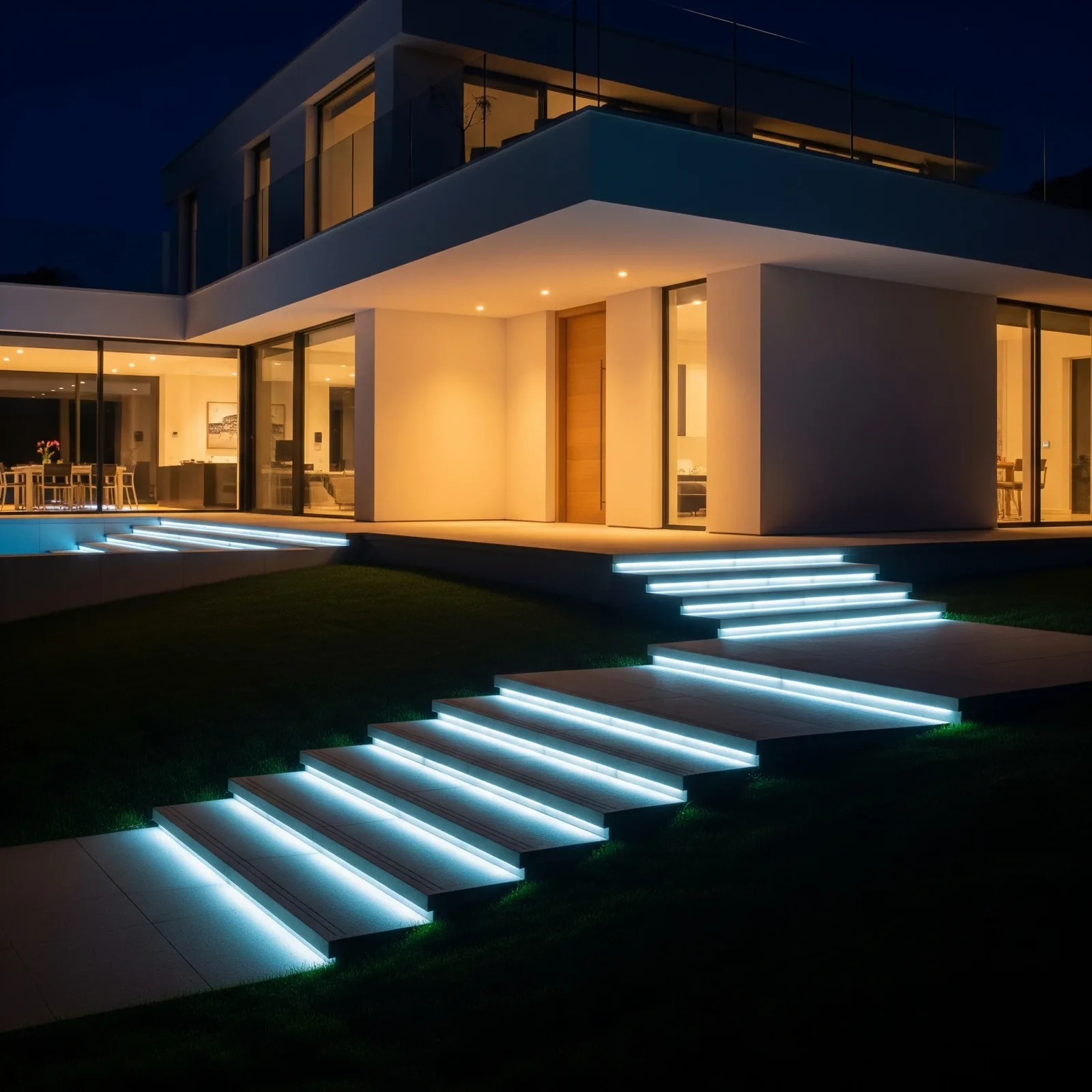
Modern Smart Home with Nighttime Guide Lights: Safety That Thinks for You
Among the most valued features in modern smart homes is the automatic nighttime guide light system — illuminating risk-path zones inside the home without disturbing sleep. This is especially important for homes with elderly residents, who face significantly higher fall risks in the dark than any other demographic group.
Why Do Elderly Residents Especially Need Nighttime Guide Lights?
Elderly residents face multiple compounding risk factors: vision that diminishes in low light with age, reduced balance stability, slower physical response times when unexpected things happen, and frequent nighttime bathroom trips that represent the highest-risk moments. The critical difference between an ordinary home and a smart home is that the smart home provides exactly the right amount of light the instant movement is detected — without any need to find a switch in the dark.
Technology Used: PIR Sensor + Soft Light LED Strip
Nighttime guide systems for elderly safety combine two core technologies. PIR (Passive Infrared) Sensors detect body heat the moment a resident begins to move, working reliably even in complete darkness. Soft Light LED strips (2700–3000K warm white) provide gentle, non-glaring illumination that guides without blinding — bright enough to see the path clearly, dim enough not to jolt the resident awake.
Comparison: Ordinary Home vs. Smart Home for the Elderly
In an ordinary home, the light switch may be across the room, lights come on at full blinding brightness, and there is no detection or emergency alert if something goes wrong. In a smart home, PIR sensors activate guide lights the instant the elderly resident begins to rise from bed; LED Soft Light illuminates only the necessary path without disturbing others; and the system connects to emergency alerts if abnormal inactivity is detected after movement.
Configuration via Home Assistant on Raspberry Pi 5
Home Assistant on Raspberry Pi 5 enables precise guide light customization: time-scheduled operation from 9 PM to 6 AM; per-zone brightness adjustment for bedside, corridor, and stairs; 1–3 minute post-motion lighting duration; independent sensor zones for each area; and integration with the fall alert system so that guide lights and emergency alerts work together as one cohesive safety system.
HappySmart: Complete Nighttime Guide Light Installation for Elderly Safety
HappySmart designs and installs nighttime guide light systems tailored for elderly residents — risk-area survey, optimal PIR Sensor and LED strip selection, Home Assistant integration with custom settings, thorough training for both residents and family members, and reliable long-term after-sales service. Because the safety of the people you love should never wait for an accident to happen first.