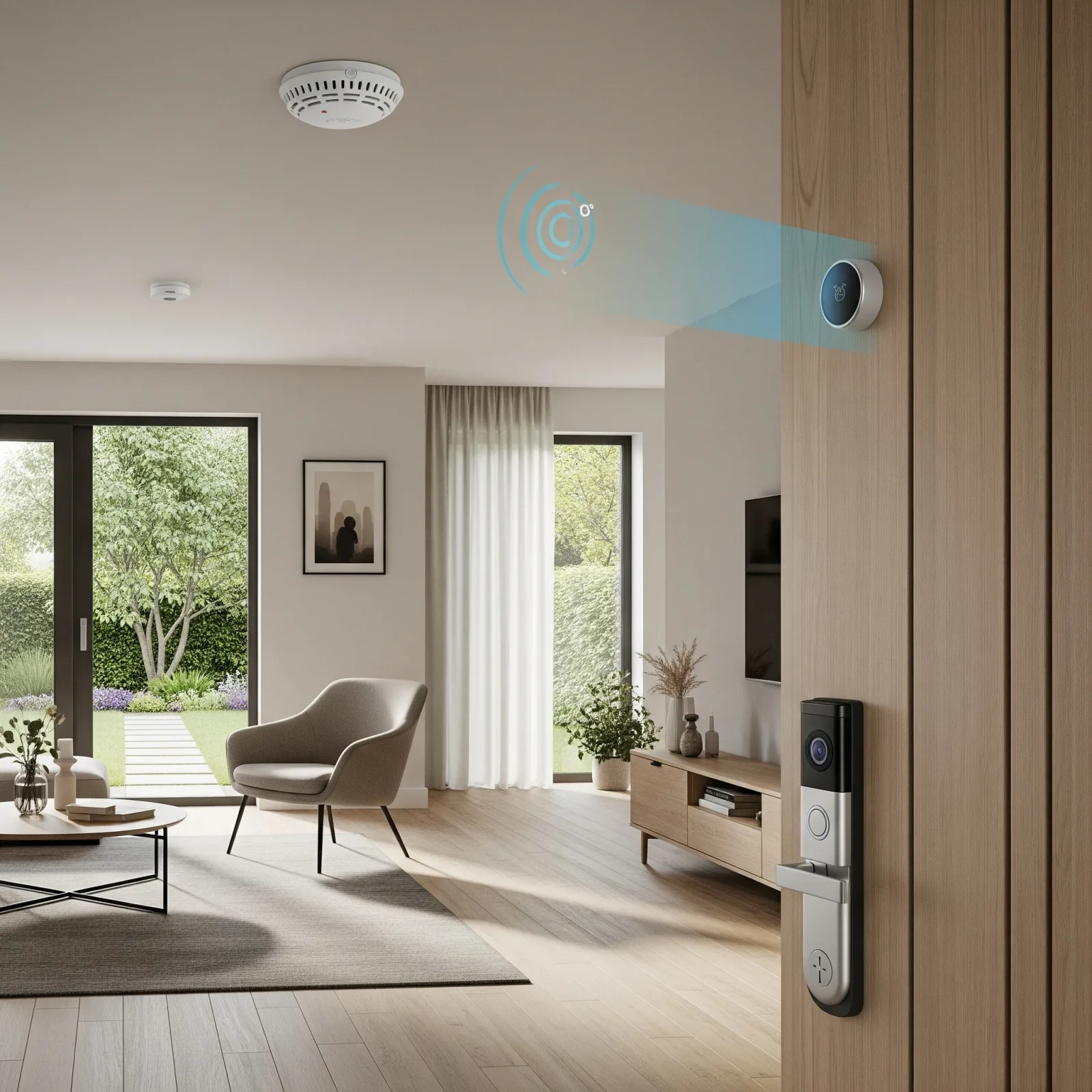
What Is Smart Home Safety?
Smart Home Safety is an interconnected ecosystem of devices and software — the Internet of Things (IoT) — designed to monitor, detect, and respond to critical events in homes with elderly residents. Unlike a basic CCTV system, Smart Home Safety doesn’t just record; it analyzes and responds automatically.
The 5 Core Components
1. Motion Sensors (PIR and mmWave)
- PIR Sensor: Budget-friendly (200–800 THB), detects physical movement (walking), but cannot detect someone lying still.
- mmWave Radar Sensor: High-precision (1,000–8,000 THB), detects breathing and heartbeat — knows someone is present even when motionless.
2. Smart Door Sensor and Smart Lock
- Smart Door Sensor: Detects open/close events, alerts when a senior leaves home outside expected hours (e.g., 2–5 AM).
- Smart Lock: Remote lock/unlock via smartphone, supports PIN, fingerprint, and keycard. Caregivers can issue temporary codes for healthcare workers.
3. mmWave + AI Camera for Fall Detection
Two levels of fall detection:
- Entry level: mmWave Radar detects “fall patterns” when an object remains low for an abnormally long time.
- Advanced: AI Camera (e.g., Kami Vision) uses Pose Estimation video analysis for higher accuracy, though with privacy tradeoffs.
4. Mobile Alert System
- LINE Notify / LINE Bot: Best fit for Thai context — families already have LINE, no new app needed.
- Home Assistant Companion App: Push notifications with photos, location, and event history.
- Smart Speaker: In-home voice alerts for seniors who don’t carry phones constantly.
5. Environmental Monitoring
- Temperature + Humidity: Bangkok’s March–May heat (>38°C) raises Heat Stroke risk significantly for seniors.
- PM2.5: Bangkok AQI frequently hits 100–150 during dry season — dangerous for elderly with lung or heart conditions.
- CO Gas Detector: Prevents gas leaks from kitchens or gas water heaters.
Why Seniors Living Alone Need This Most
With no one present to see an incident, the average time-to-assistance in a conventional home is 8–14 hours. Smart Home Safety can reduce that to 5–15 minutes.
WHO research shows that seniors who receive help within 1 hour of a fall have a 3× higher chance of full recovery versus those helped after 6 hours.
Investment and Value
| System Level | Key Devices | Investment | Response Time |
|---|---|---|---|
| Starter | PIR × 2 + Door Sensor + LINE | 3,000–5,000 THB | 5–15 min |
| Standard | mmWave × 2 + Smart Lock + Camera | 15,000–25,000 THB | 2–8 min |
| Advanced | Full Automation + AI Camera | 40,000–70,000 THB | 30–90 sec |
Compared to Bangkok nursing home fees of 25,000–60,000 THB/month, Smart Home Safety lets seniors live at home safely longer — with ROI that must include quality of life.
Conclusion
Smart Home Safety is not a luxury — it is safety infrastructure for the elderly in an era of smaller families and busier caregivers. Even a Starter Package delivers meaningful protection at an accessible price point.