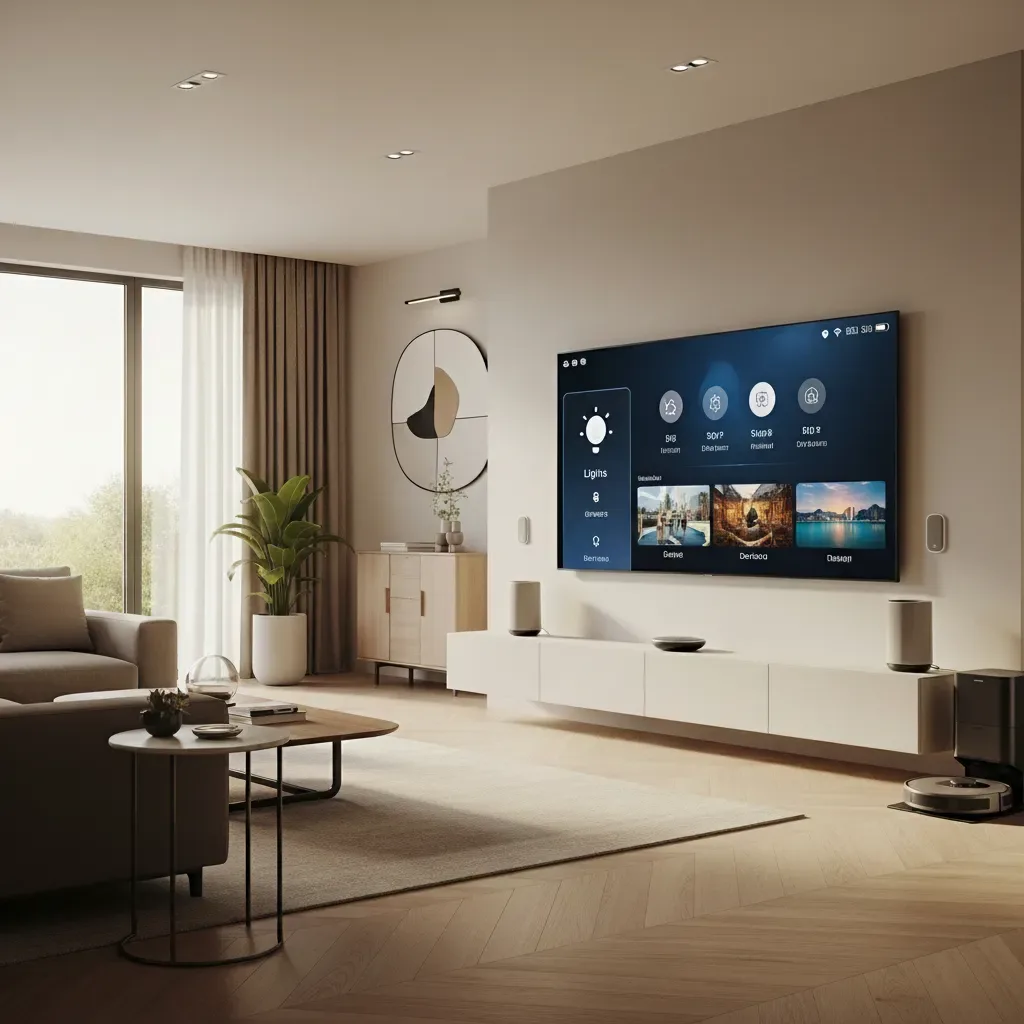
What IoT Is and How It Powers Smart Homes
Internet of Things (IoT) refers to physical objects — light bulbs, sensors, door locks, thermostats, cameras — connected to a network to send data and receive commands. In the context of a smart home, IoT is the infrastructure that allows every device in the house to communicate, coordinate, and respond to events or instructions automatically. The value is not in any individual device but in the system behaviour that emerges when they work together.
Global IoT device count exceeded 18 billion in 2026. A typical smart home in Thailand may operate between 20 and 100+ connected devices. The critical challenge is no longer sourcing devices — it is making cross-brand devices interoperate reliably.
Matter 1.4: The Standard That Solves Compatibility
Before Matter achieved widespread adoption, smart home users faced ecosystem lock-in: Apple devices worked only within HomeKit, Google devices within Google Home, and mixing brands required workarounds or redundant purchases. Matter resolves this as an application-layer protocol running on IP networking, enabling any Matter-certified device to discover and communicate with any other, regardless of manufacturer.
Matter 1.4, current as of 2026, expanded device class coverage significantly beyond the initial 1.0 release, now including: - Energy management devices with real-time power monitoring - EV charging stations - Water leak and freeze sensors - Robotic vacuum cleaners - Air quality monitors (PM2.5, CO2, VOC)
Thread: The Mesh Network That Makes Smart Homes Reliable
Thread is a mesh networking protocol engineered specifically for IoT. Unlike Wi-Fi, where every device connects directly to a central router, Thread enables each node to relay data for other nodes, creating a self-expanding, self-healing network with no single point of failure. In the Thai context, this matters both for reliability — homes in areas with marginal Wi-Fi coverage can still run stable automations — and for local control during ISP outages.
Thread's key characteristics: - Sub-50ms latency: Commands reach devices in under 50 milliseconds from the hub. - Self-healing routing: If any node fails, the mesh automatically finds an alternative path. - Battery efficiency: Sensor nodes running on AA cells operate for 2–4 years between replacements. - Local-first control: Core automations run on the local Thread network, bypassing cloud routing entirely.
IoT Device Categories for a Complete Thai Smart Home
A fully equipped Thai smart home in 2026 draws from several IoT device categories:
Lighting: Smart bulbs (Philips Hue, Xiaomi, Yeelight), in-wall smart switches (Aqara, Sonoff), and smart dimmers compatible with Thai wiring standards.
Security: IP cameras (EZVIZ, Dahua, TP-Link Tapo) with 4K and AI detection, smart locks (Yale, Xiaomi, Samsung SmartThings), and door/window sensors (Aqara, Eve).
Environmental: Temperature and humidity sensors, PM2.5 air quality monitors, gas and smoke detectors with Thai TIS (มอก.) certification.
Energy: Smart plugs with per-device power monitoring, IR blasters for legacy AC control, and solar inverter integration for homes with PV panels.
Building Your IoT Ecosystem Systematically
The most effective approach is to begin with a defined use case — security, energy savings, or convenience — and select a hub and ecosystem first before purchasing individual devices. Investing in a quality Thread border router (HomePod mini, Apple TV 4K, or Google Nest Hub Max) at the outset ensures that every subsequent device addition integrates cleanly.
HappySmart AI SmartHome designs IoT systems with both immediate needs and future scalability in mind, specifying hardware that maintains cross-platform compatibility as the ecosystem evolves.