Bangkok's PM2.5 Situation and the Need for Prevention
Bangkok experiences two clearly elevated PM2.5 seasons annually. The cool-dry season (November-February) sees high levels from traffic, still air, and pollution accumulation. The agricultural burning season (March-May) brings smoke from rice stubble and forest burning in Northern and Northeastern regions — with average daily PM2.5 in Bangkok often reaching 50-100 μg/m³, 3-6 times the WHO standard.
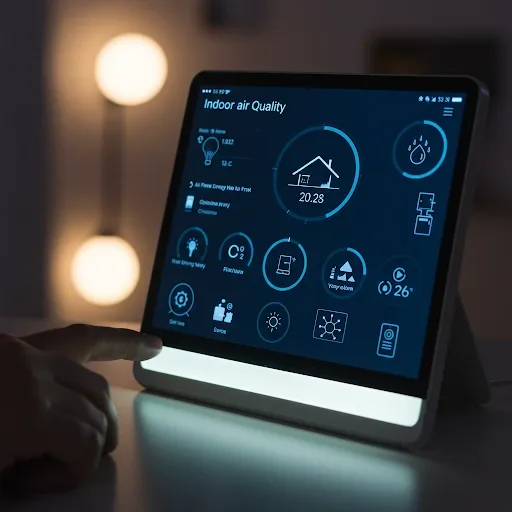
Proactive protection through Smart Home systems offers a critical advantage: the system responds before you're exposed to pollutants, rather than after PM2.5 has already entered your body. This prevention-first approach is fundamentally more effective than reactive responses.
Real-Time Detection and Alert Systems
Smart Home systems prevent PM2.5 exposure through continuous real-time detection. Indoor PM2.5 sensors transmit data every 1-5 minutes while outdoor sensors or Air4Thai API simultaneously monitor external levels — giving a complete indoor-outdoor picture.
Effective alert systems should operate at three tiers. Yellow level (PM2.5 25-35 μg/m³): LINE notification to stay aware and increase purifier speed. Orange level (PM2.5 35-75 μg/m³): maximum purifier speed, close all windows, repeat alert. Red level (PM2.5 above 75 μg/m³): full protection mode including PAP system activation if installed, and advisory to stay indoors.
Automatic Control and AI Learning
Modern Smart Home systems incorporate AI that learns occupant lifestyle patterns — wake times, commute schedules, work-from-home days — and adjusts proactively without manual commands.
Practical examples: the system learns residents wake at 06:30 daily and increases bedroom purifier to High speed from 06:00, ensuring clean air at wake time. Or it learns cooking typically happens 18:00-19:00 and pre-increases kitchen purifier speed 15 minutes early to prevent cooking smoke accumulation.
Home Assistant integration enables more sophisticated automation combining multiple sensor inputs with outdoor meteorological data to decide whether to open windows or activate a PAP system — decisions that would be impossible to make manually with this level of real-time accuracy.
Additional Smart Home Benefits for PM2.5 Prevention
Beyond direct health protection, Smart Home systems deliver additional value. Ninety-day air quality history helps understand patterns and plan ahead — including knowing which months require higher filter replacement budgets based on actual pollution data.
Real-time Indoor vs Outdoor comparison enables accurate ventilation decisions at any time of day. And filter life tracking based on actual device runtime ensures timely replacement without changing too early or running filters past their effective lifespan.
HappySmart: Complete Air Quality Solutions
HappySmart designs and installs comprehensive Smart Home systems for air quality management — from selecting appropriate sensors through Home Assistant integration to configuring automations specifically calibrated for Bangkok's air quality patterns. Expert consultants are available to find solutions suited to each home's layout and budget.