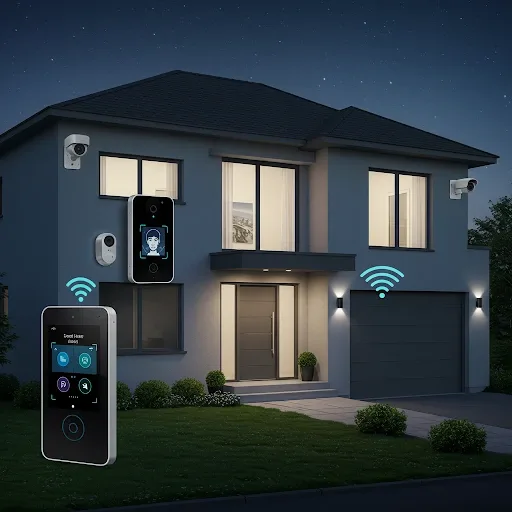
Why Smart Home Security Matters More Than Ever in 2025
Home security in the digital era has evolved far beyond traditional CCTV cameras and mechanical locks. Smart home security in 2025 integrates AI throughout every security component, enabling your home to respond to threats automatically even when you are on the other side of the world.
Research consistently shows that homes with visible smart security systems experience significantly fewer break-in attempts, as opportunistic criminals tend to select easier targets.
AI Security Cameras: Intelligent Eyes for Your Home
AI cameras in 2025 go well beyond simple video recording. Real-time alerts deliver notifications with video clips to your smartphone the moment abnormal movement is detected. Face recognition identifies household members and flags unfamiliar faces immediately. Sound and activity detection can distinguish between breaking glass, an explosion, or a distress call — triggering appropriate automatic responses.
Storage options support both cloud storage and local storage on NAS devices or SD cards, giving you flexibility and ensuring footage remains accessible even if your internet connection goes down.
Smart Lock: Locking Technology That Actually Thinks
Smart locks in 2025 outperform traditional key locks on every dimension. Proximity-based auto-lock and unlock detects your smartphone and operates the lock without any manual action. Temporary digital PINs can be issued for service workers, housekeepers, or guests with a preset expiry time. Tamper alerts send instant notifications with photos if someone attempts to force the lock. A complete entry log records every entry event including the time and unlock method used.
Security Sensors: The Invisible Protection Network
Vibration sensors mounted on windows and doors trigger alerts when someone attempts to break or force them open. PIR motion sensors use infrared technology to detect movement within defined zones, linking to smart lights and alarm triggers automatically. Air quality and environmental sensors detect smoke, CO2 levels, and gas leaks, alerting residents before dangerous concentrations develop.
Smart Security Installation Strategy
Begin with a needs assessment based on your residence type — condo, standalone house, or townhome — along with the number of family members and your budget. Choose a platform based on your needs: Google Home or Alexa for voice-integrated setups; Home Assistant or HomeKit for advanced customization.
Position cameras at critical points: front door, back door, and parking area. Use strong passwords and enable two-factor authentication on all accounts. Add a UPS battery backup to ensure core security devices remain operational during power outages.
Future AI Security Trends to Watch
Behavior learning systems are advancing rapidly, learning normal household activity patterns and flagging anomalies automatically without manual rule-setting. Deep learning cameras are dramatically reducing false alerts caused by wind-blown foliage or pets moving through frame. Next-generation smart locks are incorporating multi-factor biometric authentication combining facial recognition and voice identification for a new tier of access security.