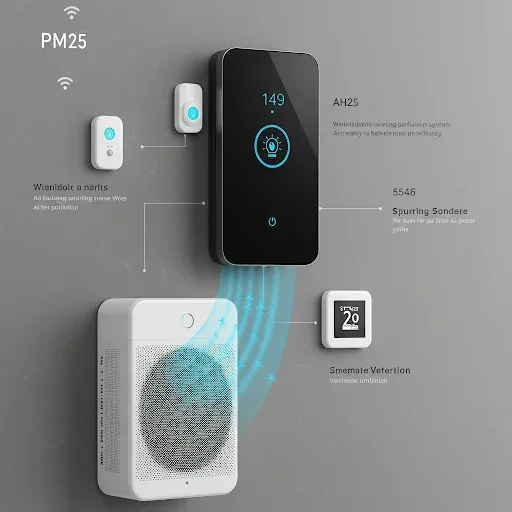
Why IoT Changes the Air Filtration Game
Before IoT, air purifiers ran at fixed speeds with no awareness of actual air quality — users guessed and manually adjusted constantly. IoT changed this with real-time sensors, behavioral AI, and connectivity that makes every home device work intelligently together. The result is cleaner air using less energy.
Multi-Dimensional Sensors
Modern IoT air filtration systems cover 6 parameters: PM2.5 and PM10 for fine dust; VOC for organic compounds from fresh paint, new furniture, and cleaning products; CO2 from room occupants' breathing; CO from gas leaks or stoves; and temperature plus humidity affecting comfort and mold growth. Sensor data feeds AI every minute to decide whether to increase or reduce filtration intensity.
Multi-Layer Filters for Multi-Type Threats
IoT systems excel not just at connectivity but at combining high-performance filter layers: HEPA H13 removes 99.97% of particles ≥0.3 microns; activated carbon absorbs VOCs, formaldehyde, and odors; nano-fiber enhances capture of ultra-fine particles; and negative ions cause dust particles to clump and fall from the air. Verify that ionizer models are certified low-ozone — high ozone levels harm lung tissue.
AI and Smart Home Integration
AI in modern IoT purifiers learns when you wake up, arrive home, or cook, and adjusts operation proactively. Control via mobile app, voice commands through Alexa, Google Assistant, or Siri, and connect to HomeKit, Mi Home, or Home Assistant for advanced automations — such as activating the kitchen purifier when the gas stove turns on, or increasing air circulation when the AC switches off.
Measurable Benefits
IoT air purifier users report indoor PM2.5 dropping from 80-100 μg/m³ on heavy dust days to below 15 μg/m³ within 30 minutes, reduced respiratory disease risk, 50% less dust on furniture, 20-35% energy savings compared to running at constant full speed, and real-time alerts eliminating the need to guess air quality.
Buying Guide
Choose models with HEPA H13 and activated carbon, CADR ≥2.5x room floor area, and compatibility with your existing smart home platform. Verify filter replacement cost and availability. Popular brands in Thailand include Dyson Purifier Hot+Cool, Philips AeraSense Series 3000, Xiaomi Mi Air Purifier 4 Pro, Blueair HEPASilent, and LG PuriCare 360 — all offering smart home connectivity at varying levels.